
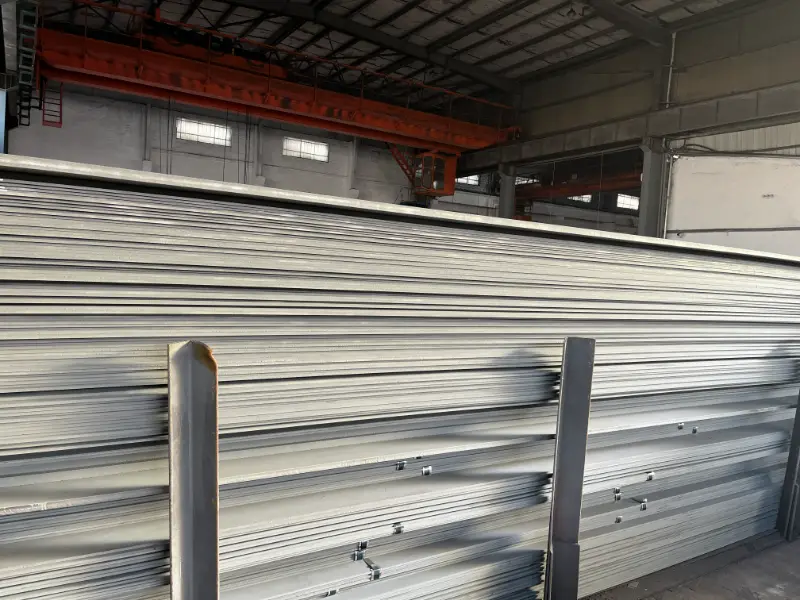
S355JR+410 Clad Steel Plate
S355JR+410 Clad Steel Plate: Composition, Properties and Equivalents
Explore chemical composition, mechanical and physical properties of S355JR carbon steel bonded with 410 martensitic stainless steel cladding, including equivalents and application guidance.
Welding, hot forming, cold forming, machining, plasma/laser cutting
- Phone : +8618037372205
- Email : [email protected]
- WhatsApp: Contact via Whtsapp
- WeChat: +8618037372205
S355JR+410 Clad Steel Plate Introduction
S355JR+410 clad steel plate is a bimetallic composite material manufactured by explosion bonding or hot-roll bonding a corrosion-resistant 410 martensitic stainless steel (UNS S41000, 1.4006) cladding layer onto a load-bearing S355JR structural steel substrate conforming to EN 10025-2. S355JR provides excellent weldability and mechanical strength, while the 410 cladding (typically 1.5–5 mm thick) imparts resistance to atmospheric corrosion, mild acids, and wear in moderately aggressive environments. This combination is widely used in pressure vessels, heat exchangers, flue-gas desulfurization systems, and industrial storage tanks where both structural integrity and surface protection are required. The metallurgical bond ensures high interface shear strength, allowing the clad plate to be fabricated using standard welding and forming procedures. Typical delivery conditions include as-rolled, normalized, or stress-relieved, and the plate can be supplied with a mill test certificate acc. EN 10204 3.1.
S355JR+410 Clad Steel Plate Chemical Composition
The chemical composition is given separately for the S355JR substrate and the 410 stainless steel cladding. Substrate limits comply with EN 10025-2, and cladding limits comply with ASTM A240 for UNS S41000 (with minor adjustments per EN 10088-2 grade 1.4006). Note: Actual melt analysis may show tighter ranges, and the clad interface zone may contain trace interdiffusion of elements.
| Element | Nominal Value (S355JR Base) | Nominal Value (410 Cladding) | Remarks |
|---|---|---|---|
| Carbon (C) | ≤0.24 | ≤0.15 | Base: max 0.24%; Clad: 410 stainless steel, max 0.15% per ASTM A240 |
| Silicon (Si) | ≤0.55 | ≤1.00 | Base: typical 0.15–0.35%; Clad: Si ≤1.00% for 410 |
| Manganese (Mn) | ≤1.60 | ≤1.00 | Base: max 1.60%; Clad: max 1.00% |
| Phosphorus (P) | ≤0.035 | ≤0.040 | Both limits per respective standards |
| Sulfur (S) | ≤0.035 | ≤0.030 | Lower S in cladding for better corrosion resistance |
| Chromium (Cr) | – | 11.50–13.50 | Cladding typical 12.5% Cr |
| Nickel (Ni) | – | ≤0.75 | Residual element; 410 is a straight chromium grade |
| Iron (Fe) | Balance | Balance | Major element for both layers |
| Nitrogen (N) | ≤0.012 | – | Base steel limit to avoid strain aging |
| Copper (Cu) | ≤0.55 (if specified) | – | For S355JR, Cu may be present for atmospheric corrosion resistance |
S355JR+410 Clad Steel Plate Thermal and Electrical Physical Properties
Physical properties are dominated by the S355JR base metal because the cladding is relatively thin. The following values represent the composite plate at room temperature unless otherwise noted. Variations: The 410 cladding has slightly different thermal expansion and thermal conductivity, which can influence performance at elevated temperatures.
| Property | Typical Value | Unit | Test Condition / Remarks |
|---|---|---|---|
| Density (ρ) | 7.85 | g/cm³ | Approx. weighted average (base 7.85, clad 7.70) |
| Elastic Modulus (E) | 210 | GPa | Longitudinal; room temperature |
| Shear Modulus (G) | 81 | GPa | Calculated from E and ν |
| Poisson's Ratio (ν) | 0.30 | – | For structural steel at room temperature |
| Thermal Expansion (α) | 12.0 (base) / 10.5 (clad) | 10⁻⁶/K | 20–300°C; base and clad listed separately |
| Thermal Conductivity (λ) | 42–52 (base) | W/(m·K) | At 20–300°C; cladding ~25 W/(m·K) at 100°C |
| Specific Heat Capacity | 0.46–0.50 | J/(g·K) | At 20°C; average for composite |
| Electrical Resistivity (ρ_e) | 0.21 (base) / 0.57 (clad) | µΩ·m | At 20°C; base steel vs. 410 stainless |
S355JR+410 Clad Steel Plate Mechanical Properties
Mechanical properties are primarily determined by the S355JR substrate. Values below are typical for plates with thickness ≤ 100 mm in normalized or as-rolled condition. Bond integrity between cladding and base is verified by shear strength and bending tests per ASTM A264 or EN 13479. Test conditions: transverse specimens at room temperature, unless noted.
| Property | Specification Requirement | Unit | Test Condition / Remarks |
|---|---|---|---|
| Yield Strength (ReH) | ≥355 | MPa | Thickness ≤ 16 mm; for 16–40 mm: ≥345 MPa; >40 mm: ≥335 MPa |
| Tensile Strength (Rm) | 470–630 | MPa | Thickness ≤ 100 mm |
| Elongation (A) | ≥22 | % | Gauge length 5.65√So (transverse); for thickness ≤ 16 mm |
| Bend Test (Clad interface) | No cracking/open disbonding at 180° | – | Mandrel diameter = 2× sample thickness (t) per ASTM A264 |
| Shear Strength (τ, cladding) | ≥140 | MPa | Shear test on clad interface as specified by EN 13479 |
| Impact Energy (KV) at –20°C | ≥27 | J | Charpy-V notch, longitudinal, for S355JR base |
| Hardness | ≤ 250 HV10 | – | Base metal zone; cladding usually 150–220 HB |
S355JR+410 Clad Steel Plate Directly Equivalent Material Standards and Replaceable Grades
| Country/Region | Standard | Grade | Remarks |
|---|---|---|---|
| Europe | EN 13479 / EN 10025-2 + EN 10088-2 | S355JR + 1.4006 (410) | Base standard combination |
| USA | ASTM A264 | Type 405 Clad (base A516 Gr 70 + clad 410S) | 410S has lower C; similar corrosion resistance |
| Japan | JIS G3601 | SUS410-clad mild steel (SM400B base) | SM400B base comparable to S355JR |
| International | ISO 13847 | SSC 410/355 | ISO clad plate standard with 355 MPa yield class substrate |
S355JR+410 Clad Steel Plate Application Introduction
S355JR+410 clad steel combines the high-strength, weldable structural base with a wear- and corrosion-resistant surface layer. It is cost-effective compared to solid stainless steel and allows large-dimension fabrications. Typical application criteria: operating temperatures up to ~450°C (cladding side), pH limited mainly to mildly acidic environments; abrasive media benefit from higher hardness of 410. The material can be hot formed at temperatures over 950°C followed by appropriate cooling. Welding requires a buttering layer with ER309 or similar when joining clad sides.
Product Applications: Pressure vessels (ASME VIII Div.1 or EN 13445), Heat exchangers (tube sheets, shell plates), Storage tanks for aggressive media, Flue-gas ductwork and stack liners, Relining plates for existing steel structures, Silos and bins for abrasive materials
Processed into products: Tube sheets in shell-and-tube heat exchangers, Clad stiffeners and support rings, Manway covers and nozzles with cladding, Corrosion-resistant weld overlays replaced by integral cladding, Flue-gas chimney expansion joints, Panels for electrolytic cells in hydrometallurgy
Application industries: Oil & Gas (offshore platforms, storage tanks), Chemical & Petrochemical (reactors, columns, piping), Power Generation (flue-gas desulfurization, chimney liners), Mining & Mineral Processing (chutes, hoppers, wear liners), Water Treatment (clarifiers, sludge tanks), Construction (architectural panels, bridge components)
S355JR+410 Clad Steel Plate Similar / Alternative Clad Combinations
| Country/Region | Standard | Grade | Remarks |
|---|---|---|---|
| Europe | EN 13479 | S355JR + 1.4301 (304) | Austenitic cladding for superior corrosion resistance; higher cost |
| USA | ASTM A264 | SA516 Gr 70 + 316L | Widely used for pressure vessels with enhanced corrosion resistance |
| Europe | EN 13479 | P355GH + 410 | For elevated temperature service (P355GH base) |
| Europe | EN 13479 | S355J2 + 1.4404 (316L) | Toughness guaranteed down to –20°C with molybdenum-bearing cladding |
| Japan | JIS G3601 | SM490B + SUS316L | Higher strength base with molybdenum stainless cladding |
| China | GB/T 8165 | Q355B + 06Cr13 (410) | Chinese standard clad plate with similar 355 MPa base |
Notes:
Clad plate ordering: Specify total thickness, clad thickness, base material (EN 10025 S355JR), cladding material (EN 10088 1.4006 or ASTM A240 410), and acceptance standard (e.g., ASTM A264 or EN 13479). Bond integrity test: Ultrasonic inspection per ASTM A578 Level I is standard. Post-weld heat treatment: may be required for base metal thicknesses >30 mm; the 410 cladding may be tempered to restore the HAZ properties. Surface finish: Cladding side can be supplied pickled, passivated, or blast-cleaned.
- Share



