
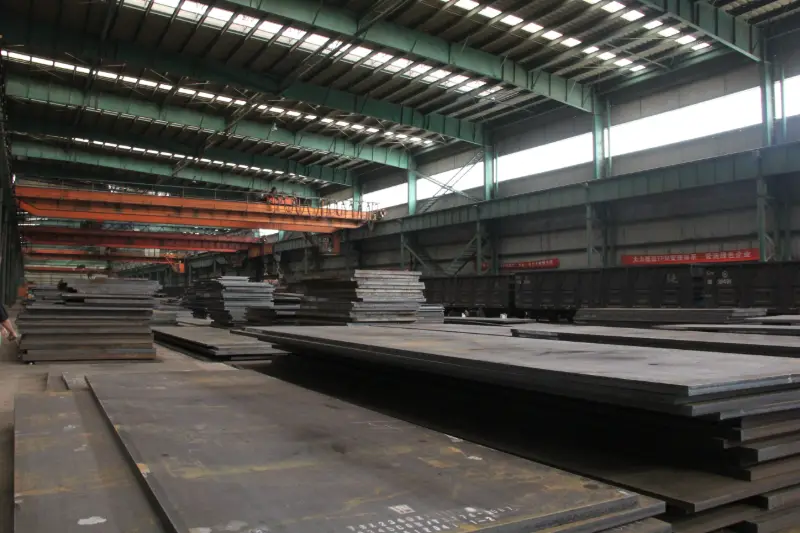
A537 CL1 + 410 Clad Steel Plate
A537 CL1 + 410 Clad Steel Plate: High-Strength Base with Corrosion-Resistant Cladding
Detailed material data for A537 CL1 + 410 clad steel plate, combining ASTM A537 Class 1 carbon-manganese-silicon steel plate as backing and 410 martensitic stainless steel as cladding, providing strength and corrosion resistance for pressure vessels and process equipment.
Hot bonding (roll-bonded, explosion-bonded), welding, forming, machining
- Phone : +8618037372205
- Email : [email protected]
- WhatsApp: Contact via Whtsapp
- WeChat: +8618037372205
A537 CL1 + 410 Clad Steel Plate Introduction
A537 CL1 + 410 Clad Steel Plate is a metallurgically bonded composite plate consisting of a backing (base) material conforming to ASTM A537/A537M Class 1 (normalized heat-treated carbon-manganese-silicon steel for pressure vessels) and a cladding layer of 410 martensitic stainless steel (typically as per ASTM A240). The base provides high strength and toughness at moderate temperatures, while the 410 cladding offers good corrosion resistance, oxidation resistance up to 650°C, and wear resistance. This combination is widely used in the fabrication of pressure vessels, heat exchangers, and storage tanks where the internal environment requires resistance to mild corrosive media and the mechanical integrity of carbon steel is economically advantageous. The bond is typically achieved by hot rolling, explosion cladding, or weld overlay. The final properties combine the strength of the base with the corrosion performance of the clad layer.
A537 CL1 + 410 Clad Steel Plate Chemical Composition
The elemental composition is provided separately for the ASTM A537 Class 1 base steel (heat analysis as per ASTM A537/A537M) and the 410 stainless steel cladding (typical as per ASTM A240). The base is a carbon-manganese-silicon steel with controlled microalloying for toughness. The 410 cladding is a martensitic stainless steel with 11.5–13.5% Cr for corrosion resistance. Values are maximum unless a range is given. Copper, nickel, chromium, and molybdenum in the base are residual element limits.
| Element | Value (wt%) | Remark |
|---|---|---|
| Carbon (C) | ≤0.24 | Base A537 CL1 |
| Manganese (Mn) | 0.70–1.35 (thickness ≤40 mm) / 1.00–1.60 (thickness >40 mm) | Base A537 CL1 |
| Silicon (Si) | 0.15–0.50 | Base A537 CL1 |
| Phosphorus (P) | ≤0.035 | Base A537 CL1 |
| Sulfur (S) | ≤0.035 | Base A537 CL1 |
| Copper (Cu) | ≤0.35 | Base A537 CL1 |
| Nickel (Ni) | ≤0.25 | Base A537 CL1 |
| Chromium (Cr) | ≤0.25 | Base A537 CL1 |
| Molybdenum (Mo) | ≤0.08 | Base A537 CL1 |
| Carbon (C) | ≤0.15 | Cladding 410 |
| Manganese (Mn) | ≤1.00 | Cladding 410 |
| Silicon (Si) | ≤1.00 | Cladding 410 |
| Phosphorus (P) | ≤0.040 | Cladding 410 |
| Sulfur (S) | ≤0.030 | Cladding 410 |
| Chromium (Cr) | 11.5–13.5 | Cladding 410 |
| Nickel (Ni) | ≤0.75 | Cladding 410 |
A537 CL1 + 410 Clad Steel Plate Thermal and Electrical Physical Properties
Physical property data are typical at room temperature and are provided separately for the carbon steel base (A537 CL1) and the 410 stainless steel cladding. These values are not specified in ASTM A537/A537M but are derived from standard references for similar steel grades. Actual properties may vary slightly depending on heat treatment and bonding process.
| Property | Typical Value | Unit | Condition / Remark |
|---|---|---|---|
| Density (ρ) | 7.85 / 7.75 | g/cm³ | Base (A537) / Cladding (410) |
| Elastic Modulus (E) | 205 / 200 | GPa | Base / Cladding at 20°C |
| Shear Modulus (G) | 80 / 78 | GPa | Base / Cladding estimated |
| Poisson's Ratio (ν) | 0.29 / 0.27–0.30 | — | Base / Cladding |
| Thermal Expansion (α) | 12.0 / 9.9 | 10⁻⁶/K | 20–100°C, Base / Cladding |
| Thermal Conductivity (λ) | 51.9 / 24.9 | W/(m·K) | At 100°C, Base / Cladding |
| Specific Heat Capacity | 486 / 460 | J/(kg·K) | Base / Cladding at 20–100°C |
| Electrical Resistivity (ρe) | 0.14 / 0.60 | μΩ·m | Base / Cladding at 20°C |
A537 CL1 + 410 Clad Steel Plate Mechanical Properties
The mechanical strength of the clad plate is derived from the ASTM A537 Class 1 base steel. The 410 cladding does not carry structural loads. Values listed are minimum requirements per ASTM A537/A537M for thickness ≤100 mm. Testing is performed at room temperature on specimens without cladding. Elongation is measured over a 200 mm (8 in.) gauge length. Impact properties (Charpy V-notch) are subject to supplementary requirements if specified.
| Property | Required Value | Unit | Test Condition |
|---|---|---|---|
| Yield Strength (ReH) | ≥345 | MPa | All thicknesses, transverse or longitudinal |
| Tensile Strength (Rm) | 485–620 | MPa | All thicknesses, transverse or longitudinal |
| Elongation (A) | ≥22 | % | Gauge length 200 mm (8 in.), all thicknesses (≤100 mm) |
A537 CL1 + 410 Clad Steel Plate Fully Equivalent Material Standards and Substitutable Grades
| Country/Region | Standard | Grade | Remarks |
|---|---|---|---|
| USA / International | ASME SA-264 | SA-537 Class 1 + Type 410 | Identical composite plate specification for pressure vessels |
| USA | ASTM A264 | A537 CL1 + 410 | Standard specification for stainless chromium-nickel steel clad plate |
A537 CL1 + 410 Clad Steel Plate Application Introduction
A537 CL1 + 410 clad plate is especially suited for service conditions requiring moderate corrosion resistance combined with high structural integrity at temperatures typically between -45°C and 400°C. The 410 cladding withstands atmospheric corrosion, fresh water, mild acids, and some organic media. It is often selected where the cost of solid stainless steel is prohibitive but a corrosion barrier is necessary. Fabrication follows standard pressure vessel practices, with special attention to welding procedures that often require a 309L or similar transition layer.
Product Applications: Pressure vessels and autoclaves, Shell-and-tube heat exchangers, Cladded pipe and fittings, Storage tanks and process columns, Transition joints and flanges, Reactor internals and baffles
Processed into products: Shell plates (rolled and welded cylinders), Heads (dished, elliptical, flat flanges), Nozzle reinforcements and manway covers, Internal support rings and weirs, Flame-cut and machined tank floors, Baffle plates and partition walls
Application industries: Oil & Gas (separators, knock-out drums, crude oil tanks), Petrochemical (reactors, columns, heat exchangers), Chemical processing (storage tanks, mild acid service), Pulp & Paper (digesters, bleaching towers), Power generation (flue gas desulphurization equipment, condensate tanks), Water treatment (clad vessels for desalination)
A537 CL1 + 410 Clad Steel Plate Similar or Alternative Materials Recommendation
| Country/Region | Standard | Grade | Remarks |
|---|---|---|---|
| USA | ASTM A264 / ASME SA-264 | SA-516 Gr70 + 410 | Similar base tensile properties, good pressure vessel alternative |
| USA | ASTM A264 / ASME SA-264 | A537 CL1 + 304L | Corrosion resistance improvement for more aggressive media |
| Europe | EN 10028-6 / EN 10028-2 | P355GH + 1.4006 | Comparable normalized base with 12%Cr steel cladding |
Notes:
Welding considerations: The base A537 CL1 requires preheat and post-weld heat treatment (PWHT) depending on thickness and code requirements. For joining clad plates, a buttering layer with E309L or ER309L is commonly used before filling with matching base metal consumables. Bend test: Clad plates may be subjected to side bend or face bend tests per ASTM A264 to verify bond integrity. Heat treatment: The final normalizing of the base must be compatible with the cladding's intergranular corrosion resistance; 410 cladding may require tempering after normalizing to achieve desired hardness. Ultrasonic testing is typically performed per ASTM A578/A578M to verify bond quality and detect any unbonded areas. Pressure vessel design allowable stresses for the base are per ASME Section II Part D; the 410 cladding is not credited for structural thickness.
- Share



