
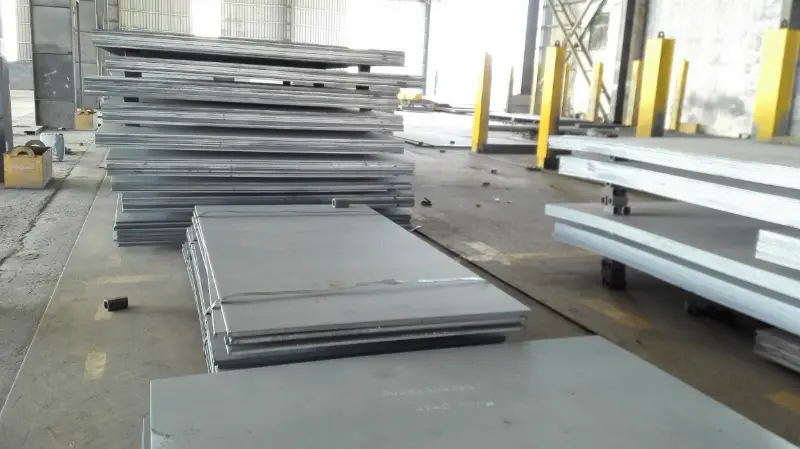
A537 CL1 + 904L Clad Steel Plate
A537 CL1 + 904L Clad Steel Plate - Pressure Vessel Composite with Superior Corrosion Resistance
Explore chemical composition, mechanical and physical properties, international equivalents, and application guidance for A537 CL1 + 904L clad steel plate, a high-strength carbon-manganese steel base clad with super austenitic stainless steel 904L, designed for aggressive chemical and offshore environments.
Hot rolling, explosion bonding, weld overlay, cutting, forming, welding (with appropriate filler metals), machining
- Phone : +8618037372205
- Email : [email protected]
- WhatsApp: Contact via Whtsapp
- WeChat: +8618037372205
A537 CL1 + 904L Clad Steel Plate Introduction
A537 CL1 + 904L clad steel plate is a metallurgically bonded composite material combining a high-strength pressure vessel steel base (ASTM A537 Class 1) with a corrosion-resistant 904L stainless steel cladding. The base provides excellent structural integrity and mechanical properties at moderate temperatures, while the 904L cladding (UNS N08904) offers exceptional resistance to pitting, crevice corrosion, and stress corrosion cracking in chloride-rich and acidic media. This cost-effective solution enables fabrication of heavy-walled pressure vessels, heat exchangers, and storage tanks that require both pressure-bearing capacity and long-term durability in aggressive chemical, pharmaceutical, and offshore applications. The clad plate is typically produced by hot rolling, explosion bonding, or weld overlay, ensuring a strong, continuous metallurgical bond that meets ASTM A264 or ASME SA-264 specifications.
A537 CL1 + 904L Clad Steel Plate Chemical Composition
The chemical composition is specified separately for the base metal A537 CL1 and the cladding layer 904L. The base metal is a carbon‑manganese‑silicon steel with controlled microalloying elements. The 904L cladding is a high‑alloy austenitic stainless steel with low carbon, high molybdenum, and copper additions to resist sulfuric, phosphoric, and chloride‑containing environments. Values are taken from ASTM A537/A537M and ASTM A240/A240M.
| Element | Base (A537 CL1) | Cladding (904L) | Remarks |
|---|---|---|---|
| Carbon (C) | ≤0.24 | ≤0.020 | Product analysis tolerance applies |
| Manganese (Mn) | 0.70–1.35 (≤1.35 for product analysis) | ≤2.00 | Or as agreed: 0.70–1.60 for base |
| Phosphorus (P) | ≤0.035 | ≤0.045 | Typical limitation for wrought products |
| Sulfur (S) | ≤0.035 | ≤0.030 | For enhanced corrosion resistance of cladding |
| Silicon (Si) | 0.15–0.50 | ≤1.00 | Base: typical range, may be slightly wider for product analysis |
| Copper (Cu) | ≤0.35 (if specified) | 1.00–2.00 | Cu in base is residual maximum; in cladding it improves corrosion resistance |
| Nickel (Ni) | ≤0.25 (residual) | 23.00–28.00 | High Ni stabilizes austenite and enhances resistance to stress corrosion cracking |
| Chromium (Cr) | ≤0.25 (residual) | 19.00–23.00 | Essential for passivity and pitting resistance |
| Molybdenum (Mo) | ≤0.08 (residual) | 4.00–5.00 | Key element for chloride pitting and crevice corrosion resistance |
| Nitrogen (N) | Not specified | ≤0.10 | May be deliberately added to improve strength |
| Iron (Fe) | Balance | Balance | - |
| Other elements | Nb, Ti, V may be present as grain refiners | – | Base may contain microalloying additions; limits per ASTM A20/A20M |
A537 CL1 + 904L Clad Steel Plate Thermal and Electrical Physical Properties
The physical properties provided are representative of the individual materials (base A537 CL1 and cladding 904L) at room temperature unless stated otherwise. For the composite plate, an effective value can be approximated by the rule of mixtures based on thickness ratio. These values are typical and not specified as mandatory by the ASTM standards.
| Property | Typical Value | Unit | Material / Conditions |
|---|---|---|---|
| Density (ρ) | 7.85 (base); 8.0 (cladding); ≈7.95 (composite 80/20) | g/cm³ | At 20°C; estimated for clad ratio 80% base / 20% cladding |
| Modulus of Elasticity (E) | 205 (base); 195 (cladding) | GPa | At room temperature |
| Shear Modulus (G) | 80 (base); 75 (cladding) | GPa | Approximate values |
| Poisson Ratio (ν) | 0.29 (base); 0.30 (cladding) | – | Elastic range |
| Thermal Expansion (α) | 12.5 (base); 16.0 (cladding) [20–100°C] | 10⁻⁶/K | Mean coefficient; base value typical for C‑Mn steel; cladding value for 904L |
| Thermal Conductivity (λ) | 52 (base); 13.5 (cladding) | W/(m·K) | At 20°C; base conductivity decreases with temperature |
| Specific Heat Capacity (cp) | 0.46 (base); 0.50 (cladding) | J/(g·K) | Near room temperature |
| Electrical Resistivity (ρₑ) | 0.20 (base); 0.85 (cladding) | µΩ·m | At 20°C; base for carbon steel; cladding for 904L |
A537 CL1 + 904L Clad Steel Plate Mechanical Properties
Mechanical properties are primarily determined by the base metal A537 CL1 in the normalized (or stress‑relieved) condition. Tensile tests are performed on the base metal or on specimens taken from the composite plate after removing the cladding. The clad plate must also meet bond shear strength requirements per ASTM A264. Bend test is conducted to confirm ductility and bond integrity. For the cladding, elongation and hardness are typical for solution annealed 904L.
| Property | Required Value | Unit | Test Conditions |
|---|---|---|---|
| Yield Strength (ReH) – Base | ≥345 (50) | MPa (ksi) | 0.2% offset; transverse or longitudinal |
| Tensile Strength (Rm) – Base | 485–620 (70–90) | MPa (ksi) | At room temperature |
| Elongation (A) – Base | ≥22 (in 200 mm); ≥18 (in 50 mm) | % | Gauge length dependent; 200 mm (8 in.) or 50 mm (2 in.) |
| Yield Strength – Cladding (904L) | ≥220 (32) | MPa (ksi) | Annealed condition, typical value |
| Tensile Strength – Cladding (904L) | 490–690 (71–100) | MPa (ksi) | Solution annealed |
| Elongation – Cladding | ≥35 | % | In 50 mm, typical |
| Shear Strength (Clad Bond) | ≥140 (20) | MPa (ksi) | ASTM A264 requirement; test conducted on bond interface |
| Bend Test (Composite) | No cracks or separation | – | 180° bend, diameter = 3 × thickness (base dominated); cladding in tension or compression as specified |
| Impact Toughness – Base (KV₂) | ≥27 (20) at -30°C (optional) | J (ft·lb) | Charpy V‑notch; test temperature and values per supplementary requirement S5 of A537, if invoked |
| Hardness – Base | ≤200 HBW (informative) | HBW | Normalized condition |
A537 CL1 + 904L Clad Steel Plate Completely Equivalent Material Standards and Replaceable Designations
The table lists international standards or specifications that directly cover 904L‑clad A537 CL1 steel plates or combinations recognized as functionally identical. No direct single designation exists for the composite, but the combination is manufactured under the umbrella of clad plate standards.
| Country/Region | Standard | Designation | Remarks |
|---|---|---|---|
| USA / International | ASTM A264 / ASME SA‑264 | A537 CL1 + 904L (UNS N08904) | Standard for stainless chromium‑nickel steel clad plate; specifies bond requirements and base/cladding combinations. |
| Europe | EN 13445‑4 / EN 10028 (separate components) | P355GH + 1.4539 (X1NiCrMoCu25‑20‑5) | Clad plates may be specified by agreement; equivalent base and cladding grades used in pressure vessels. |
| China | GB/T 8165 / NB/T 47002 | Q345R + 015Cr21Ni26Mo5Cu2 (S34553) | Chinese composite plate standard; Q345R corresponds to A537 CL1; cladding number is similar to 904L. |
| Japan | JIS G 3601 / JIS G 4304 | SPV235 + SUS890L | Japanese commercial designations; SPV235 matches A537 CL1 strength class; SUS890L approximates 904L. |
A537 CL1 + 904L Clad Steel Plate Application Introduction
A537 CL1 + 904L clad steel plate finds use wherever a combination of robust mechanical strength and extreme corrosion resistance is required. The 904L cladding excels in environments containing sulfuric acid, phosphoric acid, chlorides, and other halides, making it a cost‑effective alternative to solid 904L constructions. The A537 CL1 base provides the necessary pressure‑containing capability for vessels operating at moderate temperatures (typically up to 400°C for the base). Typical applications span the chemical, petrochemical, pulp & paper, and marine sectors.
Product Applications: Pressure vessels (ASME VIII‑1/2) for acids and aggressive chemicals, Heat exchangers (shell‑and‑tube, plate type) for seawater or chemical media, Storage tanks for concentrated sulfuric acid, phosphoric acid, Columns and distillation towers in refineries, Scrubbers and absorbers for air pollution control, Process piping and fittings (fabricated from clad plate)
Processed into products: Shell courses and heads of pressure vessels, Tube sheets for shell‑and‑tube heat exchangers (cladding on process side), Nozzles and manways with weld‑overlay clad of 904L, Flanges and reinforcement pads, Internal baffles, supports, and distribution trays for columns, Transition joints between solid 904L piping and clad nozzle stubs
Application industries: Chemical processing industry (reactors, storage tanks, piping), Petrochemical and refining (acid coolers, heat exchangers), Offshore and marine engineering (heat exchangers, evaporators, desalination plants), Flue gas desulfurization (FGD) systems in power plants, Pharmaceutical and food processing equipment (clean, corrosion‑free surfaces), Pulp and paper (digesters, bleaching equipment)
A537 CL1 + 904L Clad Steel Plate Analogous / Substitute Material Recommendations
When full corrosion resistance of 904L is not required, or when alternative base/clad combinations are more cost effective, the following similar clad plates may be considered. The base metal is kept similar in strength, while the cladding is substituted with a lower‑alloyed stainless steel or nickel alloy.
| Country/Region | Standard | Designation | Remarks |
|---|---|---|---|
| USA / International | ASTM A264 / ASME SA‑264 | A537 CL1 + 316L (UNS S31603) | Lower cost cladding with good general corrosion resistance, but lower pitting resistance equivalent (PREN) than 904L. |
| USA / International | ASTM A264 / ASME SA‑264 | A537 CL1 + 2205 duplex (UNS S32205) | Improved strength and stress corrosion cracking resistance, suitable for chloride environments up to moderate temperatures. |
| USA / International | ASTM A265 / ASME SA‑265 | A537 CL1 + Nickel 201 (UNS N02201) | Used where high nickel corrosion resistance (e.g., caustic) is needed without Mo; different base/cladding standard. |
| Europe | EN 13445‑4 | P355GH + 1.4404 (316L) | Alternative to A537+904L for less severe chemical duties. |
| International | ASTM A264 | A537 CL2 + 904L | Higher strength base (A537 Class 2, yield ≥415 MPa) for reduced wall thickness with identical corrosion barrier. |
Notes:
Welding: Welding of the clad plate requires careful selection of filler metals: A537 CL1 base welds with E7018 or similar; transition zone uses over‑alloyed fillers (e.g., ERNiCrMo‑3 for cladding side) to maintain corrosion resistance. Post‑weld heat treatment (PWHT) may be required for the base metal (stress relief) but must be evaluated to avoid sensitization of the 904L cladding. Testing: Ultrasonic testing (UT) of the bond is mandatory per ASTM A264/A578. Dye penetrant test for cladding after fabrication is often specified. Design Allowable Stresses: Use ASME Section II Part D for A537 CL1 (allowable stress ~138 MPa at 300°C) in conjunction with the corrosion allowance provided by the cladding. Availability: Commercial sizes range from 6 mm to over 150 mm total thickness, with cladding thickness typically 1.5–5 mm, depending on the manufacturing method.
- Share



