
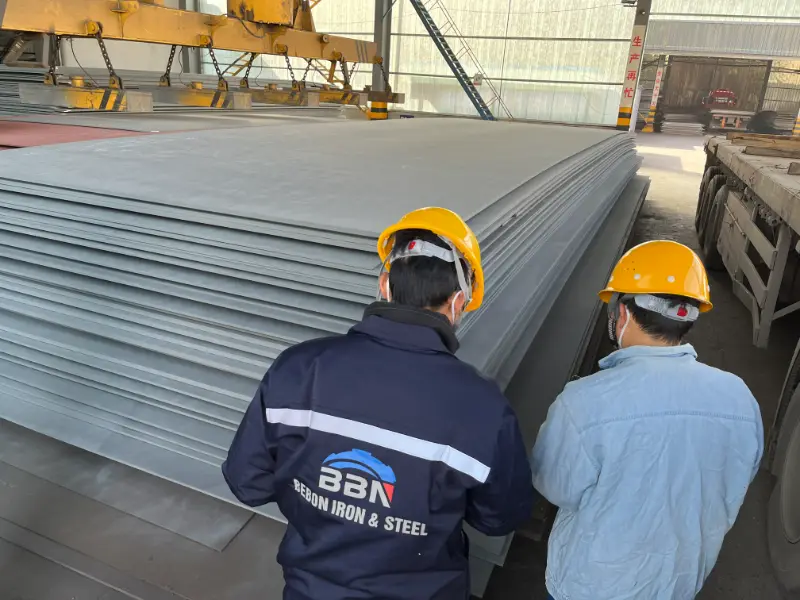
ASTM A516 Gr.70 + 904L Stainless Steel Clad Plate
ASTM A516 Gr.70 + 904L Stainless Steel Clad Plate: Premium Corrosion-Resistant Pressure Vessel Steel
Explore the dual-layer excellence of A516 Gr.70 carbon steel base with 904L stainless steel cladding, designed for demanding pressure vessels and chemical processing equipment requiring high strength and outstanding corrosion resistance.
Hot rolling, cold forming, welding (with proper procedures for dissimilar joints), machining
- Phone : +8618037372205
- Email : [email protected]
- WhatsApp: Contact via Whtsapp
- WeChat: +8618037372205
ASTM A516 Gr.70 + 904L Stainless Steel Clad Plate Introduction
ASTM A516 Gr.70 + 904L clad steel plate is a metallurgically bonded composite consisting of a base metal of ASTM A516 Grade 70 carbon steel plate for pressure vessels and a cladding layer of 904L (UNS N08904) super austenitic stainless steel.
- Base metal: A516 Gr.70 provides excellent strength and toughness at moderate temperatures, with minimum tensile strength of 70 ksi (485 MPa) and guaranteed impact properties at low temperatures down to -46 °C.
- Cladding metal: 904L offers exceptional resistance to reducing acids such as sulfuric, phosphoric, and acetic acids, as well as pitting and crevice corrosion in chloride environments, due to its high nickel, chromium, molybdenum and copper content.
The clad plate delivers a cost-effective solution by combining structural integrity with a thin layer of high-alloy corrosion protection, eliminating the need for solid alloy construction. It is produced per ASTM A263 / ASME SA-263 specifications, commonly with an explosive bonding or hot-roll bonding process that ensures full metallurgical fusion.
ASTM A516 Gr.70 + 904L Stainless Steel Clad Plate Chemical Composition
The table lists the chemical requirements for both the base metal (A516 Grade 70) and the cladding metal (904L – UNS N08904) as per ASTM A516 and ASTM A240 respectively. Actual clad plate composition shall meet these limits, with the cladding layer typically 3–6 mm thick.
| Element | Specified Value | Remarks |
|---|---|---|
| C (Base) | ≤0.27 (for thickness ≤12.5 mm) / ≤0.28 (>12.5-50 mm) / ≤0.30 (>50-100 mm) | A516 Gr.70 base metal |
| Mn (Base) | 0.79–1.30 (for thickness ≤40 mm) / 0.85–1.20 (>40 mm) | A516 Gr.70 base metal |
| P (Base) | ≤0.035 | A516 Gr.70 base metal |
| S (Base) | ≤0.035 | A516 Gr.70 base metal |
| Si (Base) | 0.13–0.45 | A516 Gr.70 base metal |
| C (Clad) | ≤0.020 | 904L cladding (ASTM A240) |
| Mn (Clad) | ≤2.00 | 904L cladding |
| P (Clad) | ≤0.045 | 904L cladding |
| S (Clad) | ≤0.030 | 904L cladding |
| Si (Clad) | ≤1.00 | 904L cladding |
| Cr (Clad) | 19.0–23.0 | 904L cladding |
| Ni (Clad) | 23.0–28.0 | 904L cladding |
| Mo (Clad) | 4.0–5.0 | 904L cladding |
| Cu (Clad) | 1.0–2.0 | 904L cladding |
| Fe (Clad) | Balance | 904L cladding |
ASTM A516 Gr.70 + 904L Stainless Steel Clad Plate Physical Properties
Physical properties vary between the carbon steel base and the 904L cladding. The table lists typical values for each layer at room temperature unless noted. For design of clad structures, thermal expansion mismatch should be considered, but the metallurgical bond accommodates it reliably.
| Property | Typical Value | Unit | Test Condition / Layer |
|---|---|---|---|
| Density, ρ | 7850 | kg/m³ | Base metal A516 Gr.70 |
| Density, ρ | 8000 | kg/m³ | Cladding 904L |
| Modulus of Elasticity, E | 205 | GPa | Base metal A516 Gr.70; 20°C |
| Modulus of Elasticity, E | 195 | GPa | Cladding 904L; 20°C |
| Shear Modulus, G | 80 | GPa | Base metal A516 Gr.70 |
| Shear Modulus, G | 75 | GPa | Cladding 904L |
| Poisson's Ratio, ν | 0.29 | – | Base metal A516 Gr.70 |
| Poisson's Ratio, ν | 0.30 | – | Cladding 904L |
| Thermal Expansion Coeff., α | 12.1 | 10⁻⁶/K | Base, 20–100 °C |
| Thermal Expansion Coeff., α | 15.5 | 10⁻⁶/K | Clad 904L, 20–100 °C |
| Thermal Conductivity, λ | 52 | W/(m·K) | Base metal A516 Gr.70, 20 °C |
| Thermal Conductivity, λ | 13 | W/(m·K) | Cladding 904L, 20 °C |
| Specific Heat Capacity, Cp | 486 | J/(kg·K) | Base metal A516 Gr.70, 20 °C |
| Specific Heat Capacity, Cp | 500 | J/(kg·K) | Cladding 904L, 20 °C |
| Electrical Resistivity, ρe | 0.17 | μΩ·m | Base metal A516 Gr.70, 20 °C |
| Electrical Resistivity, ρe | 0.85 | μΩ·m | Cladding 904L, 20 °C |
ASTM A516 Gr.70 + 904L Stainless Steel Clad Plate Mechanical Properties
The mechanical properties refer to the base metal A516 Grade 70 in normalized condition, which determines the overall strength of the clad plate. Bond integrity is verified by shear strength test per ASTM A263. Impact test requirements depend on the specified temperature, commonly -46 °C for pressure vessels.
| Property | Specified Value | Unit | Test Condition |
|---|---|---|---|
| Yield Strength, ReH (Base) | ≥260 | MPa | Transverse, room temperature |
| Tensile Strength, Rm (Base) | 485–620 | MPa | Transverse, room temperature |
| Elongation, A (Base) | ≥21 (in 200 mm) / ≥25 (in 50 mm) | % | Room temperature, gage length per ASTM A370 |
| Bend Test (Base) | D=2a (thickness ≤25.4 mm); D=3a (>25.4 mm) | – | 180° bend, no cracks, a=specimen thickness |
| Charpy V-notch Impact, KV (Base) | ≥27 (average of 3), ≥20 (individual) | J | At -46 °C (some specs -29 °C), transverse |
| Bond Shear Strength | ≥140 | MPa | Clad interface per ASTM A263 |
ASTM A516 Gr.70 + 904L Stainless Steel Clad Plate Fully Equivalent Material Standards & Substitute Grades
| Country/Region | Standard | Designation/Grade | Remarks |
|---|---|---|---|
| USA | ASTM A263 | SA-516 Gr.70 + SA-240 904L | Direct equivalent; ASME SA-263 identical |
| China | NB/T 47002.1-2009 | Bimetallic Clad Plate: Q345R (or 16MnR) + S39042 | Closest Chinese standard, Q345R is similar to A516 Gr.70 but not identical |
| European Union | EN 10028-5 | P355GH + X1NiCrMoCuN25-20-7 (1.4539) | EN designation for 904L clad on pressure vessel steel P355GH |
| Japan | JIS G3603 | SPV355 + SUS 890L | JIS clad plate standard with 904L cladding |
ASTM A516 Gr.70 + 904L Stainless Steel Clad Plate Application Introduction
This clad plate offers an ideal combination of mechanical strength and high corrosion resistance, especially in sulfuric and phosphoric acid environments. Key sectors:
Product Applications: Pressure vessels and reactors, Distillation columns and towers, Heat exchangers and condensers, Storage tanks for corrosive chemicals, Autoclaves in hydrometallurgy, Scrubbers and absorbers
Processed into products: Shell courses and heads (dished, hemispherical), Tube sheets and baffles for shell-and-tube heat exchangers, Nozzle reinforcements and flanges, Internal tray supports and distributors, Clad pipes (via roll-bonded clad plate rolled into pipe), Weld overlays at edges and joints for corrosion continuity
Application industries: Chemical processing (sulfuric acid, phosphoric acid, acetic acid plants), Petrochemical and refining, Pharmaceutical and food processing equipment, Pulp and paper (digesters, bleach washers), Flue gas desulfurization (FGD) systems in power plants, Seawater handling and desalination plants, Offshore oil and gas (splash zone components)
ASTM A516 Gr.70 + 904L Stainless Steel Clad Plate Similar / Alternative Clad Materials
| Country/Region | Standard | Designation/Grade | Remarks |
|---|---|---|---|
| USA | ASTM A263 | SA-516 Gr.70 + 316L (UNS S31603) | Lower cost alternative; suitable for less aggressive acids, but inferior to 904L in chloride pitting resistance |
| USA | ASTM A263 | SA-516 Gr.70 + 317L (UNS S31703) | Higher Mo content than 316L; better pitting resistance but still below 904L performance |
| USA | ASTM A264 | A516 Gr.70 + Nickel 200 | For caustic and high-temperature alkaline environments where stainless would not perform |
| USA | ASTM A265 | A516 Gr.70 + Nickel alloy C276 | For extremely aggressive media, superior to 904L in many reducing environments; higher cost |
| China | NB/T 47002.1 | Q345R + S31603 (316L) | Commom Chinese analog of an economical clad plate |
| EU | EN 10028-5 | P355GH + 1.4404 (316L) | European alternative to 904L clad for milder service |
Notes:
Fabrication notes:
- Welding: Welds at clad side must use matching 904L filler (e.g., ERNiCrMo-3 or ERNiCrMo-13 depending on application) to preserve corrosion resistance. Transition joints need careful procedures to avoid carbon steel dilution.
- Forming: Cold forming is possible, but attention must be paid to the clad layer cracking at large strains; hot forming above 950 °C may degrade the bond; interpass temperature limits must be observed.
- Inspection: Ultrasonic testing per ASTM A578 Level I or II is standard to ensure full bond. Shear strength test samples per lot are required.
- Certification: Mill certificates must report chemical analysis of both layers, mechanical tests of the base plate, bond shear test, and ultrasonic examination.
- Share



