
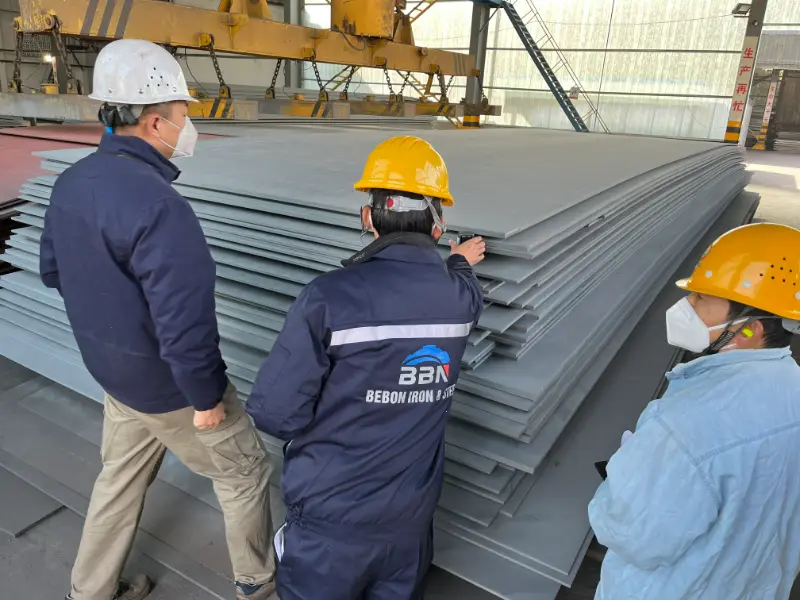
P265GH+904L Clad Steel Plate
P265GH+904L Clad Steel Plate: High-Strength Pressure Vessel Base with Superior Corrosion Resistance
Comprehensive technical data for P265GH+904L clad steel plate, a composite material combining a P265GH carbon steel base and a 904L super austenitic stainless steel cladding, ideal for pressure vessels in corrosive environments.
Hot rolling, explosion welding, cold forming, machining, welding (with appropriate filler metals)
- Phone : +8618037372205
- Email : [email protected]
- WhatsApp: Contact via Whtsapp
- WeChat: +8618037372205
P265GH+904L Clad Steel Plate Introduction
P265GH+904L clad steel plate is a metallurgically bonded composite material consisting of a base layer of P265GH pressure vessel steel (conforming to EN 10028-2) and a cladding layer of 904L (UNS N08904) super austenitic stainless steel. This combination provides the structural strength and cost-effectiveness of carbon steel with the exceptional corrosion resistance of high-alloy austenitic stainless steel, particularly in sulfuric, phosphoric, and chloride-containing environments. The clad plate is typically manufactured by explosion welding or hot rolling, ensuring a strong metallurgical bond. It is widely used in chemical processing, oil & gas, and marine industries where both mechanical integrity and resistance to aggressive media are required.
P265GH+904L Clad Steel Plate Chemical Composition
Nominal chemical composition for both the P265GH base (EN 10028-2) and the 904L cladding (EN 10028-7 / ASTM A240 UNS N08904). Actual values may vary within standard limits. The clad plate bond zone exhibits a thin diffusion layer with no significant change in bulk composition.
| Part | Element | Min. / Typical | Max. | Notes |
|---|---|---|---|---|
| Base (P265GH) | C | - | 0.20 | EN10028-2 |
| Base (P265GH) | Si | - | 0.40 | |
| Base (P265GH) | Mn | 0.80 | 1.40 | |
| Base (P265GH) | P | - | 0.025 | |
| Base (P265GH) | S | - | 0.010 | |
| Base (P265GH) | Cr | - | 0.30 | residual |
| Base (P265GH) | Ni | - | 0.30 | residual |
| Base (P265GH) | Mo | - | 0.08 | residual |
| Base (P265GH) | Cu | - | 0.30 | residual |
| Base (P265GH) | Nb | - | 0.02 | residual |
| Base (P265GH) | Ti | - | 0.03 | residual |
| Base (P265GH) | V | - | 0.02 | residual |
| Base (P265GH) | Al | 0.020 | - | total Al |
| Clad (904L) | C | - | 0.020 | EN10028-7 / 1.4539 |
| Clad (904L) | Si | - | 0.70 | |
| Clad (904L) | Mn | - | 2.00 | |
| Clad (904L) | P | - | 0.030 | |
| Clad (904L) | S | - | 0.010 | |
| Clad (904L) | Cr | 19.0 | 23.0 | |
| Clad (904L) | Ni | 23.0 | 28.0 | |
| Clad (904L) | Mo | 4.0 | 5.0 | |
| Clad (904L) | Cu | 1.0 | 2.0 | |
| Clad (904L) | N | - | 0.10 | optional |
P265GH+904L Clad Steel Plate Thermal and Electrical Physical Properties
Physical properties are presented separately for the base (P265GH) and cladding (904L) at room temperature unless otherwise specified. Thermal expansion mismatch should be considered during design at elevated temperatures. Effective properties for the composite depend on thickness ratio and temperature.
| Property | Material | Value | Unit | Test Condition |
|---|---|---|---|---|
| Density (ρ) | P265GH | 7.85 | g/cm³ | Room temperature |
| Density (ρ) | 904L | 7.95 | g/cm³ | Room temperature |
| Modulus of Elasticity (E) | P265GH | 210 | GPa | Room temperature |
| Modulus of Elasticity (E) | 904L | 195 | GPa | Room temperature |
| Shear Modulus (G) | P265GH | 81 | GPa | Calculated |
| Shear Modulus (G) | 904L | 75 | GPa | Calculated |
| Poisson's Ratio (ν) | P265GH | 0.30 | – | |
| Poisson's Ratio (ν) | 904L | 0.30 | – | |
| Thermal Expansion (α) | P265GH | 12.0 | 10⁻⁶/K | 20 – 100°C |
| Thermal Expansion (α) | P265GH | 13.0 | 10⁻⁶/K | 20 – 200°C |
| Thermal Expansion (α) | P265GH | 13.8 | 10⁻⁶/K | 20 – 300°C |
| Thermal Expansion (α) | 904L | 15.5 | 10⁻⁶/K | 20 – 100°C |
| Thermal Expansion (α) | 904L | 16.0 | 10⁻⁶/K | 20 – 200°C |
| Thermal Expansion (α) | 904L | 16.5 | 10⁻⁶/K | 20 – 300°C |
| Thermal Conductivity (λ) | P265GH | 51 | W/(m·K) | At 20°C |
| Thermal Conductivity (λ) | P265GH | 48 | W/(m·K) | At 100°C |
| Thermal Conductivity (λ) | 904L | 12 | W/(m·K) | At 20°C |
| Thermal Conductivity (λ) | 904L | 15 | W/(m·K) | At 100°C |
| Specific Heat Capacity (cp) | P265GH | 0.46 | kJ/(kg·K) | Room temperature |
| Specific Heat Capacity (cp) | 904L | 0.50 | kJ/(kg·K) | Room temperature |
| Electrical Resistivity (ρe) | P265GH | 0.22 | μΩ·m | Room temperature |
| Electrical Resistivity (ρe) | 904L | 0.85 | μΩ·m | Room temperature |
P265GH+904L Clad Steel Plate Mechanical Properties
Mechanical properties are determined predominantly by the base material P265GH. Values below refer to the full-thickness clad plate at room temperature unless otherwise noted. Bond integrity is verified by shear test and bend test. Requirements are in accordance with EN 10028-2 for the base and typical project specifications for clad plates.
| Property | Value | Unit | Test Condition / Remarks |
|---|---|---|---|
| Yield Strength (ReH) | 265 (min) | MPa | Base material, room temperature, t ≤ 16 mm |
| Yield Strength (ReH) | 255 (min) | MPa | Base, room temperature, 16 < t ≤ 40 mm |
| Tensile Strength (Rm) | 410 – 530 | MPa | Clad plate, full thickness |
| Elongation (A) | 22 (min) | % | Gauge length 5.65√S₀, transverse |
| Elongation (A) | 20 (min) | % | Gauge length 5.65√S₀, longitudinal |
| Impact Energy (KV₂) | 27 (min) | J | Base material, at 0°C, transverse |
| Impact Energy (KV₂) | 34 (min) | J | Base material, at 0°C, longitudinal |
| Shear Strength (τ) | 200 (min) | MPa | Bond interface, according to ASTM A264 |
| Bend Test | No cracks or separation | – | 180° bend, 3 × thickness mandrel, base in tension |
P265GH+904L Clad Steel Plate Equivalent Clad Material Standards & Alternative Designations
| Country/Region | Standard | Grade / Designation | Remarks |
|---|---|---|---|
| USA | ASME SA-264 / SA-263 | SA-516 Gr.65 + UNS N08904 | Pressure vessel clad plate, base normalization, clad solution annealed |
| China | GB/T 8165 / NB/T 47002.1 | Q345R + S39042 | Equivalent cladding to 904L (015Cr21Ni26Mo5Cu2) |
| Japan | JIS G3601 | SGV410 + SUS 890L | JIS designation for 904L clad; SGV410 similar to P265GH |
| Germany/EU | EN 13445 / VdTÜV 350 | P265GH + 1.4539 | Harmonized European practice; bond test per SEP 1390 |
| UK | BS 1501 + BS 1449 | 1501-224-490B + 904S13 | Legacy designations, now superseded by EN |
P265GH+904L Clad Steel Plate Application Introduction
P265GH+904L clad plates are designed to combine the economic and strength advantages of low-alloy carbon steel with the superior corrosion resistance of 904L super austenitic stainless steel. They are primarily used in welded pressure vessels and process equipment that handle aggressive, acidic, or chloride-bearing fluids. The carbon steel backing provides structural integrity under pressure, while the clad layer (typically 2–4 mm thick) protects against corrosion, allowing design temperatures up to 400°C depending on code. Care must be taken during fabrication: all welds that contact the corrosive medium must be performed using 904L or higher-alloy filler metals; the carbon steel base must not be exposed to the process side. Post-weld heat treatment (PWHT) may be required according to pressure vessel codes, and the cooling rate must ensure no sensitization of the 904L cladding.
Product Applications: Pressure vessels and reactors, Heat exchangers and condensers, Storage tanks for aggressive chemicals, Column and tower shells, Scrubbers and absorbers, Pipes and fittings (clad or lined)
Processed into products: Process column / distillation column shells, Heat exchanger tube sheets and channels, Reactor pressure shells for hydrogenation or oxidization, Desuperheater bodies, Filter press plates, Storage tank bottoms and shells for phosphoric acid or mixed acids, Pump bodies and valve bodies (when fabricated from clad plate)
Application industries: Chemical and petrochemical processing, Oil & gas (upstream and downstream), Pulp and paper (digesters, bleach plants), Desalination plants (evaporator shells), Flue gas desulfurization (FGD) systems, Pharmaceutical and food processing, Nuclear (secondary circuit components)
P265GH+904L Clad Steel Plate Similar or Alternative Clad/Coated Material Solutions
| Country/Region | Standard | Grade | Remarks |
|---|---|---|---|
| International | ASTM A264 | SA-516 Gr.60 + 316L (UNS S31603) | Lower cost cladding, less pitting resistance than 904L, suitable for mild chloride environments |
| International | EN 13445 | P265GH + 1.4404 (316L) | Common European alternative; limited in hot sulfuric acid |
| International | Explosion clad spec | P265GH + 254 SMO (UNS S31254) | Higher Mo content (6%), better chloride resistance than 904L, more expensive |
| International | Nickel alloy clad | SA-516 Gr.70 + Alloy C-276 (N10276) | Extreme corrosion resistance, used for concentrated acids, significantly higher cost |
| International | Organic coated | EN 10025-2 S355J2 + PTFE/epoxy coating | Non-metallic barrier, limited service temperature and wear resistance |
Notes:
Important additional requirements:
- Clad thickness is typically 2 mm to 4 mm, specified as minimum thickness after final forming.
- Ultrasonic testing (UT) per EN 10160 or ASTM A578 for base plate; bond integrity tested by full UT scanning per project specification.
- Shear test and tension test (base-driven) required per batch; supplementary chemical analysis of cladding per heat.
- 904L cladding must exhibit resistance to intergranular corrosion per ASTM A262 Practice C (Huey) or per ISO 3651-2 when specified.
- Welding procedure qualification must include dissimilar metal welds (DMW) between 904L and carbon steel, often using ERNiCrMo-3 (Alloy 625) filler to avoid carbon migration.
- The maximum service temperature must consider the difference in thermal expansion; rapid temperature changes may be limited to avoid spalling or bond degradation.
- Share



