
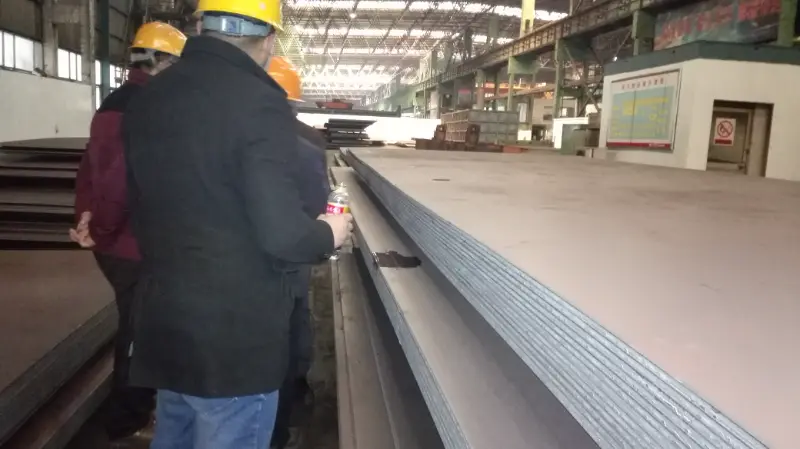
A516 Gr70 + 316 Clad Steel Plate
A516 Gr70 + 316 Clad Steel Plate: High-Strength Carbon Steel Base with Superior Corrosion Resistance
Comprehensive material data for ASTM A516 Grade 70 carbon steel base explosively or roll bonded with 316 austenitic stainless steel cladding, covering chemical composition, mechanical and physical properties, international equivalents, and application guidance.
Explosion bonding, roll bonding, hot rolling, welding, forming, cutting, bending
- Phone : +8618037372205
- Email : [email protected]
- WhatsApp: Contact via Whtsapp
- WeChat: +8618037372205
A516 Gr70 + 316 Clad Steel Plate Introduction
A516 Gr70 + 316 clad steel plate is a composite material combining a pressure vessel quality carbon steel base (ASTM A516/A516M Grade 70) with a corrosion-resistant 316 austenitic stainless steel cladding (ASTM A240/A240M Type 316).
- The base provides high strength and toughness for structural integrity at moderate temperatures, suitable for pressure vessel construction.
- The 316 cladding (16-18% Cr, 10-14% Ni, 2-3% Mo) offers excellent resistance to pitting and crevice corrosion in chloride-bearing and acidic environments.
Manufactured by explosion bonding or roll bonding, the clad plate meets ASTM A264 requirements, achieving a minimum shear bond strength of 140 MPa at the interface. It is widely used in pressure vessels, heat exchangers, and chemical processing equipment where both mechanical reliability and corrosion protection are required. The cladding thickness typically ranges from 5% to 20% of the total plate thickness.
A516 Gr70 + 316 Clad Steel Plate Chemical Composition
Chemical composition is specified separately for the base metal and the cladding layer. The base metal conforms to ASTM A516 Grade 70 (ladle analysis), while the clad layer meets ASTM A240 Type 316. Values are in weight percent. Carbon content of the base is thickness dependent, with typical maximum for medium thickness plates indicated.
| Layer | Element | Standard Value (wt.%) | Remarks |
|---|---|---|---|
| Base (A516 Gr70) | C | ≤0.28 (t ≤50 mm); ≤0.30 (50< t ≤100 mm) | Ladle analysis, thickness dependent |
| Base (A516 Gr70) | Mn | 0.85 – 1.20 | Ladle analysis |
| Base (A516 Gr70) | Si | 0.15 – 0.40 | Ladle analysis |
| Base (A516 Gr70) | P | ≤0.035 | |
| Base (A516 Gr70) | S | ≤0.035 | |
| Base (A516 Gr70) | Cu (if specified) | ≤0.35 | May be required for improved corrosion resistance |
| Base (A516 Gr70) | Ni (if specified) | ≤0.35 | |
| Base (A516 Gr70) | Cr (if specified) | ≤0.35 | |
| Base (A516 Gr70) | Mo (if specified) | ≤0.08 | |
| Base (A516 Gr70) | Nb (if specified) | ≤0.02 | |
| Base (A516 Gr70) | V (if specified) | ≤0.02 | |
| Base (A516 Gr70) | Ti (if specified) | ≤0.02 | |
| Clad (316) | C | ≤0.08 | ASTM A240 Type 316 |
| Clad (316) | Mn | ≤2.00 | |
| Clad (316) | Si | ≤1.00 | |
| Clad (316) | P | ≤0.045 | |
| Clad (316) | S | ≤0.030 | |
| Clad (316) | Cr | 16.0 – 18.0 | |
| Clad (316) | Ni | 10.0 – 14.0 | |
| Clad (316) | Mo | 2.00 – 3.00 | |
| Clad (316) | N | ≤0.10 | Optional element |
A516 Gr70 + 316 Clad Steel Plate Thermal and Electrical Physical Properties
Physical properties are presented for both the base carbon steel (A516 Gr70) and the austenitic stainless steel cladding (316) at ambient conditions unless otherwise noted. These values are typical for design calculations. Composite thermal expansion is controlled mainly by the base thickness. Values for 316 cladding reflect the fully annealed condition.
| Layer | Property | Typical Value | Unit | Test Condition / Remarks |
|---|---|---|---|---|
| Base (A516 Gr70) | Density (ρ) | 7.85 | g/cm³ | At room temperature |
| Base (A516 Gr70) | Modulus of Elasticity (E) | 200 | GPa | At room temperature |
| Base (A516 Gr70) | Shear Modulus (G) | 80 | GPa | At room temperature |
| Base (A516 Gr70) | Poisson's Ratio (ν) | 0.3 | - | At room temperature |
| Base (A516 Gr70) | Thermal Expansion (α) | 12.0 × 10⁻⁶ | 1/°C | 20–100 °C |
| Base (A516 Gr70) | Thermal Conductivity (λ) | 52 | W/(m·K) | At 0 °C |
| Base (A516 Gr70) | Specific Heat Capacity | 490 | J/(kg·K) | At room temperature |
| Base (A516 Gr70) | Electrical Resistivity (ρₑ) | 0.15 – 0.20 | μΩ·m | At room temperature |
| Clad (316) | Density (ρ) | 8.0 | g/cm³ | At room temperature |
| Clad (316) | Modulus of Elasticity (E) | 193 | GPa | At room temperature |
| Clad (316) | Thermal Expansion (α) | 15.9 × 10⁻⁶ | 1/°C | 0–100 °C |
| Clad (316) | Thermal Conductivity (λ) | 14.0 | W/(m·K) | At 100 °C |
| Clad (316) | Specific Heat Capacity | 500 | J/(kg·K) | At room temperature |
| Clad (316) | Electrical Resistivity (ρₑ) | 0.74 | μΩ·m | At room temperature |
A516 Gr70 + 316 Clad Steel Plate Mechanical Properties
Mechanical properties of the clad plate are determined primarily by the base metal. Tensile tests are performed using base metal thickness (excluding cladding contribution) per ASTM A264. The clad plate must meet the minimum requirements of ASTM A516 Gr70. Bending and shear bond tests confirm the integrity of the cladding and interface. All tests at room temperature unless indicated.
| Property | Standard Value | Unit | Test Condition / Remarks |
|---|---|---|---|
| Yield Strength (ReH) | ≥260 | MPa | Room temperature, based on base metal thickness |
| Tensile Strength (Rm) | 485 – 620 | MPa | Room temperature, based on base metal thickness |
| Elongation (A) in 200 mm | ≥17 | % | Gauge length 200 mm, base metal thickness |
| Elongation (A) in 50 mm | ≥21 | % | Gauge length 50 mm, base metal thickness |
| Bend Test | No cracks or separation in clad | - | 180° bend; bend diameter according to A516 base thickness (e.g., 1.5t for t≤19mm); clad side in tension or compression |
| Shear Bond Strength | ≥140 | MPa | Clad-to-base interface, tested per ASTM A264 |
| Charpy Impact (optional) | As specified (e.g., 27 J avg at -46°C) | J | When impact testing is required for the base metal, minimum average values per supplemental requirements |
A516 Gr70 + 316 Clad Steel Plate Direct Equivalents: Full Substitution Standards and Grades
| Country/Region | Standard | Grade (Base + Clad) | Remarks |
|---|---|---|---|
| USA | ASTM A264 | A516 Gr70 + 316 | Original specification |
| EU | EN 13445-2 / EN 10028 | P355GH + 1.4401 (X5CrNiMo17-12-2) | Clad plate for pressure equipment; comparable base yield ~355 MPa |
| China | GB/T 8165 / NB/T 47002.1 | Q345R + S31603 (06Cr17Ni12Mo2) | Explosion or roll bonded; Q345R mechanical properties similar to A516 Gr70 |
| Japan | JIS G3601 | SLT36 or SLT410 + SUS316 | Clad steel for pressure vessels; SLT36 minimum tensile 360 MPa |
| ISO | ISO 16528-2 | P355 + X5CrNiMo17-12-2 | Harmonized standard for clad products |
A516 Gr70 + 316 Clad Steel Plate Application Introduction
A516 Gr70 + 316 clad combines the pressure-containing strength of carbon steel with the chemical resistance of stainless steel, making it cost-effective for large fabrication while ensuring long service intervals. The clad layer faces the corrosive medium; the carbon steel back provides structural support. Common uses:
- Pressure vessels and columns in sour service, acid gases, chloride media.
- Heat exchanger shells and channel covers where cooling water or process fluids cause corrosion.
- Flue gas desulfurization absorbers in power plants.
- Storage tanks for aggressive chemicals (e.g., sulfuric acid, caustic soda, phosphoric acid).
- Hydrocracking reactors and high-pressure separators. The material can be cut, rolled, welded (with proper electrodes for both base and clad), and formed using standard processes adapted for clad plate.
Product Applications: Pressure vessels (separators, knock-out drums), Heat exchangers (shells, channels), Columns & towers (absorbers, strippers), Reactors and autoclaves, Storage tanks for corrosive chemicals, Expansion joints, cladded tube sheets
Processed into products: Vessel shell plates (rolled into cylinders), Dished heads (formed from clad plate), Tube sheets for heat exchangers, Nozzles and flanges (clad overlaid or integral), Baffle plates and structural internals (clad side exposed), Clad pipes and fittings produced from plate
Application industries: Oil & Gas (Upstream, Refining), Chemical Processing, Power Generation (FGD, Nuclear), Desalination Plants, Pulp & Paper, Pharmaceutical Manufacturing, Mining & Hydrometallurgy
A516 Gr70 + 316 Clad Steel Plate Similar / Closely Related Materials
| Country/Region | Standard | Grade (Base + Clad) | Remarks |
|---|---|---|---|
| USA | ASTM A264 | A516 Gr65 + 316 | Lower base strength (min yield 240 MPa); similar corrosion resistance |
| USA | ASTM A264 | A516 Gr70 + 316L | Extra-low carbon clad (<0.03% C) for improved intergranular corrosion resistance |
| USA | ASTM A264 | A516 Gr70 + 304L | Substitute with no molybdenum for less aggressive environments |
| EU | EN 13445 | P265GH + 1.4401 | Base P265GH with lower strength; often used in lighter pressure vessels |
| China | GB/T 8165 | Q245R + S31603 | Lower strength base similar to A516 Gr60, same clad |
| Japan | JIS G3601 | SCMV4 + SUS316L | For high-temperature service, Cr-Mo base |
Notes:
- Welding: Requires buttering pass with 309L or 316L over the carbon steel preparation, then clad side welded with 316L filler. PWHT may be required for base metal; cladding must be protected from sensitization (controlled cooling times, solution annealing after welding if needed).
- Forming: Hot or cold forming possible; hot forming temperatures above 600 °C may cause carbide precipitation in the clad if not stabilized – solution annealing is recommended after hot forming.
- Inspection: Ultrasonic examination of bond (100% per ASTM A264) is mandatory. Penetrant testing of clad surface after fabrication. Ferrite content in weld overlay should be 3–10 FN to avoid hot cracking.
- Ordering: Specify clad thickness, total plate thickness, base/clad grades, bond test requirements, and any supplementary requirements (e.g., impact test temperature for base, intergranular corrosion test for clad per ASTM A262 Practice E).
- Surface protection: The carbon steel side should be painted or corrosion allowed for in service; the clad side requires cleaning and passivation after fabrication.
- Share



