
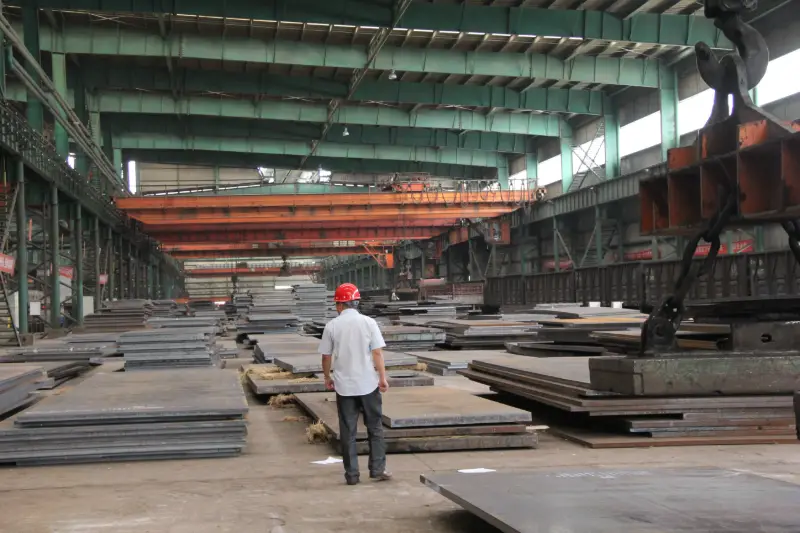
A537CL1+316L Clad Steel Plate
A537CL1+316L Clad Steel Plate: High-Strength Base & Superior Corrosion Resistance
Explore the dual-material clad plate combining ASTM A537 Class 1 carbon-manganese-silicon strength with ASTM A240 Type 316L stainless steel corrosion resistance. Ideal for pressure vessels and chemical processing.
Hot rolling, explosion bonding, roll bonding, welding overlay (for fabrication)
- Phone : +8618037372205
- Email : [email protected]
- WhatsApp: Contact via Whtsapp
- WeChat: +8618037372205
A537CL1+316L Clad Steel Plate Introduction
The A537CL1+316L clad steel plate is a composite material consisting of a base layer of ASTM A537 Class 1 carbon-manganese-silicon steel, offering high strength and good toughness, bonded to a cladding layer of ASTM A240 Type 316L austenitic stainless steel, providing excellent corrosion resistance.
- Base material: ASTM A537 CL1, typically used for pressure vessels and boilers, with minimum yield strength of 345 MPa and tensile strength ranging from 485 to 620 MPa.
- Cladding: ASTM A240 316L, a low-carbon molybdenum-bearing stainless steel with superior resistance to pitting and crevice corrosion in chloride environments.
- The metallurgical bond achieved through hot rolling, explosion welding, or other bonding methods ensures a continuous and reliable interface with high shear strength.
This combination is ideal for applications requiring structural integrity under pressure together with protection against aggressive media, such as in chemical reactors, heat exchangers, desalination plants, and flue gas desulfurization systems. The clad plate meets the requirements of ASTM A264, which covers stainless chromium-nickel steel clad plate, and delivers the corrosion resistance of solid 316L at a reduced cost and weight compared to a solid stainless steel plate.
A537CL1+316L Clad Steel Plate Chemical Composition
Composition is provided separately for the base steel (ASTM A537 Class 1) and the cladding (ASTM A240 Type 316L). Actual values depend on plate thickness and heat analysis.
- Base: C max 0.24; Mn 0.70–1.60; Si 0.15–0.50; P max 0.025; S max 0.025; trace levels of Ni, Cr, Mo, Cu as specified.
- Cladding: C max 0.03; Cr 16.0–18.0; Ni 10.0–14.0; Mo 2.0–3.0; Mn max 2.0; Si max 0.75; P max 0.045; S max 0.03; N max 0.10.
| Element | Standard Value (wt%) | Remarks |
|---|---|---|
| C | ≤ 0.24 | Base (A537 CL1) heat analysis |
| Mn | 0.70 – 1.60 | Base (A537 CL1); ≤40 mm: 0.70-1.35, >40-65 mm: 0.85-1.50 |
| Si | 0.15 – 0.50 | Base (A537 CL1) |
| P | ≤ 0.025 | Base (A537 CL1) |
| S | ≤ 0.025 | Base (A537 CL1) |
| Cu | ≤ 0.35 | Base (A537 CL1) |
| Ni | ≤ 0.25 | Base (A537 CL1) |
| Cr | ≤ 0.25 | Base (A537 CL1) |
| Mo | ≤ 0.08 | Base (A537 CL1) |
| C | ≤ 0.03 | Cladding (316L) |
| Mn | ≤ 2.00 | Cladding (316L) |
| Si | ≤ 0.75 | Cladding (316L) |
| P | ≤ 0.045 | Cladding (316L) |
| S | ≤ 0.030 | Cladding (316L) |
| Cr | 16.0 – 18.0 | Cladding (316L) |
| Ni | 10.0 – 14.0 | Cladding (316L) |
| Mo | 2.00 – 3.00 | Cladding (316L) |
| N | ≤ 0.10 | Cladding (316L) |
A537CL1+316L Clad Steel Plate Thermal and Electrical Physical Properties
Properties are listed for both the base (A537 CL1) and cladding (316L) at ambient temperature, unless specified otherwise. For the composite, effective properties depend on relative thickness; use linear interpolation for parallel properties.
- Base: density 7.85 g/cm³, thermal expansion ~11.7 µm/m·°C, thermal conductivity ~51.9 W/m·K.
- Cladding: density 7.98 g/cm³, thermal expansion ~16.5 µm/m·°C, thermal conductivity ~16.2 W/m·K.
| Property | Value | Unit | Remarks |
|---|---|---|---|
| Density (ρ) | 7.85 | g/cm³ | Base (A537 CL1) |
| Density (ρ) | 7.98 | g/cm³ | Cladding (316L) |
| Elastic Modulus (E) | 200 | GPa | Base (A537 CL1) |
| Elastic Modulus (E) | 193 | GPa | Cladding (316L) |
| Shear Modulus (G) | 76.9 | GPa | Base (A537 CL1) |
| Shear Modulus (G) | ~77 | GPa | Cladding (316L) |
| Poisson's Ratio (ν) | 0.29 | – | Base (A537 CL1) |
| Poisson's Ratio (ν) | 0.29 | – | Cladding (316L) |
| Thermal Expansion (α) | 11.7 | µm/m·°C | Base, 20–100°C |
| Thermal Expansion (α) | 16.5 | µm/m·°C | Cladding, 20–100°C |
| Thermal Conductivity (λ) | 51.9 | W/m·K | Base, 20°C |
| Thermal Conductivity (λ) | 16.2 | W/m·K | Cladding, 20°C |
| Specific Heat Capacity | 486 | J/kg·K | Base |
| Specific Heat Capacity | 500 | J/kg·K | Cladding |
| Electrical Resistivity (ρ_e) | 1.5 × 10⁻⁷ | Ω·m | Base |
| Electrical Resistivity (ρ_e) | 7.4 × 10⁻⁷ | Ω·m | Cladding |
A537CL1+316L Clad Steel Plate Mechanical Properties
Properties apply at room temperature unless otherwise noted. Tensile and yield properties are measured on the base metal side of the clad plate as per ASTM A264. Bond shear strength and bend test confirm clad integrity.
- Yield and tensile conform to ASTM A537 Class 1.
- Elongation in 200 mm gauge length.
- Shear strength of the bond ≥ 140 MPa.
- 180° bend test with no cracks or separation (bend diameter = 3 times thickness).
| Property | Value | Unit | Test Condition |
|---|---|---|---|
| Yield Strength (ReH) | ≥ 345 | MPa | Room temp, base metal, transverse direction |
| Tensile Strength (Rm) | 485 – 620 | MPa | Room temp, base metal, transverse direction |
| Elongation (A) | ≥ 20 (≤40 mm thick); ≥ 18 (40-65 mm thick) | % | Gauge length 200 mm, base metal |
| Shear Strength (Bond) | ≥ 140 | MPa | Thickness direction, clad interface |
| Bend Test | No cracks or separation | – | 180° bend, bend diameter = 3t |
| Charpy V-Notch Impact (KV) | ≥ 27 J (average) (if specified) | J | At -46°C (-50°F), base metal, transverse |
A537CL1+316L Clad Steel Plate Completely Equivalent Material Standards & Replaceable Grades
| Country/Region | Standard | Grade | Remarks |
|---|---|---|---|
| USA | ASTM A264 | A537CL1 + 316L | Stainless chromium-nickel steel clad plate; base ASTM A537 Class 1, cladding ASTM A240 316L |
| USA | ASME SA-264 | A537CL1 + 316L | Boiler & Pressure Vessel Code version; identical to ASTM A264 |
| Europe | EN 10028-7 | P355GH + X2CrNiMo17-12-2 (1.4404) | Comparable base strength (P355GH) and 316L-type cladding; alternative designation |
| Japan | JIS G3601 | SGV480 + SUS316L | Similar pressure vessel base steel clad with SUS316L; check thickness & properties |
| International | ISO 10807 | P355GH + X2CrNiMo17-12-2 | Equivalent clad plate standard aligning with EN specifications |
A537CL1+316L Clad Steel Plate Application Introduction
A537CL1+316L clad plates are widely used in industries requiring both high pressure/temperature structural performance and resistance to corrosive media. The combination reduces weight and cost compared to solid stainless steel, while maintaining excellent corrosion protection on the process side.
Product Applications: Pressure Vessels (reactors, separators, drums), Heat Exchangers (shell and tube, plate type), Storage Tanks (corrosive chemicals, acids), Columns and Towers (distillation, absorption), Autoclaves and Digesters, Piping Systems and Manifolds, Water Wall Panels and Boiler Components
Processed into products: Vessel shells and heads (formed from clad plate), Tube sheets (clad with stainless on face), Baffles and support plates, Flanges and nozzles (clad overlay or welded constructions), Clad transition joints (connecting different materials), Lining plates for FGD absorbers
Application industries: Chemical Processing, Petrochemical and Refining, Oil & Gas (onshore and offshore), Power Generation (fossil, nuclear), Desalination Plants, Pulp & Paper, Marine and Shipbuilding, Flue Gas Desulfurization (FGD) Systems
A537CL1+316L Clad Steel Plate Similar / Alternative Material Recommendations
| Country/Region | Standard | Grade | Remarks |
|---|---|---|---|
| USA | ASTM A264 | A516 Gr 70 + 316L | Lower base strength (485-620 MPa similar but yield 260 MPa) with same corrosion cladding; good for moderate pressure |
| USA | ASTM A264 | A537 CL2 + 316L | Stronger base (yield ≥ 450 MPa) with same corrosion resistance; for higher pressure applications |
| Global | Various | Solid 316L Plate | Full-thickness stainless steel; no bonding layer; higher cost but homogeneous corrosion resistance |
| Global | ASTM A240 / EN 10088 | Duplex 2205 (UNS S32205) Plate | Higher strength and better stress corrosion cracking resistance than 316L; solid solution, no clad |
| USA | ASTM A265 | A516 Gr 70 + Inconel 625 | Nickel-alloy cladding for extreme corrosive environments; base similar, but cladding better against hot acids |
| Europe | EN 10028-7 | P265GH + 1.4404 | Lower strength base (yield ~265 MPa) with 316L cladding; cost-effective for low-pressure vessels |
Notes:
Clad plates are typically delivered with an ultrasonic examination (UT) in accordance with ASTM A578 to ensure full bond integrity. Welding procedures must address the dissimilar metal joint; the base side is usually welded with a matching carbon steel consumable, and the cladding side is overlaid or welded with a 309LMo buttering layer followed by a 316L filler to maintain corrosion resistance. Post-weld heat treatment (PWHT) may be required for the base material depending on thickness and code rules (e.g., ASME Section VIII); care must be taken to avoid sensitization of the 316L cladding. When ordering, specify plate dimensions, cladding thickness, bonding method (explosion, roll bond), and any supplementary testing (e.g., shear test, bend test, impact test).
- Share



