
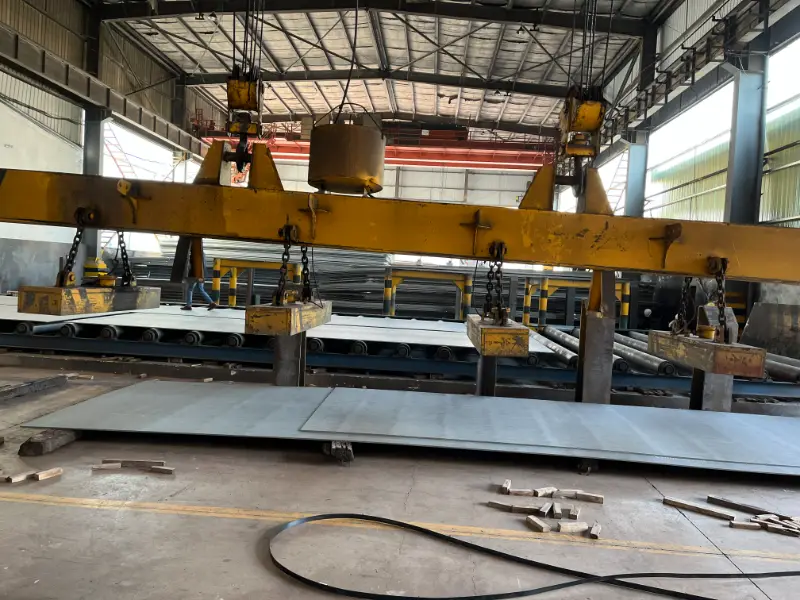
ASTM A516 Gr70 + 316L Clad Steel Plate
ASTM A516 Gr70 + 316L Clad Steel Plate: Dual-Metal Solution for Pressure Vessels and Corrosive Environments
Comprehensive material data for ASTM A516 Grade 70 carbon steel base clad with 316L austenitic stainless steel. Includes chemical composition, mechanical properties, physical data, equivalent standards, and application guidance.
Hot rolling, explosive bonding, roll bonding; subsequent hot/cold forming, welding, stress relieving (if required)
- Phone : +8618037372205
- Email : [email protected]
- WhatsApp: Contact via Whtsapp
- WeChat: +8618037372205
ASTM A516 Gr70 + 316L Clad Steel Plate Introduction
ASTM A516 Gr70 + 316L clad steel plate is a bimetallic composite that combines the high strength and cost-effectiveness of A516 Grade 70 pressure vessel carbon steel with the excellent corrosion resistance of 316L stainless steel. The base provides structural integrity under moderate temperatures, while the cladding offers protection against pitting, crevice corrosion, and oxidation in chloride-containing environments. Manufactured per ASTM A264/A264M, this material is widely specified for pressure vessels, heat exchangers, tube sheets, and chemical processing equipment where a full stainless steel construction would be uneconomical. It delivers a unique balance of
- High strength (485–620 MPa tensile) from the carbon steel backing
- Excellent weldability and low-temperature toughness typical of fine-grain steel
- Superior corrosion resistance from the 316L cladding
- Cost savings by substituting a high-alloy solid plate with a clad structure
Typical delivery condition is normalized for the base, with the clad layer in solution-annealed condition, ensuring homogeneous interface bonding and excellent formability.
ASTM A516 Gr70 + 316L Clad Steel Plate Chemical Composition
Chemical requirements for the base metal (A516 Gr70) and the cladding (316L stainless steel). Values are maximum unless a range is given. The clad layer must meet ASTM A240 316L; the base meets ASTM A516 Gr70. Full analysis of the clad is mandatory; base chemistry is typical for pressure vessel quality steel.
| Element | Standard Value | Remarks |
|---|---|---|
| C | Base: ≤0.30; Clad: ≤0.030 | Base carbon depends on thickness (≤0.28 for t≤12.5 mm). Clad per A240. |
| Mn | Base: 0.85–1.20; Clad: ≤2.00 | Base Mn for thickness >40 mm; for thinner plates lower range applies. |
| P | Base: ≤0.035; Clad: ≤0.045 | |
| S | Base: ≤0.035; Clad: ≤0.030 | |
| Si | Base: not specified; Clad: ≤1.00 | Base Si typically 0.15-0.40 but not mandated for Gr70. Clad per A240. |
| Ni | Base: not specified; Clad: 10.0–14.0 | |
| Cr | Base: not specified; Clad: 16.0–18.0 | |
| Mo | Base: not specified; Clad: 2.00–3.00 | |
| N | Clad: ≤0.10 | Not specified for base. |
| Fe | Balance for both |
ASTM A516 Gr70 + 316L Clad Steel Plate Thermal and Electrical Physical Properties
Physical properties of the clad plate are influenced by both the carbon steel base and the 316L cladding. The table provides typical property ranges for each component at room temperature unless noted. For design calculations, composite values can be estimated by volumetric averaging. Properties are averages from published data for A516 Gr70 and A240 316L.
| Property | Standard Value | Unit | Test Conditions |
|---|---|---|---|
| Density (ρ) | Base: 7.85; Clad: 8.00 | g/cm³ | At 20°C |
| Modulus of Elasticity (E) | Base: 205; Clad: 193 | GPa | At 20°C |
| Shear Modulus (G) | Base: ~80; Clad: ~77 | GPa | Approximate |
| Poisson's Ratio (ν) | Base: 0.29; Clad: 0.29 | - | At 20°C |
| Thermal Expansion (α) – 20–100°C | Base: 11.7; Clad: 16.0 | µm/m·°C | |
| Thermal Expansion (α) – 20–300°C | Base: 12.8; Clad: 16.5 | µm/m·°C | |
| Thermal Conductivity (λ) at 100°C | Base: 52; Clad: 15 | W/m·K | |
| Specific Heat Capacity (Cp) | Base: 460; Clad: 500 | J/kg·K | At 20–100°C |
| Electrical Resistivity (ρe) | Base: ~0.16; Clad: ~0.74 | µΩ·m | At 20°C |
ASTM A516 Gr70 + 316L Clad Steel Plate Mechanical Properties
Mechanical values are based on the base metal (A516 Gr70) because the cladding is not credited for strength according to ASTM A264. Tensile testing of the clad plate is performed on full-thickness specimens; stresses are calculated using only the base metal thickness. The bond shear strength between base and clad is separately verified. Values apply to normalized base material at room temperature.
| Property | Standard Value | Unit | Test Conditions |
|---|---|---|---|
| Yield Strength (ReH) | ≥260 | MPa | Base metal thickness ≤200 mm; per ASTM A516 Gr70 |
| Tensile Strength (Rm) | 485–620 | MPa | Base metal; full-thickness specimen stress based on base only |
| Elongation (A) | ≥23 | % | In 50 mm gauge for thickness >40 mm; min 21% for thin plates |
| Bond Shear Strength | ≥140 | MPa | Per ASTM A264 shear test; clad-to-base interface |
| Bend Test (180°) | No cracking or separation | - | Clad in tension or compression; bend radius per base thickness per ASTM A264 |
ASTM A516 Gr70 + 316L Clad Steel Plate Fully Equivalent Material Standards and Substitutable Grades
| Country/Region | Standard | Grade | Remarks |
|---|---|---|---|
| USA (ASME) | ASME SA-264 | SA-516 70 + SA-240 316L | Identical to ASTM A264 combination; accepted by ASME Boiler & Pressure Vessel Code |
| Japan | JIS G3601 | SUS316L + SGV480 | SGV480 is comparable to A516 Gr70; clad plate for pressure vessels |
| China | GB/T 8165 | Q345R + S31603 | Q345R is closely matched to A516 Gr70 in strength; 316L clad |
| Europe | EN 13445-2 (clad products) | P265GH + X2CrNiMo17-12-2 (1.4404) | Designation according to EN 10028-2 base and clad; similar application |
ASTM A516 Gr70 + 316L Clad Steel Plate Application Introduction
A516 Gr70 + 316L clad plates are engineered for service conditions where strength, toughness, and moderate corrosion resistance must be combined economically. The 316L layer handles a wide range of chemicals, especially those containing chlorides (e.g., seawater, brines), while the thick carbon steel backing carries pressure loads. Typical applications in oil & gas, chemical processing, power generation, and marine industries include tubular reactors, columns, storage tanks, and clad pipe components. Compatibility with standard welding procedures (with proper transition buttering) and forming operations makes this clad plate a versatile choice.
Product Applications: Clad pressure vessels and reactors, Tube sheets and baffles for shell-and-tube heat exchangers, Clad plate for column and tank fabrication, Clad structural components for corrosive atmospheres, Transition joints for dissimilar metal piping
Processed into products: Vessel shells and heads (formed by cold or hot spinning), Flanges and nozzles with stainless overlay, Internal trays and support rings, Clad pipe spools and fittings, Explosion-bonded transition pieces for joining stainless pipe to carbon steel
Application industries: Oil and gas production (offshore topside equipment), Chemical and petrochemical processing, Pulp and paper (digesters, bleach towers), Desalination and water treatment, Power generation (FGD scrubbers, heat exchangers), Food and pharmaceutical (clad vessels for cleanability)
ASTM A516 Gr70 + 316L Clad Steel Plate Similar or Near-Equivalent Material Recommendations
| Country/Region | Standard | Grade | Remarks |
|---|---|---|---|
| USA | ASTM A264 | A516 Gr70 + 304L | Lower Mo clad: slightly less pitting resistance; comparable strength |
| USA | ASTM A264 | A516 Gr65 + 316L | Lower base strength (450-585 MPa) but same clad corrosion resistance |
| USA | ASTM A264 | A516 Gr70 + 2205 duplex | Higher strength clad; excellent chloride SCC resistance; more expensive |
| International | Various | SA-203 Gr.E + 316L (cryogenic) | Nickel-alloyed base for low-temperature service; clad same 316L |
| China | GB/T 8165 | Q245R + S31603 | Lower base strength (400-520 MPa); otherwise similar corrosion performance |
Notes:
Welding: The carbon steel side is welded with compatible low-hydrogen electrodes; the clad side must be welded using a buttering layer (e.g., ER309L) to avoid carbon migration, followed by a 316L filler for the clad cap. Post-weld heat treatment (PWHT) may be required per code; the 316L cladding can be susceptible to sensitization if held in the 450–850°C range for extended periods. Inspection: Clad plates are normally delivered with 100% ultrasonic examination of the bond area per ASTM A578 Level C or equivalent. Forming: Hot forming should be performed within the temperature range that avoids base grain coarsening and clad sigma-phase embrittlement; cold forming requires careful control of strain to prevent interface disbonding. Corrosion test: The clad layer is subject to intergranular corrosion testing per ASTM A262 Practice E when specified. Certification: Material is typically supplied with EN 10204 3.1 certificates covering both base and clad chemical analyses, base tensile tests, bond shear tests, and NDT.
- Share



