
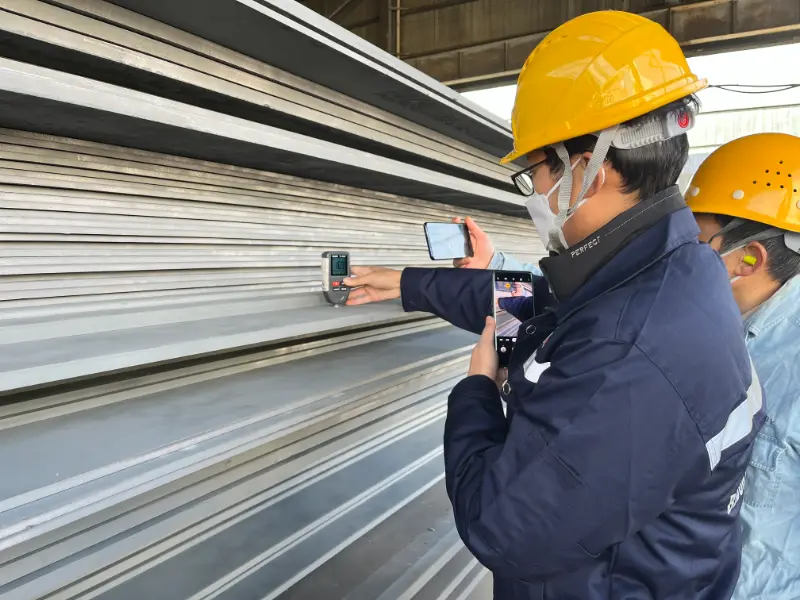
S355JR+316L Clad Steel Plate
S355JR+316L Clad Steel Plate: Structural Base with Superior Corrosion Resistance from 316L Stainless Steel Cladding
S355JR+316L clad steel plate combines the high strength of S355JR carbon-manganese structural steel with the excellent corrosion resistance of 316L austenitic stainless steel, providing a cost-effective solution for demanding environments.
Welding (transition layer recommended), hot/cold forming, machining, cutting (plasma, laser, waterjet)
- Phone : +8618037372205
- Email : [email protected]
- WhatsApp: Contact via Whtsapp
- WeChat: +8618037372205
S355JR+316L Clad Steel Plate Introduction
S355JR+316L clad steel plate is a metallurgically bonded composite material featuring a base layer of S355JR structural steel (EN 10025-2) and a cladding layer of 316L (1.4404) stainless steel (EN 10088-3 / ASTM A240). The S355JR base provides high yield and tensile strength, weldability, and toughness, widely used in construction and pressure vessels. The 316L cladding offers outstanding resistance to pitting and crevice corrosion in chloride-containing media, organic acids, and marine atmospheres. This combination allows designers to use the superior mechanical properties of carbon steel while ensuring long-term surface integrity through the stainless steel layer, significantly reducing material costs compared to solid 316L plates. The bond is typically achieved by hot rolling or explosion welding, ensuring full shear strength. Typical applications include chemical tanks, heat exchangers, desalination plants, flue gas desulfurization systems, and structural components in aggressive environments.
Key characteristics:
- High yield strength (min 355 MPa for S355JR base)
- Excellent impact toughness
- 316L cladding: durable passive layer, low carbon for intergranular corrosion resistance
- Bimetal bond integrity per ASTM A264 class 1 or EN 13445-4
- Available in various thickness ratios (e.g., base + 2-3 mm cladding)
S355JR+316L Clad Steel Plate Chemical Composition
The composite plate consists of two distinct layers. The base S355JR meets EN 10025-2 limits for carbon-manganese steel, ensuring strength and weldability. The cladding 316L fulfills EN 10088-3 / ASTM A240 with low carbon (max 0.03%) to prevent sensitization and high molybdenum content (~2.0-2.5%) for pitting resistance. Actual cladding thickness typically ≥3 mm to guarantee corrosion performance. Composition below is based on ladle analysis unless stated.
| Part | Element | Standard Value (%) | Remarks |
|---|---|---|---|
| Base (S355JR) | C | ≤0.24 | For thickness ≤40 mm; ≤0.24 max |
| Base (S355JR) | Si | ≤0.55 | - |
| Base (S355JR) | Mn | ≤1.60 | - |
| Base (S355JR) | P | ≤0.035 | - |
| Base (S355JR) | S | ≤0.035 | - |
| Base (S355JR) | N | ≤0.012 | - |
| Base (S355JR) | Cu | ≤0.55 | If specified |
| Cladding (316L) | C | ≤0.03 | Low carbon for weldability |
| Cladding (316L) | Si | ≤1.00 | - |
| Cladding (316L) | Mn | ≤2.00 | - |
| Cladding (316L) | P | ≤0.045 | - |
| Cladding (316L) | S | ≤0.015 | Commonly ≤0.030 for ASTM |
| Cladding (316L) | Cr | 16.5 – 18.5 | Key for passivity |
| Cladding (316L) | Ni | 10.0 – 13.0 | Austenite stabilizer |
| Cladding (316L) | Mo | 2.00 – 2.50 | Pitting resistance |
| Cladding (316L) | N | ≤0.10 | Optional |
S355JR+316L Clad Steel Plate Thermal and Electrical Physical Properties
The composite plate exhibits graduated physical properties across the bond. For structural analysis, effective properties can be approximated by the volume fraction of base and cladding. The values below represent the bulk properties of each layer at room temperature unless noted. Exact thermal conductivity and expansion depend on clad thickness ratio; for thin cladding (3-5 mm on 20 mm base), the base dominates mechanical/thermal response. Contact manufacturer for composite specific data.
| Property | Typical Value | Unit | Test Condition / Remarks |
|---|---|---|---|
| Density (S355JR base) | 7.85 | g/cm³ | Carbon steel typical |
| Density (316L cladding) | 8.00 | g/cm³ | Stainless steel typical; overall plate density ~7.87 g/cm³ for 5 mm clad / 20 mm base |
| Elastic modulus (S355JR) | 210 | GPa | At ambient temperature |
| Elastic modulus (316L) | 193-200 | GPa | Room temperature |
| Shear modulus (S355JR) | ~81 | GPa | Calculated |
| Poisson's ratio (S355JR) | 0.3 | - | Typical for structural steel |
| Poisson's ratio (316L) | 0.27-0.30 | - | Austenitic stainless steel |
| Thermal expansion coeff. (S355JR) | 12.0 ×10⁻⁶ | K⁻¹ | 20-100°C; 13.6 ×10⁻⁶ at 20-300°C |
| Thermal expansion coeff. (316L) | 16.0 ×10⁻⁶ | K⁻¹ | 20-100°C; 17.0 ×10⁻⁶ at 20-300°C |
| Thermal conductivity (S355JR) | 51.9 | W/(m·K) | At 100°C |
| Thermal conductivity (316L) | 14.6 | W/(m·K) | At 100°C; significantly lower than base |
| Specific heat capacity (S355JR) | ~460 | J/(kg·K) | Typical carbon steel |
| Specific heat capacity (316L) | ~500 | J/(kg·K) | Stainless steel |
| Electrical resistivity (S355JR) | ~0.18 | μΩ·m | At 20°C |
| Electrical resistivity (316L) | ~0.74 | μΩ·m | At 20°C |
S355JR+316L Clad Steel Plate Mechanical Properties
The composite plate inherits its load-bearing capacity from the S355JR base. Tensile testing is performed on full-thickness specimens (after removing the cladding proportionally or full section), and results must meet the base metal standard for the specified thickness range. Minimum values are given below. For design, the cladding contribution is usually neglected in strength calculations. Impact toughness is guaranteed for the base metal; cladding toughness is not critical.
| Property | Standard Required Value | Unit | Test Condition / Remarks |
|---|---|---|---|
| Yield strength (ReH) | ≥ 355 | MPa | Thickness ≤ 16 mm; for 16 |
| Tensile strength (Rm) | 470 – 630 | MPa | Thickness ≤ 100 mm; for thinner ranges same band |
| Elongation (A) | ≥ 22 | % | Longitudinal, gauge length 5.65√So; for thickness ≤ 16 mm; for 16 |
| Bend test (mandrel diameter) | No cracks | - | Bend test on full plate: 180° bend with mandrel dia = 3a (a=plate thickness) for S355JR |
| Impact energy (KV) at -20°C | ≥ 27 J (JR quality) | J | Charpy-V, longitudinal; min. 27 J average (min 20 J single) |
| Shear strength of clad bond | ≥ 140 | MPa | Per ASTM A264; shear test on interface |
S355JR+316L Clad Steel Plate Direct Equivalent Standards and Substitutable Grades
| Country/Region | Standard | Grade | Remarks |
|---|---|---|---|
| Europe | EN 13445-4 / EN 10025-2 + EN 10088-3 | S355JR + 1.4404 (316L) | Identical specification; 1.4404 is standard 316L designation |
| USA | ASTM A264 | A516 Gr.70 (or A572 Gr.50) + 316L | Base often selected as A516 for pressure vessels; A572 Gr.50 equivalent to S355JR. Cladding per ASTM A240 316L |
| China | GB/T 8165-2008 | Q355B + 022Cr17Ni12Mo2 | Q355B similar to S355JR; 022Cr17Ni12Mo2 is Chinese 316L |
| Japan | JIS G3601 | SM490A + SUS316L | SM490A tensile properties comparable; cladding SUS316L |
| International | ISO 21029-2 | P265GH or similar + X2CrNiMo17-12-2 | For cryogenic vessels; base P265GH may be substituted per design |
S355JR+316L Clad Steel Plate Application Introduction
S355JR+316L clad plates combine structural efficiency with corrosion resistance, making them ideal for equipment where the process side is corrosive but the structural support can be carbon steel. The cladding thickness is usually 2-5 mm, sufficient for many chemical environments. Applications span multiple industries:
Product Applications: Pressure vessels and storage tanks, Heat exchanger shells and tube sheets, Stacks and ducting for flue gas systems, Digesters and chemical reactors, Crystallizers and evaporators, Shipbuilding (ballast water tanks, cargo tanks), Process piping components (seamless clad pipes)
Processed into products: Vessel shells and heads, Tube plates (drilled for heat exchanger tubes), Flanges and stub ends (clad ring type), Dished ends (formed from clad blanks), Structural beams and columns (partial cladding for splash zones), Welded pipe fittings (clad on internal surface)
Application industries: Chemical and petrochemical processing, Oil & gas (offshore topsides, seawater handling), Power generation (flue gas desulfurization, heat recovery steam generators), Pulp & paper (digesters, bleaching towers), Desalination (multi-stage flash evaporators), Water treatment and environmental equipment, Marine engineering (storage tanks, cargo holds)
S355JR+316L Clad Steel Plate Similar or Alternative Clad Material Recommendations
| Country/Region | Standard | Grade | Remarks |
|---|---|---|---|
| Europe | EN 10025-2 / EN 10088-3 | S235JR+304L | Lower base strength, 304L cladding for less aggressive environments |
| Europe | EN 10025-2 / EN 10088-3 | S355J2+N+316L | Same base but with better low-temperature toughness (J2) and normalized delivery |
| USA | ASTM A264 | A36 + 316L | Economy base, thicker cladding often required for strength |
| China | GB/T 8165-2008 | Q245R + S31603 | Pressure vessel steel base with 316L cladding |
| Global | - | Duplex 2205 clad on S355JR | Higher strength and better corrosion resistance than 316L, for severe chloride services |
Notes:
Clad plate ordering requires specification of base and clad thickness, clad surface finish (2B, No.1, etc.), and weldability requirements (transition layer between base and clad during fabrication). Ultrasonic testing per ASTM A578/A578M or EN 10160 is mandatory to ensure bond integrity. Maximum service temperature is limited by the S355JR base (~400°C); the 316L cladding may retain oxidation resistance beyond that, but strength drops. For temperatures above 350°C, consider a boiler steel base (e.g., 16Mo3 or P265GH). Always consult manufacturer for specific composite data for design.
- Share



