
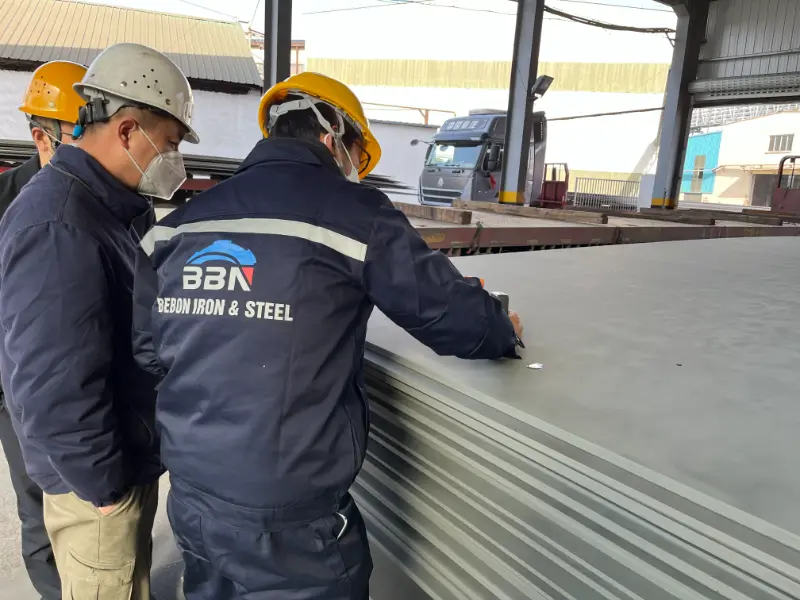
A537 CL1 + 304L Clad Steel Plate
A537 CL1 + 304L Clad Steel Plate – Composite for Pressure Vessels
Technical data for clad steel plate combining ASTM A537 CL1 base with 304L stainless steel cladding. Covers chemical composition, mechanical and physical properties, international equivalents, and typical applications.
Hot roll bonding, explosion cladding, weld overlay
- Phone : +8618037372205
- Email : [email protected]
- WhatsApp: Contact via Whtsapp
- WeChat: +8618037372205
A537 CL1 + 304L Clad Steel Plate Introduction
ASTM A537 CL1 + 304L clad steel plate is a composite material produced by integrally bonding an ASTM A537 Class 1 (CL1) carbon-manganese-silicon steel base to a layer of 304L (UNS S30403) austenitic stainless steel. The base provides high strength and good toughness after normalizing, while the 304L cladding offers excellent corrosion resistance in moderate environments.
The composite plate is primarily used in pressure vessels, storage tanks, and chemical processing equipment where both structural integrity and resistance to corrosive media are required. Typical manufacturing processes include hot-roll bonding, explosion bonding, or weld overlay. The final product conforms to standards such as ASTM A263 or ASTM A264 for stainless steel clad plate.
A537 CL1 + 304L Clad Steel Plate Chemical Composition
The table provides the chemical requirements for both the base metal (ASTM A537 CL1) and the cladding metal (304L to ASTM A240). Actual clad plate chemical analysis is split by layer; the base and clad zones must meet their respective standard limits. Values shown are maximum unless a range is given.
| Element | Required Value (Base - A537 CL1) | Remarks |
|---|---|---|
| C | ≤0.24 | Base metal |
| Si | 0.15–0.50 | Base metal |
| Mn | 0.70–1.35 (thk ≤65 mm); 1.00–1.60 (thk >65–100 mm) | Base metal, depending on plate thickness |
| P | ≤0.035 | Base metal |
| S | ≤0.035 | Base metal |
| Cu | ≤0.35 | Base metal |
| Ni | ≤0.25 | Base metal |
| Cr | ≤0.25 | Base metal |
| Mo | ≤0.08 | Base metal |
| Fe | Balance | Base metal |
| C | ≤0.03 | Cladding - 304L per ASTM A240 |
| Si | ≤1.00 | Cladding - 304L |
| Mn | ≤2.00 | Cladding - 304L |
| P | ≤0.045 | Cladding - 304L |
| S | ≤0.030 | Cladding - 304L |
| Cr | 18.0–20.0 | Cladding - 304L |
| Ni | 8.0–12.0 | Cladding - 304L |
| N | ≤0.10 | Cladding - 304L |
| Fe | Balance | Cladding - 304L |
A537 CL1 + 304L Clad Steel Plate Thermal and Electrical Physical Properties
The physical properties for the composite plate are largely determined by the carbon steel base (A537 CL1), which makes up the bulk thickness. Values for both the base and the 304L cladding are given for reference. The clad plate design typically uses base properties for structural calculations, while considering the thermal expansion difference for temperature cycling.
| Property | Typical Value | Unit | Test Condition / Remarks |
|---|---|---|---|
| Density (ρ) | 7.85 (base) / 8.00 (clad) | g/cm³ | Room temperature |
| Modulus of Elasticity (E) | 200 (base) / 193 (clad) | GPa | Room temperature |
| Shear Modulus (G) | 80 (base) / 77 (clad) | GPa | Room temperature |
| Poisson's Ratio (ν) | 0.30 (base) / 0.29 (clad) | - | Room temperature |
| Thermal Expansion Coefficient (α) | 11.7 (base) / 16.5 (clad) | 10⁻⁶ /K | Mean value 20–100 °C; base and clad values differ significantly |
| Thermal Conductivity (λ) | 52 (base) / 15 (clad) | W/(m·K) | At 100 °C |
| Specific Heat Capacity | 460 (base) / 500 (clad) | J/(kg·K) | Room temperature |
| Electrical Resistivity (ρ_e) | 0.15 (base) / 0.72 (clad) | µΩ·m | Room temperature |
A537 CL1 + 304L Clad Steel Plate Mechanical Properties
Mechanical properties of the clad plate are primarily governed by the base metal (A537 CL1), per ASTM A263/A264 requirements. The cladding layer does not contribute to tensile strength. The table lists base metal tensile and impact properties (typical specification values for plates ≤65 mm thick) and the minimum shear strength at the clad interface.
| Property | Required Value | Unit | Test Condition |
|---|---|---|---|
| Yield Strength (ReH) | ≥ 345 | MPa | Room temperature, for base metal thickness ≤65 mm |
| Tensile Strength (Rm) | 485–620 | MPa | Room temperature, for base metal thickness ≤65 mm |
| Elongation A (50 mm gauge) | ≥ 22 | % | Base metal, thickness ≤65 mm |
| Impact Energy (KV₂) | ≥ 27 (typically supplementary S3) | J | At -20 °C or as agreed; Charpy V-notch, transverse |
| Bend Test | No cracks or openings in clad; bend angle 180° | - | Guided bend; diameter per A263/A264; usually 2T for base and 4T for clad |
| Shear Strength (clad interface) | ≥ 140 | MPa | Per ASTM A264, applicable to explosion-bonded or roll-bonded clad |
A537 CL1 + 304L Clad Steel Plate Fully Equivalent Material Standards and Substitute Grades
| Country/Region | Standard | Grade | Remarks |
|---|---|---|---|
| USA | ASTM A263 / A264 | A537 CL1 + 304L (SA-537 Class 1 base, SA-240 304L clad) | Formally specified clad plate; this is the direct product designation |
| Europe | EN 10028-2 + EN 10028-7 | P355GH + 1.4307 (approx. ASME SA-516 Gr. 70) | P355GH (base) similar to A516 Gr.70, not identical to A537 CL1; often used when ASME and PED dual stamp is required |
| China | GB/T 8165 | Q345R + S30403 | Mechanical base similar to A537 CL1 but with lower guaranteed yield; the combination is commonly used for Chinese pressure equipment |
A537 CL1 + 304L Clad Steel Plate Application Introduction
The A537 CL1 + 304L clad plate combines high strength and good toughness with adequate corrosion resistance in many chemical environments. The base steel, after normalizing, provides reliable performance in pressure vessel service from moderate to low temperatures (Typically down to -30 °C with impact test). The 304L cladding protects against oxidation and a wide range of corrosive solutions, reducing life-cycle costs by avoiding solid stainless steel construction.
- Pressure equipment design often uses the base metal mechanical properties and assumes no strength contribution from the clad.
- Fabrication requires careful attention to weld both the structural (carbon steel) and overlay (stainless) without cross-contamination.
- Typical thickness range: base 12–100 mm, clad 2–6 mm, depending on service conditions.
Product Applications: Pressure vessels (coke drums, separators, reactors), Storage tanks for corrosive chemicals, Heat exchanger shells and channels, Digesters and bleaching towers in pulp mills, Seawater cooling water systems, Sour service equipment in refining
Processed into products: Cylindrical shell courses and formed heads of pressure vessels, Tube sheets for heat exchangers, Separator plates in multi-chamber vessels, Transition joints (carbon steel to stainless steel pipe), Flanges with corrosion resistant gasket faces, Internal structural components that require cleanable surface
Application industries: Oil & Gas (offshore and onshore), Petrochemical, Chemical processing, Power generation (high-temperature water circuits), Desalination, Fertilizer, Pulp & paper
A537 CL1 + 304L Clad Steel Plate Similar / Alternative Material Recommendations
| Country/Region | Standard | Grade | Remarks |
|---|---|---|---|
| USA | ASTM A263 / A264 | A516 Gr. 70 + 304L | Base has lower strength (min. 260 MPa yield) but excellent weldability; suitable for moderate conditions |
| USA | ASTM A263 / A264 | A537 CL2 + 304L | Higher strength base (min. 415 MPa yield); quenched and tempered; for thicker wall pressure vessels |
| USA | ASTM A263 / A264 | A537 CL1 + 316L | Use when higher corrosion resistance (molybdenum addition) is required; 316L cladding instead of 304L |
| Japan | JIS G3601 | SUS304L clad on SM490B | SM490B base steel (min. 325 MPa yield) similar to A537 CL1; common in Japanese pressure vessel fabrication |
Notes:
- Actual clad plate mechanical properties depend on base plate thickness; values in tables are illustrative for ≤65 mm thickness. For thicker base plates, mechanical test requirements may be adjusted per ASTM A537.
- Intergranular corrosion resistance of 304L cladding is usually verified by ASTM A262 Practice E (Strauss) test after sensitizing heat treatment at 675°C, as required by ASTM A263/A264.
- Thermal stress calculations should account for the differential expansion between base and clad during heating/cooling; design codes such as ASME VIII-2 may require assessment.
- Clad plate can be supplied with mill certificate showing chemical analysis, tensile (base), impact (base), shear strength, and corrosion test results.
- Share



