
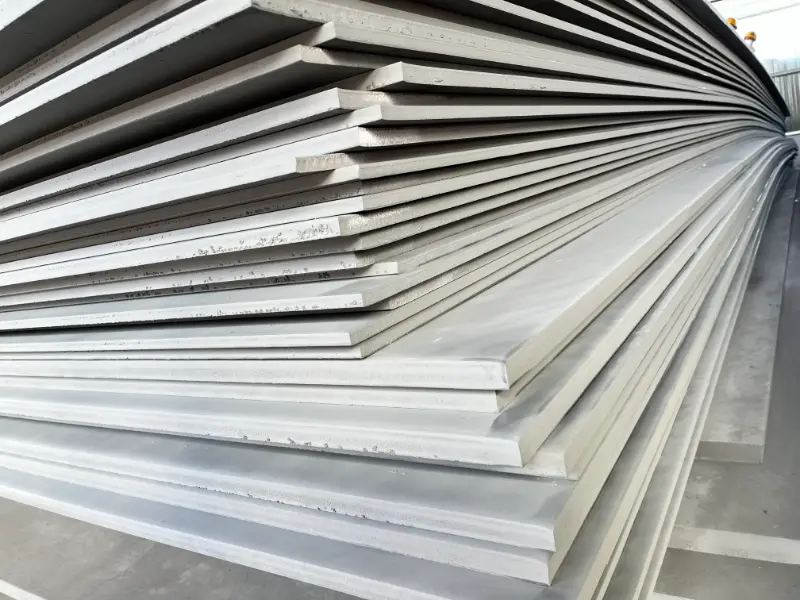
S355JR+304 Clad Steel Plate
S355JR+304 Clad Steel Plate: High-Strength Carbon Steel Backer with 304 Stainless Corrosion Barrier
Explore the performance of S355JR+304 clad steel plate, engineered to provide the mechanical strength of EN 10025 S355JR structural steel and the excellent corrosion resistance of 304 (1.4301) stainless steel. Ideal for pressure vessels, chemical storage, and marine structures.
Hot rolling, hot forming, cold bending, welding (with appropriate dissimilar‑metal welding procedures), machining
- Phone : +8618037372205
- Email : [email protected]
- WhatsApp: Contact via Whtsapp
- WeChat: +8618037372205
S355JR+304 Clad Steel Plate Introduction
S355JR+304 clad steel plate is a bimetallic composite material manufactured by roll bonding, explosive welding, or overlaying a 304 stainless steel layer onto a load-bearing S355JR carbon-manganese structural steel substrate. This combination delivers:
- High strength and toughness from the S355JR backing (minimum yield 355 MPa), ensuring structural integrity under static and dynamic loads.
- Superior corrosion resistance from the 304 (UNS S30400/1.4301) cladding, which withstands oxidizing acids, organic chemicals, and atmospheric exposure.
- Cost efficiency by reducing the use of solid stainless steel; the thin cladding layer (typically 2–5 mm) replaces expensive solid alloys while maintaining full contact with aggressive media.
- Excellent weldability and formability common to both base and clad metals, enabling conventional fabrication processes with appropriate filler metals.
Typical total thickness ranges from 5 mm to 50 mm and beyond, with cladding ratio usually between 5% and 20% of total thickness. The bond integrity is guaranteed by a minimum shear strength (≥200 MPa) as per EN 13479 or equivalent standards.
S355JR+304 Clad Steel Plate Chemical composition – typical for base S355JR and clad 304
The clad plate consists of two distinct alloys: the base metal S355JR conforming to EN 10025‑2 (ladle analysis), and the cladding layer 304 conforming to EN 10088‑2 (austenitic stainless steel). The table lists the permissible ranges for major elements. For the clad layer, carbon ≤ 0.07% and chromium 17.5–19.5% provide corrosion resistance. Nitrogen is not intentionally added but may be present in residuals. Phosphorus and sulfur are controlled to low levels for both metals.
| Element | Nominal value (Base / Clad) | Remarks |
|---|---|---|
| C | ≤ 0.24 / ≤ 0.07 | Base (S355JR) / Clad (304) |
| Si | ≤ 0.55 / ≤ 1.00 | Base / Clad |
| Mn | ≤ 1.60 / ≤ 2.00 | Base / Clad |
| P | ≤ 0.035 / ≤ 0.045 | Base / Clad |
| S | ≤ 0.035 / ≤ 0.030 | Base / Clad |
| Cu | ≤ 0.55 / – | Base only; clad residual Cu ≤ 0.50 typical |
| Cr | ≤ 0.30 / 17.5 – 19.5 | Base / Clad |
| Ni | – / 8.0 – 10.5 | Clad only; base residual Ni ≤ 0.30 |
| N | ≤ 0.012 / ≤ 0.11 | Base / Clad |
| Mo | – / – | Not specified for 304 |
| Nb | ≤ 0.05 / – | Base microalloy (optional) |
| Ti | ≤ 0.05 / – | Base microalloy (optional) |
| V | ≤ 0.12 / – | Base |
| Al | ≥ 0.020 (total) / – | Base (if fully killed) |
S355JR+304 Clad Steel Plate Thermal and electrical properties
The overall physical behaviour of the clad plate is governed predominantly by the base metal S355JR because of its much larger thickness fraction. However, during thermal cycling the difference in expansion coefficients (α) between carbon steel (~12 ×10⁻⁶ K⁻¹) and 304 stainless steel (~17.3 ×10⁻⁶ K⁻¹) must be considered in design to avoid interfacial stresses. Values are given for the base metal first, followed by the clad layer where relevant.
| Property | Typical value | Unit | Condition / Reference |
|---|---|---|---|
| Density (ρ) | 7850 (base) / 8000 (clad) | kg/m³ | 20 °C |
| Elastic modulus (E) | 210 (base); 200 (clad) | GPa | 20 °C, static |
| Shear modulus (G) | 81 (base); 77 (clad) | GPa | Calculated from E, ν |
| Poisson's ratio (ν) | 0.29 (base); 0.30 (clad) | – | Room temperature |
| Thermal expansion (α) | 12.0 (base) / 17.3 (clad) | 10⁻⁶ K⁻¹ | 20–200 °C |
| Thermal expansion (α) | 13.5 (base) / 18.4 (clad) | 10⁻⁶ K⁻¹ | 20–500 °C |
| Thermal conductivity (λ) | 52 (base); 15 (clad) | W/(m·K) | 20 °C |
| Specific heat capacity (cp) | 470 (base); 500 (clad) | J/(kg·K) | 20 °C |
| Electrical resistivity (ρe) | 0.22 (base); 0.72 (clad) | µΩ·m | 20 °C |
S355JR+304 Clad Steel Plate Mechanical properties
The mechanical strength of the clad plate is derived from the S355JR substrate, while the cladding contributes negligibly to load‑bearing capacity. Therefore, the tensile and impact properties refer to the base metal, tested on specimens taken from the total thickness (including cladding) after an appropriate heat treatment. Bond shear strength is a mandatory test for clad plates to verify metallurgical integrity; it must meet the minimum requirement of EN 13479 (≥ 200 MPa). Bending tests are performed with the cladding in tension and compression to ensure crack‑free adhesion.
| Property | Required / Typical value | Unit | Test condition | |
|---|---|---|---|---|
| Yield strength (ReH) | ≥ 355 | MPa | For base thickness ≤ 16 mm; transverse specimen | |
| Yield strength (ReH) | ≥ 345 | MPa | Base thickness 16 < t ≤ 40 mm | |
| Yield strength (ReH) | ≥ 335 | MPa | Base thickness 40 < t ≤ 63 mm | |
| Tensile strength (Rm) | 470 – 630 | MPa | Base thickness ≤ 63 mm | |
| Elongation (A) | ≥ 22 | % | 5.65√So gauge length, longitudinal | |
| Impact energy (KV) | ≥ 27 | J | 20 °C, Charpy V‑notch, longitudinal | |
| Impact energy (KV) | ≥ 27 | J | 0 °C (when specified as S355J0) | |
| Bend test (mandrel diameter) | 3a (tensile clad) / 2a (compression clad) | – | 180° bend, a = specimen thickness; no cracks or separation | |
| Bond shear strength | ≥ 200 | MPa | Per ASTM A264 or EN 13479; room temperature | |
| Hardness (base) | ≤ 150 | HB | Typical; not mandatory for S355JR |
S355JR+304 Clad Steel Plate Full equivalent material standards and grades
| Country / Region | Standard | Grade | Remarks |
|---|---|---|---|
| Europe | EN 10025‑2 + EN 10088‑2 | S355JR + 1.4301 | Clad per EN 13479; normalized or as‑rolled |
| USA | ASTM A516 / A516M + ASTM A240 | Gr. 65 + 304 | Clad per ASTM A264; also A516 Gr.60 +304 |
| Japan | JIS G3106 + JIS G4304 | SM490A + SUS304 | Clad per JIS G3601 |
| China | GB/T 3274 + GB/T 4237 | Q345B + 06Cr19Ni10 | Clad per GB/T 8165; also Q355B + S30408 |
S355JR+304 Clad Steel Plate Application Introduction
S355JR+304 clad plate is ideally suited for components that must meet demanding mechanical loads while resisting moderately aggressive environments. The combination allows designers to use the carbon steel for structural support and apply only a thin layer of stainless steel where corrosion resistance is needed.
- Use the cladding on the process‑side (internal) for vessels and tanks.
- Ensure proper weld joint design – typically a stainless steel filler is used for the clad side and carbon‑manganese filler for the base side; a buttering layer of 309L or similar is common at the transition.
- Clad plates can be cold formed to moderate extents; hot forming may require temperature control to avoid sensitization of the 304 layer and to protect the bond interface.
- All clad plates must be ultrasonically tested (100% scanning) after manufacturing to detect any unbonded areas.
Product Applications: Pressure vessels and storage tanks, Process columns and reactors, Shell‑and‑tube heat exchangers (tube sheets, channels), Stack liners and chimneys, Cryogenic vessel jacketing (when impact requirements are met), Ship hulls and cargo tanks for chemicals, Flue‑gas ducts and scrubbers, Hoppers and silos for corrosive solids
Processed into products: Vessel shell courses and heads, Tube sheets for multi‑stream exchangers, Flanges and blind flanges (with clad overlay), Weld overlay repairs on existing equipment, Manways, nozzles, and reinforcement pads, Stiffening rings and support skirts (carbon steel side), Transition joints (clad‑to‑solid stainless or carbon steel piping)
Application industries: Petrochemical and chemical processing, Oil and gas upstream and downstream, Desalination and water treatment, Power generation (flue‑gas desulfurization, heat exchangers), Pulp and paper (digesters, bleach towers), Marine and offshore engineering, Food and beverage processing, Architectural and structural cladding (e.g., bridges with coastal exposure)
S355JR+304 Clad Steel Plate Similar or alternative clad materials for comparable service conditions
| Country / Region | Standard | Grade | Remarks |
|---|---|---|---|
| Europe | EN 10025‑2 / EN 10088‑2 | S355J2+N + 304 | Base with improved low‑temperature toughness (‑20°C) |
| Europe | EN 10025‑3 / EN 10088‑2 | S355NL + 304L | Normalized fine‑grain base + low‑carbon clad for better weldability |
| USA | ASTM A516 / A240 | Gr. 70 + 304L | Higher base strength (485 MPa min) with low‑carbon clad |
| International | Various | S355JR + 316L | Use 316L clad when higher pitting resistance (Mo alloy) is required |
| China | GB/T 713 / GB/T 24511 | Q345R + S30403 | Boiler‑specific base with low‑carbon 304 clad |
Notes:
Welding considerations: Use filler metals ER/ES 309L for the transition layer and ER/ES 308L for the 304 clad cap passes. The base side is welded with ER70S‑6 type fillers. Post‑weld heat treatment (stress relief) may be applied if allowed by the service environment; it should be carried out below the sensitization range (typically 450–850 °C for 304) to avoid intergranular corrosion. Inspection: Bond integrity is verified by 100% ultrasonic test (UT) to the acceptance criteria of EN 13479 or ASTM A264. Bend tests and shear strength tests are performed on production test coupons. Surface finish: The 304 side can be supplied as hot‑rolled (1D), cold‑rolled (2B), or polished if required. For food‑grade applications a pickled and passivated surface is recommended. Ordering specification: When ordering, specify total plate thickness, cladding thickness, base and clad grade, standard for bonding test, and surface condition.
- Share



