
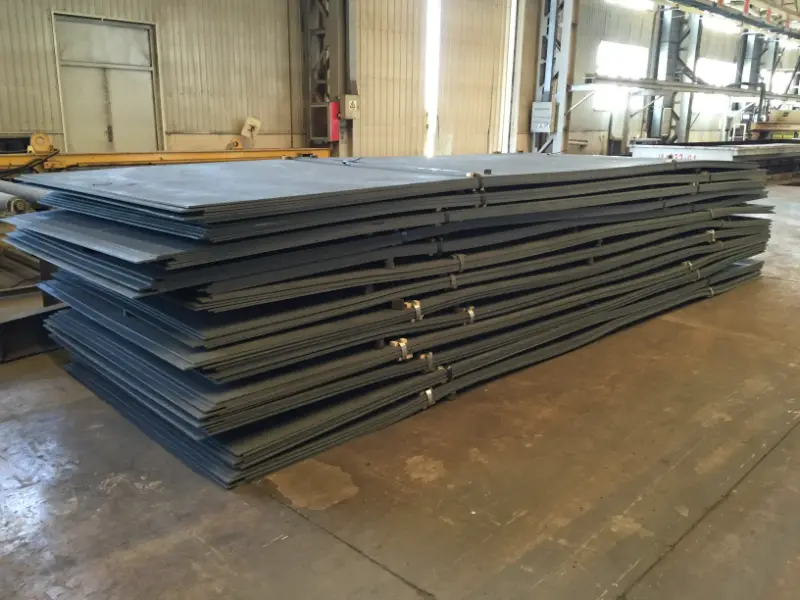
Q345B+304 Clad Steel Plate
Q345B+304 Clad Steel Plate: Composition, Mechanical Properties and Equivalents
This guide provides a comprehensive analysis of Q345B+304 clad steel plate, including chemical composition of both cladding and base layers, mechanical and thermal properties, equivalent standards, and application recommendations for industrial use.
Welding (clad side with 308L/309L filler, base side with common carbon steel electrodes), cutting (plasma, waterjet, shearing), forming (cold and hot bending, rolling), and machining (drilling, milling).
- Phone : +8618037372205
- Email : [email protected]
- WhatsApp: Contact via Whtsapp
- WeChat: +8618037372205
Q345B+304 Clad Steel Plate Introduction
Q345B+304 clad steel plate is a bimetallic composite material produced by explosive welding or hot rolling, combining a load-bearing carbon-manganese structural steel base (Q345B) with a corrosion-resistant austenitic stainless steel cladding (304, equivalent to S30408/06Cr19Ni10).
- Base layer (Q345B): Provides high strength, toughness and weldability, widely used in structural applications.
- Cladding layer (304): Offers excellent resistance to oxidation, intergranular corrosion and a wide range of chemical media, with good low-temperature toughness.
The metallurgical bond between the layers ensures superior mechanical integrity and thermal conductivity. This material is primarily designed for pressure vessels, heat exchangers and chemical tanks where both structural integrity and corrosion resistance are required, significantly reducing the cost compared to solid stainless steel construction.
Q345B+304 Clad Steel Plate Chemical Composition
The chemical composition is reported separately for the cladding layer (304 stainless steel) and the base layer (Q345B low-alloy steel). The clad plate itself does not define a unified melt analysis; instead, each component must meet its respective standard requirements. Cladding 304 (S30408 / 06Cr19Ni10) is an austenitic grade with controlled carbon for corrosion resistance. Base Q345B is a low-alloy structural steel with Mn and microalloying elements (Nb, V, Ti) for high strength and toughness. Product analysis tolerances are per the relevant standards.
| Chemical Element | Standard Value (wt%) | Remarks |
|---|---|---|
| C | ≤0.08 | Cladding layer – SUS304 (S30408) |
| Si | ≤0.75 | Cladding layer |
| Mn | ≤2.00 | Cladding layer |
| P | ≤0.045 | Cladding layer |
| S | ≤0.030 | Cladding layer |
| Cr | 18.00–20.00 | Cladding layer |
| Ni | 8.00–10.50 | Cladding layer |
| N | ≤0.10 | Cladding layer (if specified) |
| C | ≤0.20 | Base layer – Q345B (GB/T 1591) |
| Si | ≤0.50 | Base layer |
| Mn | ≤1.70 | Base layer |
| P | ≤0.035 | Base layer |
| S | ≤0.035 | Base layer |
| Nb | ≤0.07 | Base layer (optional element) |
| V | ≤0.15 | Base layer (optional element) |
| Ti | ≤0.20 | Base layer (optional element) |
| Cr | ≤0.30 | Base layer (residual) |
| Ni | ≤0.30 | Base layer (residual) |
| Cu | ≤0.30 | Base layer (residual) |
Q345B+304 Clad Steel Plate Thermal and Electrical Physical Properties
Physical properties for clad plates are not specified in product standards; the values below are averaged or estimated from constituent materials (Q345B base and 304 cladding) based on a typical 10% cladding thickness ratio. They are provided for engineering calculations. Density (ρ) is close to that of carbon steel due to the dominant thickness of the base layer. Thermal expansion (α) of the composite lies between the two layers, and care must be taken during heat treatment to avoid interfacial stresses. Thermal conductivity (λ) is reduced compared to solid carbon steel due to the lower conductivity of the stainless cladding. Electrical resistivity is slightly higher than that of plain carbon steel. All properties are at room temperature unless specified.
| Property | Typical Value | Unit | Condition / Remarks |
|---|---|---|---|
| Density (ρ) | ~7.85 | g/cm³ | Weighted average (base 7.85, cladding 7.90) |
| Elastic Modulus (E) | ~203 (base), ~193 (cladding) | GPa | At 20°C, base dominates flexural stiffness |
| Shear Modulus (G) | ~78 (base), ~77 (cladding) | GPa | Estimated |
| Poisson's Ratio (ν) | 0.30 (base), 0.30 (cladding) | - | Both layers exhibit similar values |
| Thermal Expansion Coefficient (α) 20–100°C | ~12.0 (base) / ~16.0 (cladding) | 10⁻⁶/K | Cladding higher; design compensates by compressive stress |
| Thermal Expansion Coefficient (α) 20–300°C | ~13.0 (base) / ~17.0 (cladding) | 10⁻⁶/K | Composite effective α ~13.8 based on thickness proportion |
| Thermal Conductivity (λ) | ~40 (base) / ~16 (cladding) | W/(m·K) | At 100°C; effective through-thickness ~35 for 10% clad |
| Specific Heat Capacity (c) | ~480 (base) / ~500 (cladding) | J/(kg·K) | Approximate average 485 J/(kg·K) |
| Electrical Resistivity (ρ_e) | ~0.25 (base) / ~0.72 (cladding) | μΩ·m | Composite resistivity is anisotropic; through-thickness dominated by base layer (~0.3 μΩ·m) |
Q345B+304 Clad Steel Plate Mechanical Properties
The mechanical properties of Q345B+304 clad steel plate are governed by the base metal specification for strength, while shear strength and bend properties are specific to the composite. The tensile test is performed on a full-thickness specimen. Yield strength (ReH) and elongation (A) shall meet the requirements of Q345B for the applicable thickness range (≤16 mm shown). Shear strength (τ) of the metallurgical bond must exceed 200 MPa (GB/T 8165) or 210 MPa (NB/T 47002.1). Bend testing (face and root) is conducted with a specific mandrel diameter without cracking or separation. Impact toughness (KV) at 20°C or 0°C depends on customer specification and base material grade. Values below are typical minimums based on room temperature testing.
| Property | Standard Required Value | Unit | Test Condition |
|---|---|---|---|
| Yield Strength (ReH) | ≥345 | MPa | Q345B base, thickness ≤16 mm, transverse |
| Tensile Strength (Rm) | 470–630 | MPa | Full-clad specimen, room temperature |
| Elongation (A) | ≥21 (for base Q345B, ≤16 mm) | % | Gauge length 5.65√So |
| Shear Strength (τ) | ≥200 (GB/T 8165) / ≥210 (NB/T) | MPa | Bond area, in as-delivered condition |
| Bend Test (Face Bend, cladding in tension) | No cracking or separation, bend angle 180° | - | Mandrel diameter = 2a (a = specimen thickness) |
| Bend Test (Root Bend, base in tension) | No cracking or separation, bend angle 180° | - | Mandrel diameter = 2a (if elongation ≥20%) |
| Impact Energy (KV₂) (Base layer) | ≥34 (longitudinal); ≥27 (transverse) | J | Charpy-V, 20°C, Q345B (optional) |
Q345B+304 Clad Steel Plate Fully Equivalent Material Standards and Substitute Designations
| Country/Region | Standard | Designation / Grade | Remarks |
|---|---|---|---|
| China | GB/T 8165-2008 | S30408+Q345B | Cladding S30408 (06Cr19Ni10) + base Q345B; same as Q345B+304 |
| China | NB/T 47002.1-2009 | Q345R+S30403 | For pressure vessels; cladding 304L variant; Q345R base, comparable to Q345B with controlled impurities |
| USA | ASTM A264 | 304 + A516 Gr.70 | Stainless chromium-nickel clad plate; cladding UNS S30400, base carbon steel A516 Gr.70 (similar strength to Q345B) |
| USA | ASTM A263 | 304 + A572 Gr.50 | Cladding 304, base A572 Gr.50 (YS 345 MPa min, closest equivalent to Q345B) |
| EU | EN 10359 | 1.4301 + S355J2+N | Laser welded / roll bonded clad; cladding 1.4301 (304), base S355J2 (comparable to Q345B) |
| Japan | JIS G3601 | SUS304 + SM490A | Stainless clad steel plate; cladding SUS304, base SM490A (YS 325 MPa min) |
Q345B+304 Clad Steel Plate Application Introduction
The Q345B+304 clad plate combines structural economy with excellent surface protection. It is designed to replace solid stainless steel in large vessels and structural components where the corrosion threat is primarily on the inner surface. By using the clad plate, material cost savings of 40–60% are common. Key design considerations:
- The cladding thickness must withstand corrosion allowance over the design life.
- Heat treatment must be controlled to avoid sigma phase in 304 and maintain bond integrity.
- Welded joints require a transition from stainless filler on the clad side to carbon steel filler on the base side, minimizing dilution.
Product Applications: Pressure vessel shells and heads (ASME Section VIII, GB 150), Heat exchanger tube sheets and channel covers, Chemical storage tanks (above-ground, welded field construction), Clad pipes and fittings for corrosive fluid transport, Autoclaves and digesters with internal stainless lining, Electrolytic cells and pickling tanks, Bridge expansion joints and structural elements in de-icing salt environments
Processed into products: Flanged nozzles and manways with cladding overlay, Baffle plates and support rings inside vessels, Clad thermowells and level switch bodies, Tube sheets drilled for corrosion-resistant heat exchanger tubing, Bolting and gasket seating surfaces machined from the clad side, Repair patches and half-pipe jackets for temperature control
Application industries: Petrochemical: crude oil storage tanks, reactor cladding, Chemical processing: acid storage, crystallizers, tanks for aggressive media, Power generation: flue gas desulfurization (FGD) scrubbers, chimney liners, Water treatment: desalination flash chambers, multi-stage flash evaporators, Pulp & paper: digester vessels, bleach towers, Marine engineering: offshore platform splash zone protection, Food & beverage: large storage silos and processing vats requiring CIP compatibility
Q345B+304 Clad Steel Plate Similar and Substitute Material Recommendations
| Country/Region | Standard | Designation / Grade | Remarks |
|---|---|---|---|
| China | GB/T 8165 | Q235B+304 | Lower base strength (YS 235 MPa); economic alternative for low-pressure vessels |
| China | GB/T 8165 | Q345R+304L (S30403) | Base boiler steel Q345R with improved toughness, cladding low-carbon 304L for better weldability and intergranular corrosion resistance |
| USA | ASTM A264 | 316L + A36 | Higher alloy cladding (2%Mo) for enhanced pitting resistance; base A36 (YS 250 MPa) for mild service |
| EU | EN 10359 | 1.4404 + P355NH | 316L cladding and pressure vessel steel P355NH for elevated temperature use |
| China | NB/T 47002.1 | Q245R+304 | Lower strength base (Q245R) for general chemical equipment; still provides stainless corrosion barrier |
Notes:
Additional considerations:
- Cladding thickness is typically 1.5–6 mm; common ratio tclad/ttotal = 10–20%. Overlaying by weld buildup is possible for local repairs.
- Ultrasonic testing (UT) is mandatory as per GB/T 7734 or equivalent; disbonding allowance is typically ≤3% of area.
- Post-weld heat treatment (PWHT) if required should be below 620°C to avoid sensitization of 304; alternative cladding of 304L or 316L may be specified for PWHT conditions.
- The product can be supplied with mill edges or cut to rectangular shape; surface finish of clad side can be No.1, 2B, or polished as per customer requirement.
- Share



