
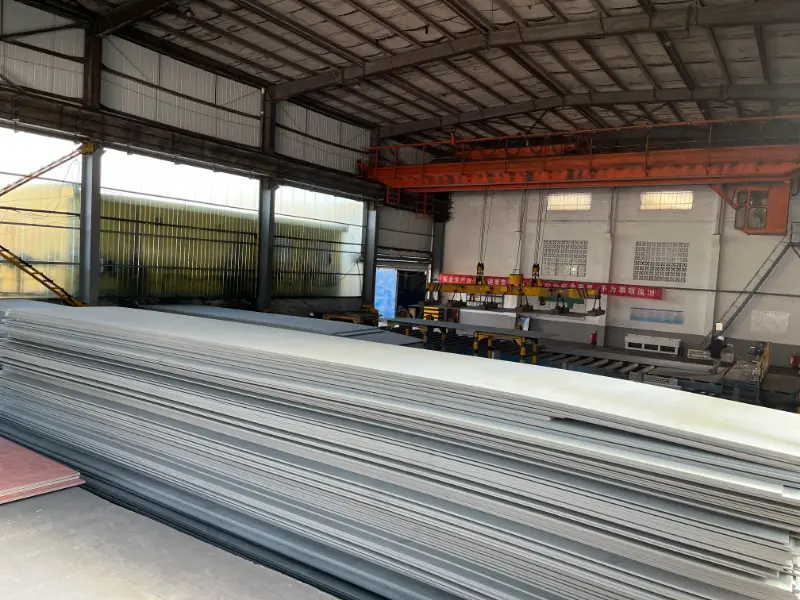
S420MC High-Strength Low-Alloy Steel for Cold Forming per EN 10149-2
S420MC High-Strength Low-Alloy Steel for Cold Forming per EN 10149-2: Automotive Structure Plate
Complete material data sheet for S420MC microalloyed steel in accordance with EN 10149-2, covering chemical composition, mechanical and physical properties, international equivalents, and typical applications in automobile structural components.
Suitable for cold forming (bending, drawing, stamping, roll forming), welding (MIG/MAG, resistance spot welding), and limited ambient temperature hot forming.
- Phone : +8618037372205
- Email : [email protected]
- WhatsApp: Contact via Whtsapp
- WeChat: +8618037372205
S420MC High-Strength Low-Alloy Steel for Cold Forming per EN 10149-2 Introduction
S420MC is a thermomechanically rolled, high-strength low-alloy (HSLA) steel grade defined in EN 10149-2 for hot-rolled flat products intended for cold forming. With a minimum yield strength of 420 MPa, it combines excellent formability and weldability with high structural strength, making it ideal for weight-optimised automotive chassis and safety components.
- Microalloyed with niobium, vanadium, or titanium for grain refinement and precipitation hardening.
- Fine-grained microstructure ensures consistent mechanical properties even after cold deformation.
- Supplied as plates, coils, and cut lengths in pickled and oiled condition, suitable for stamping, bending, roll forming, and welding.
S420MC High-Strength Low-Alloy Steel for Cold Forming per EN 10149-2 Chemical Composition
Table lists ladle analysis limits for EN 10149-2 S420MC. Maximum values unless a range is indicated. The steel is microalloyed with Nb, V, or Ti to achieve the required strength level while maintaining good weldability. Total aluminium content is specified for deoxidation. Other residual elements (Ni, Cr, Cu, Mo) are typically present only as impurities and not intentionally added.
| Chemical Element | Standard Value (wt%) | Remarks |
|---|---|---|
| C | ≤ 0.12 | Carbon |
| Si | ≤ 0.50 | Silicon |
| Mn | ≤ 1.60 | Manganese |
| P | ≤ 0.025 | Phosphorus |
| S | ≤ 0.015 | Sulphur |
| Al total | ≥ 0.015 | Total aluminium |
| Nb | ≤ 0.09 | Niobium (optional microalloy) |
| V | ≤ 0.20 | Vanadium (optional microalloy) |
| Ti | ≤ 0.15 | Titanium (optional microalloy) |
| Other (Ni, Cr, Cu, Mo) | ≤ 0.30 each (typical) | Residual elements, not intentionally added |
S420MC High-Strength Low-Alloy Steel for Cold Forming per EN 10149-2 Physical Properties
The values listed are typical for low-carbon microalloyed steels similar to S420MC and are not directly taken from EN 10149-2 (which does not specify physical properties). They are intended as engineering guidance for design calculations. The density, elastic modulus, and thermal expansion are particularly relevant for structural analysis and welding.
| Property | Typical Value | Unit | Remarks / Test Condition |
|---|---|---|---|
| Density (ρ) | 7.85 | g/cm³ | At 20 °C |
| Elastic modulus (E) | 210 | GPa | At 20 °C, tension |
| Shear modulus (G) | ≈ 81 | GPa | Calculated from E and ν |
| Poisson's ratio (ν) | 0.3 | — | In elastic range |
| Thermal expansion coefficient (α) | 11.5 – 12.5 | 10⁻⁶/K | 20 °C to 100 °C |
| Thermal conductivity (λ) | 50 – 55 | W/(m·K) | At 20 °C |
| Specific heat capacity (c) | ≈ 460 | J/(kg·K) | At 20 °C |
| Electrical resistivity (ρₑ) | 0.20 – 0.25 | µΩ·m | At 20 °C |
S420MC High-Strength Low-Alloy Steel for Cold Forming per EN 10149-2 Mechanical Properties
Mechanical properties are determined from transverse test pieces according to EN ISO 6892-1. The values depend on nominal thickness (t). The upper yield strength (ReH) and elongation after fracture (A or A80) are guaranteed. The bend test demonstrates cold formability. Impact toughness is not mandatory in EN 10149-2 unless specified, but typical Charpy-V values at -20°C exceed 27 J for thicknesses ≤10 mm.
| Property | Standard Value | Unit | Test Condition / Thickness |
|---|---|---|---|
| Upper yield strength (ReH) | ≥ 420 | MPa | Nominal thickness t ≤ 12 mm |
| Upper yield strength (ReH) | ≥ 400 | MPa | Nominal thickness 12 mm < t ≤ 20 mm |
| Upper yield strength (ReH) | ≥ 380 | MPa | Nominal thickness 20 mm < t ≤ 25 mm |
| Tensile strength (Rm) | 480 – 620 | MPa | All thicknesses t ≤ 25 mm |
| Elongation after fracture (A) | ≥ 19 | % | Thickness t ≤ 12 mm, gauge length L0 = 5.65√S0 |
| Elongation after fracture (A) | ≥ 20 | % | Thickness 12 mm < t ≤ 20 mm, L0 = 5.65√S0 |
| Elongation after fracture (A) | ≥ 21 | % | Thickness 20 mm < t ≤ 25 mm, L0 = 5.65√S0 |
| Bend test (180°) | mandrel diameter ≤ 0.5 t | — | t ≤ 10 mm (recommended) |
| Bend test (180°) | mandrel diameter ≤ 1.0 t | — | 10 mm < t ≤ 20 mm (recommended) |
S420MC High-Strength Low-Alloy Steel for Cold Forming per EN 10149-2 Direct International Equivalent Grades
| Country / Region | Standard | Grade | Remarks |
|---|---|---|---|
| Europe | EN 10149-2 | S420MC | Base standard, thermomechanically rolled microalloyed steel for cold forming |
| International (ISO) | ISO 6930-2 | HR420 | Identical concept, high yield strength for cold forming |
| Germany (Automotive) | VDA 239-100 | HR420MC | Direct technical equivalent for automotive sheet |
| USA | ASTM A1011/A1011M | HSLAS Grade 420 | Higher Mn, wider tensile range, elongation requirements differ; check thickness range |
| Japan | JIS G 3135 | SPFC 490 | Similar strength level, different chemical limits; often used for cold-formed structural parts |
S420MC High-Strength Low-Alloy Steel for Cold Forming per EN 10149-2 Application Introduction
S420MC is specifically designed for cold-formed structural components in the automotive industry. Its favourable strength-to-weight ratio and consistency after processing make it suitable for safety-critical applications. The steel can be galvanized for corrosion protection without loss of strength.
- Typical fabrication: stamping, bending, roll forming, welding (laser and spot welding produce good results).
- Surface protection: often used with zinc coating (galvanized or electrogalvanized) or cataphoretic painting.
Product Applications: Automobile chassis frames and subframes, Body-in-white (BIW) reinforcements, Suspension control arms and torsion beams, Seat backrest frames and rails, Bumper beams and energy-absorbing members, Cross members, tunnel reinforcements, and floor beams, Engine and transmission mounts
Processed into products: Lower and upper control arms, Rear and front axle beams, Door intrusion beams (side impact protection), Bumper reinforcement bars, Seat belt anchor brackets, Longitudinal rails and cross members, Spring bracket attachments, Steering knuckles (weld-formed)
Application industries: Passenger car and light commercial vehicle manufacturing, Heavy truck and bus frame production, Agricultural and construction machinery, Railway rolling stock (structural interior parts), General engineering for lightweight welded structures
S420MC High-Strength Low-Alloy Steel for Cold Forming per EN 10149-2 Closely Related or Alternative Grades
| Country / Region | Standard | Grade | Remarks |
|---|---|---|---|
| Europe | EN 10149-2 | S355MC | Lower yield strength (355 MPa) but better formability; for less demanding structural parts. |
| Europe | EN 10149-2 | S460MC | Higher yield strength (460 MPa), reduced formability; for higher-stress applications. |
| Europe | EN 10149-2 | S500MC | Even higher strength (500 MPa), often used in weight-reduced chassis components. |
| Europe (DIN legacy) | DIN 16020 | QStE 420 TM | Equivalent concept under older German standard; nearly identical chemistry and properties. |
| Japan | JIS G 3113 | SAPH 440 | Hot-rolled automobile structural steel with lower yield (305 MPa min); may substitute in less demanding parts. |
| China | GB/T 3273 | HR420MC | Adopted from ISO 6930-2; equivalent to S420MC for domestic automotive use. |
Notes:
- For thicknesses below 3 mm, refer to EN 10149-2 for A80 elongation requirements and potential adjustments to minimum yield strength.
- The steel is fully killed and fine-grained, suitable for zinc coatings without embrittlement, but hydrogen-induced cracking precautions are recommended after heavy acid pickling.
- Welding parameters should follow common HSLA steel practices (preheat usually not required for thicknesses up to 15 mm).
- Microalloying elements may cause age hardening after heavy cold forming; stress relief annealing may be necessary if post-forming fatigue life is critical.
- Share



