
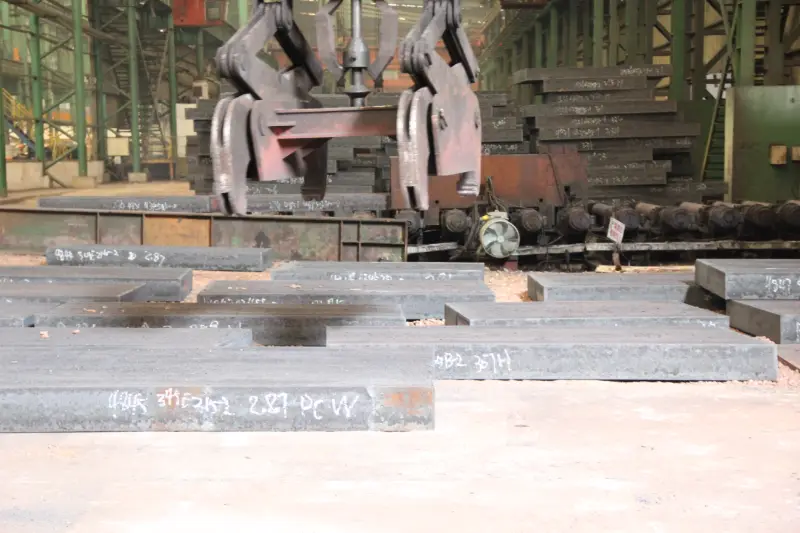
A516Gr70+304 Clad Steel
A516Gr70+304 Clad Steel: Superior Corrosion Resistance for Pressure Vessels
Explore the properties and applications of A516 Grade 70 carbon steel clad with 304 stainless steel, designed for pressure vessels and corrosive environments. Compliant with ASTM A264.
Explosion welding, roll bonding, hot rolling, welding, forming, machining
- Phone : +8618037372205
- Email : [email protected]
- WhatsApp: Contact via Whtsapp
- WeChat: +8618037372205
A516Gr70+304 Clad Steel Introduction
The A516Gr70+304 clad steel plate is a composite material consisting of a base layer of ASTM A516 Grade 70 carbon steel and a cladding layer of Type 304 (UNS S30400) austenitic stainless steel. It is manufactured by explosion welding, roll bonding, or hot rolling processes, ensuring a metallurgical bond between the two layers. This clad plate combines the high strength, toughness, and cost-effectiveness of the carbon steel base with the superior corrosion and oxidation resistance of the stainless steel cladding. Key Features:
- Base metal meets ASTM A516 Grade 70 requirements for pressure vessel applications.
- Cladding provides excellent resistance to a wide range of chemical environments.
- Conforms to ASTM A264 (Standard Specification for Stainless Chromium-Nickel Steel-Clad Plate).
- Offers a significant cost advantage over solid stainless steel while maintaining corrosion integrity on the wetted side.
A516Gr70+304 Clad Steel Chemical Composition
The table below lists the typical chemical composition requirements for both the carbon steel base (A516 Grade 70) and the stainless steel cladding (304). Values are sourced from the respective ASTM standards.
| Element | Standard Value | Remarks |
|---|---|---|
| C | Base: ≤0.31 | Clad: ≤0.08 | Base per A516; Clad per A240 |
| Mn | Base: 0.85–1.20 | Clad: ≤2.00 | |
| Si | Base: 0.15–0.40 | Clad: ≤0.75 | |
| P | Base: ≤0.035 | Clad: ≤0.045 | |
| S | Base: ≤0.035 | Clad: ≤0.030 | |
| Cr | Base: — | Clad: 18.0–20.0 | Only in cladding |
| Ni | Base: — | Clad: 8.0–10.5 | Only in cladding |
| N | Base: — | Clad: ≤0.10 | Only in cladding |
A516Gr70+304 Clad Steel Thermal and Electrical Physical Properties
Physical properties are listed separately for the base metal (A516 Gr70) and the cladding layer (Type 304), as no unified whole-plate values are defined. Values are typical at room temperature unless otherwise noted.
| Property | Standard Requirement | Unit | Condition |
|---|---|---|---|
| Density (ρ) | Base: 7.85 | Clad: 8.00 | g/cm³ | Room temperature |
| Elastic Modulus (E) | Base: ~210 | Clad: ~193 | GPa | Room temperature |
| Shear Modulus (G) | Base: ~80 | Clad: ~78 | GPa | Room temperature |
| Poisson's Ratio (ν) | Base: 0.29 | Clad: 0.30 | — | Room temperature |
| Thermal Expansion (α) | Base: 11.7 | Clad: 16.0 | µm/m·°C | 0–100 °C |
| Thermal Conductivity (λ) | Base: 52 | Clad: 16.2 | W/m·K | At 100 °C |
| Specific Heat Capacity | Base: 486 | Clad: 500 | J/kg·K | Room temperature |
| Electrical Resistivity (ρ_e) | Base: 0.15 | Clad: 0.72 | µΩ·m | Room temperature |
A516Gr70+304 Clad Steel Mechanical Properties
Mechanical properties are primarily governed by the base metal A516 Grade 70, with additional bonding requirements per ASTM A264. Testing is performed on full-thickness clad plate or on base metal after cladding removal. Bond integrity is verified by shear testing.
| Property | Standard Requirement | Unit | Condition |
|---|---|---|---|
| Yield Strength (ReH) | ≥260 | MPa | Base metal, thickness ≤50 mm |
| Tensile Strength (Rm) | 485–620 | MPa | Base metal, thickness ≤50 mm |
| Elongation (A) | ≥21 | % | Base metal, gauge 50 mm, thickness ≤50 mm |
| Shear Strength (Clad Bond) | ≥140 | MPa | Shear test per ASTM A264 |
| Bend Test (Clad Plate) | No cracking or delamination | — | 180°, d=4t (full thickness), per ASTM A264 |
A516Gr70+304 Clad Steel Completely Equivalent Material Standards and Substitutable Grades
| Country/Region | Standard | Grade | Remarks |
|---|---|---|---|
| USA | ASTM A264/A264M | 304 / A516 Gr70 | Primary specification |
| USA | ASME SA-264 / SA-516 | 304 / SA-516 Gr70 | Boiler & pressure vessel code |
| Europe | EN 13445-2 / EN 10028-2 | P355GH + X5CrNi18-10 (1.4301) clad | Equivalent backing and austenitic cladding |
| Japan | JIS G3601 / G3103 | SUS304 clad / SB480 or similar carbon backing | Clad plate standard |
A516Gr70+304 Clad Steel Application Introduction
A516Gr70+304 clad steel plate is engineered for applications that demand structural integrity under pressure combined with resistance to aggressive media. It is cost-effective by placing corrosion resistance only where needed. Key applications include:
Product Applications: Pressure vessels, Storage tanks, Heat exchangers, Reactors, Distillation columns, Storage silos
Processed into products: Shells of pressure vessels, Tube sheets for heat exchangers, Clad flanges, Transition joints, Clad heads, Process piping segments
Application industries: Oil & Gas, Chemical Processing, Power Generation, Food & Beverage, Shipbuilding, Pulp & Paper
A516Gr70+304 Clad Steel Similar or Alternative Materials Recommendation
| Country/Region | Standard | Grade | Remarks |
|---|---|---|---|
| USA | ASTM A264 | 304L / A516 Gr70 | Lower carbon cladding for improved weldability |
| USA | ASTM A264 | 316L / A516 Gr70 | Molybdenum-bearing cladding for higher pitting resistance |
| USA | ASTM A240 | 304 (solid plate) | Full stainless steel, lower strength but complete corrosion resistance |
| USA | ASTM A263 | 410S / A516 Gr70 | Martensitic stainless clad for moderate corrosion and higher hardness |
Notes:
During fabrication, appropriate welding procedures must be followed to maintain the corrosion resistance of the cladding. A transition layer may be required between the carbon steel and stainless steel weld metals. Post-weld heat treatment (if applied) should consider the thermal expansion mismatch and sensitization range of the 304 cladding. Ultrasonic testing per ASTM A264 is mandatory to ensure bond integrity. Always refer to the full material data sheet and project specifications before use.
- Share



