
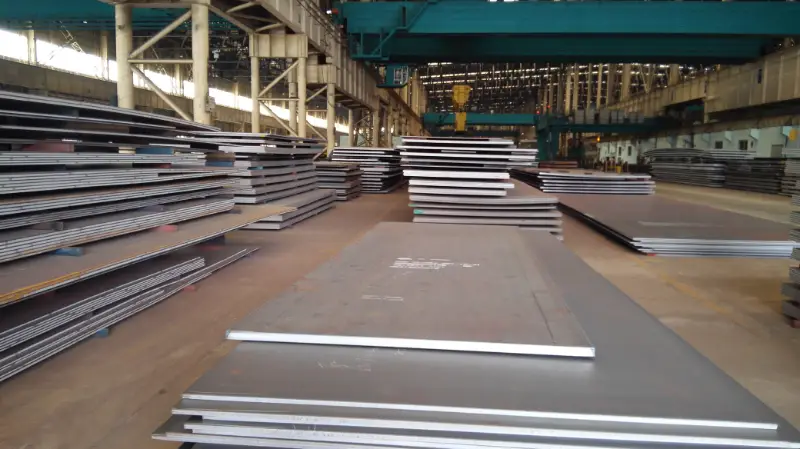
QStE460TM High-Strength Low-Alloy Steel
QStE460TM High-Strength Low-Alloy Steel for Cold Forming per SEW 092
Comprehensive material data for QStE460TM, a fine-grain structural steel for automobile structural components, including chemical composition, mechanical properties, thermal and electrical characteristics, international equivalents, and application guidance.
Cold forming, bending, welding, punching, machining (limited)
- Phone : +8618037372205
- Email : [email protected]
- WhatsApp: Contact via Whtsapp
- WeChat: +8618037372205
QStE460TM High-Strength Low-Alloy Steel Introduction
QStE460TM is a hot-rolled, thermomechanically rolled fine-grain structural steel specified in SEW 092 (now superseded by EN 10149-2). It offers a minimum yield strength of 460 MPa and excellent cold formability, making it ideal for lightweight automobile structural parts. The steel is microalloyed with niobium, vanadium, and titanium to achieve high strength and good toughness at low temperatures. It is supplied in the as-rolled plus thermomechanical rolled condition, with a controlled cooling process that refines the grain structure. Typical applications include chassis frames, cross members, longitudinal beams, and suspension arms. The material can be welded using common methods, and its fine grain size ensures consistent properties even after forming.
QStE460TM High-Strength Low-Alloy Steel Chemical Composition
The chemical composition conforms to SEW 092 for QStE460TM, which aligns closely with EN 10149-2 S460MC. The steel is microalloyed with niobium, vanadium, and titanium to ensure high strength and fine grain size. Maximum limits are specified for detrimental elements like sulfur and phosphorus. Carbon equivalent values are controlled to ensure good weldability.
| Element | Standard Value (max. or range) | Remarks |
|---|---|---|
| C | ≤ 0.12% | Maximum for good weldability and formability |
| Si | ≤ 0.50% | Contributes to strength, limited for surface quality |
| Mn | ≤ 1.60% | Solid solution strengthening; higher levels for thick products |
| P | ≤ 0.025% | Maximum for toughness |
| S | ≤ 0.015% | Maximum to prevent hot shortness |
| Al | ≥ 0.015% | Minimum for grain refinement (acid-soluble aluminum) |
| Nb | ≤ 0.09% | Microalloying for precipitation strengthening and grain refinement |
| V | ≤ 0.20% | Optional microalloying for strength |
| Ti | ≤ 0.15% | Microalloying for grain refinement and precipitation hardening |
| Nb + V + Ti | ≤ 0.22% | Combined microalloying limit |
QStE460TM High-Strength Low-Alloy Steel Thermal and Electrical Physical Properties
These physical properties are representative for fine-grain HSLA steels with a ferrite-pearlite microstructure. The values are influenced by the exact chemical composition and processing route. They are provided for engineering calculations such as heat transfer, thermal expansion, and electrical conductivity. Density is typical of carbon-manganese steels; elastic constants are typical for structural steels.
| Property | Typical Value | Unit | Condition / Temperature |
|---|---|---|---|
| Density (ρ) | 7.85 | g/cm³ | Ambient temperature |
| Elastic Modulus (E) | 210 | GPa | Ambient temperature |
| Shear Modulus (G) | 81 | GPa | Ambient temperature |
| Poisson's Ratio (ν) | 0.30 | — | — |
| Thermal Expansion Coefficient (α) | 12.0 × 10⁻⁶ | /K | 20 – 100 °C |
| Thermal Expansion Coefficient (α) | 12.5 × 10⁻⁶ | /K | 20 – 200 °C |
| Thermal Conductivity (λ) | 50 | W/(m·K) | 20 °C |
| Specific Heat Capacity (cₚ) | 460 | J/(kg·K) | 20 °C |
| Electrical Resistivity (ρ_e) | 0.18 | µΩ·m | 20 °C |
QStE460TM High-Strength Low-Alloy Steel Mechanical Properties
Mechanical properties are guaranteed in the delivery condition (thermomechanically rolled). Values depend on product thickness. The minimum yield strength of 460 MPa is valid for thicknesses up to 16 mm. Tensile testing is performed on transverse specimens. For thin sheets, elongation is measured on an 80 mm gauge length (A80), while for thicker material, a proportional gauge length (A5) may be used. Impact toughness is specified at -20°C to ensure safe performance in cold climates.
| Property | Value | Unit | Test Condition |
|---|---|---|---|
| Yield Strength (ReH) | ≥ 460 | MPa | Thickness ≤ 16 mm |
| Yield Strength (ReH) | ≥ 420 | MPa | Thickness > 16 mm ≤ 40 mm |
| Tensile Strength (Rm) | 520 – 670 | MPa | Thickness ≤ 16 mm |
| Tensile Strength (Rm) | 500 – 650 | MPa | Thickness > 16 mm ≤ 40 mm |
| Elongation (A80) | ≥ 17 | % | Thickness ≤ 3 mm, gauge length 80 mm |
| Elongation (A5) | ≥ 19 | % | Thickness > 3 mm ≤ 16 mm, proportional gauge length |
| Elongation (A5) | ≥ 17 | % | Thickness > 16 mm ≤ 40 mm |
| Bend Test (180°) | Mandrel diameter ≤ 0.5 × thickness | — | No cracks, thickness ≤ 16 mm |
| Charpy Impact Energy (KV) at -20°C | ≥ 40 (longitudinal); ≥ 27 (transverse) | J | Standard V-notch, average of 3 specimens |
QStE460TM High-Strength Low-Alloy Steel Direct Equivalent Standards and Substitutable Grades
| Country/Region | Standard | Grade | Remarks |
|---|---|---|---|
| Europe | EN 10149-2 | S460MC | Identical chemical and mechanical requirements; the direct successor to SEW 092 QStE460TM |
| International | ISO 6930-2 | FeE460TM | Equivalent thermomechanically rolled steel; slightly broader composition limits |
| Germany | DIN EN 10149-2 | S460MC | Current standard adopted in Germany, replaces SEW 092 |
QStE460TM High-Strength Low-Alloy Steel Application Introduction
QStE460TM / S460MC is specifically designed for cold-formed automobile structural parts. It combines high strength with good elongation, allowing complex shapes to be produced by bending, drawing, or roll forming. The steel exhibits excellent weldability under appropriate procedures and can be joined by resistance spot welding, MIG/MAG welding, and laser welding. Low-temperature toughness makes it suitable for safety-critical components operating in cold climates. Typical processing routes include decoiling, blanking, cold forming, and assembly into chassis systems.
Product Applications: Chassis frames, Cross members and longitudinal beams, Suspension control arms and brackets, Axle housings and subframes, Bumper reinforcement beams, Wheel rims and wheel discs (when specified for such use)
Processed into products: Pressed and welded chassis assemblies, Cold-formed flanges and U-channels, Shock absorber mounts, Engine cradles, Trailer hitches and towing devices, Structural reinforcements in body-in-white
Application industries: Automotive (passenger cars, light commercial vehicles), Heavy truck and trailer manufacturing, Agricultural equipment, Construction machinery, Railway vehicle components
QStE460TM High-Strength Low-Alloy Steel Similar / Alternative Materials with Comparable Performance
| Country/Region | Standard | Grade | Remarks |
|---|---|---|---|
| Europe | EN 10149-2 | S500MC | Higher yield strength (500 MPa) but otherwise similar formability; may require greater forming forces |
| Europe | EN 10149-2 | S550MC | Even higher strength (550 MPa) for lighter weight designs; reduced elongation |
| Japan | JIS G 3134 | SPFH590 | Hot-rolled high-strength steel sheet for automobile structural uses; tensile strength ≥ 590 MPa, comparable formability |
| USA | ASTM A1011 / A1011M | HSLAS Grade 70 (480 MPa) | High-strength low-alloy steel with minimum yield 480 MPa; similar application but slightly higher strength and different chemical approach |
| China | GB/T 20887.2 | HR460MC | Chinese hot-rolled advance high-strength steel; similar concept but may differ in microalloying details |
Notes:
Welding: Due to the low carbon equivalent, the steel can be welded with common arc and resistance processes without preheating. Post-weld heat treatment is generally not required. Surface condition: The steel is supplied with a hot-rolled surface; descaling or pickling may be needed before painting or subsequent coating. Standards note: SEW 092 has been withdrawn and replaced by EN 10149-2. For new designs, it is recommended to specify S460MC according to EN 10149-2. Formability: It offers good bendability and moderate stretch formability; severe deep drawing should be validated with trials.
- Share



