
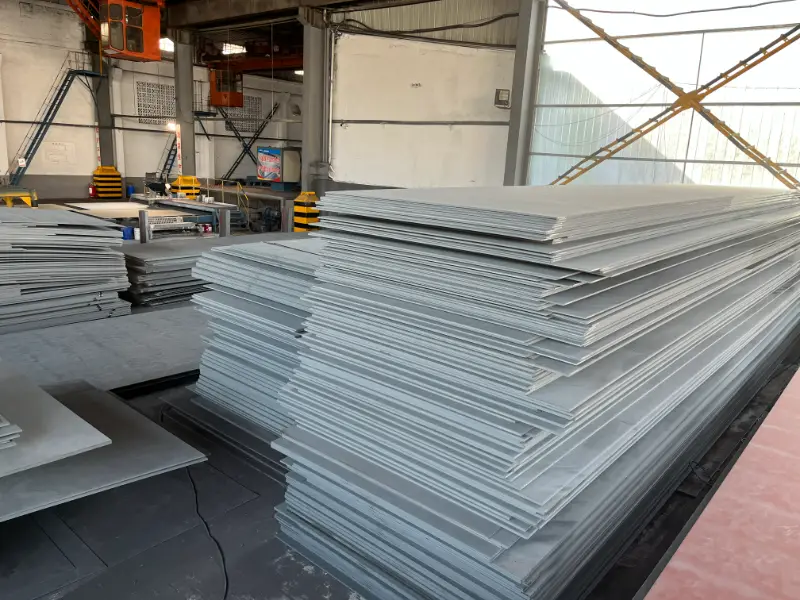
QStE420N Automobile Structure Steel Plate
QStE420N Hot-Rolled High-Strength Steel for Automotive Structural Parts | SEW092
Detailed material data sheet for QStE420N steel according to SEW092, including chemical composition, mechanical properties, thermal properties, equivalent grades, and application guidance for automotive structural components.
Cold forming, bending, stamping, deep drawing, welding, cutting, punching
- Phone : +8618037372205
- Email : [email protected]
- WhatsApp: Contact via Whtsapp
- WeChat: +8618037372205
QStE420N Automobile Structure Steel Plate Introduction
QStE420N is a hot-rolled, fine-grain structural steel specified in SEW 092 (Stahl-Eisen-Werkstoffblatt). It is designed for cold forming and is widely used in automotive structural applications requiring a minimum yield strength of 420 MPa. The steel offers a balanced combination of high strength, excellent formability, good weldability, and consistent mechanical properties across a wide thickness range. Its fine-grained microstructure, achieved through microalloying with niobium, titanium, and/or vanadium, ensures enhanced toughness and fatigue resistance. Typical delivery condition is as-rolled or normalized rolled, suitable for direct press forming, bending, and drawing operations without additional heat treatment.
QStE420N Automobile Structure Steel Plate Chemical Composition
Typical ladle analysis limits according to SEW 092 for grade QStE420N. The steel is microalloyed with niobium, titanium, and/or vanadium to achieve fine grain refinement and precipitation strengthening. Low carbon content ensures good weldability and formability. Maximum values are shown unless a range is given.
| Element | Specified Value (max, unless range) | Remarks |
|---|---|---|
| Carbon (C) | ≤0.12% | Low carbon for weldability |
| Silicon (Si) | ≤0.50% | Deoxidation and strength |
| Manganese (Mn) | ≤1.60% | Solid solution strengthener |
| Phosphorus (P) | ≤0.030% | Impurity control |
| Sulfur (S) | ≤0.025% | Improves machinability slightly |
| Aluminum (Al, total) | ≥0.015% | Grain refinement and deoxidation |
| Niobium (Nb) | ≤0.09% | Grain refiner, precipitation hardening |
| Titanium (Ti) | ≤0.15% | Grain refiner, precipitation hardening |
| Vanadium (V) | ≤0.20% | Optional microalloying element |
| Nitrogen (N) | ≤0.015% | Max, if not bound by Ti/Al |
| Molybdenum (Mo) | ≤0.10% | Optional, residuals |
| Chromium (Cr) | ≤0.30% | Residual element |
QStE420N Automobile Structure Steel Plate Thermal and Electrical Physical Properties
Physical properties are typical for low-carbon microalloyed steel and are provided for design calculations. These values are not part of the SEW 092 standard but represent common data for similar steel grades at room temperature unless stated otherwise.
| Property | Typical Value | Unit | Test Condition |
|---|---|---|---|
| Density (ρ) | 7.85 | g/cm³ | Room temperature |
| Modulus of elasticity (E) | 210 | GPa | Room temperature |
| Shear modulus (G) | 80.7 | GPa | Calculated, typical |
| Poisson's ratio (ν) | 0.30 | – | Elastic range |
| Thermal expansion coefficient (α) | 12.0 (20-100°C), 12.8 (20-200°C), 13.5 (20-300°C) | 10⁻⁶/K | Mean value over temperature range |
| Thermal conductivity (λ) | 51.9 | W/(m·K) | At 20°C |
| Specific heat capacity (cp) | 461 | J/(kg·K) | At 20°C |
| Electrical resistivity (ρe) | 0.20 – 0.25 | µΩ·m | At 20°C |
QStE420N Automobile Structure Steel Plate Mechanical Properties
Mechanical properties according to SEW 092 for QStE420N at room temperature, tested in transverse direction on flat specimens. The values depend on material thickness. Bend test is performed with mandrel diameter as specified. Impact energy is guaranteed for some thickness ranges upon agreement.
| Property | Required Value | Unit | Test Condition / Thickness (nominal) |
|---|---|---|---|
| Upper yield strength (ReH) | ≥420 | MPa | t ≤ 12 mm |
| Upper yield strength (ReH) | ≥400 | MPa | 12 < t ≤ 16 mm |
| Tensile strength (Rm) | 480 – 620 | MPa | t ≤ 16 mm |
| Elongation after fracture (A80) | ≥19 | % | t ≤ 3 mm |
| Elongation after fracture (A5) | ≥23 | % | 3 < t ≤ 16 mm |
| Bend test, 180° (mandrel diameter) | 0.5t (t ≤ 8 mm) | – | Without cracking, transverse |
| Bend test, 180° (mandrel diameter) | 1.0t (8 < t ≤ 16 mm) | – | Without cracking, transverse |
| Impact energy (KV, Charpy-V) | ≥27 | J | At -20°C, longitudinal (optional for t ≥ 6 mm) |
QStE420N Automobile Structure Steel Plate Fully Equivalent Material Standards and Substitute Grades
| Country/Region | Standard | Grade | Remarks |
|---|---|---|---|
| Europe | EN 10149-2 | S420MC | Direct equivalent; identical concept and typical compositions |
| International | ISO 6930-2 | HR420MC | Equivalent high-strength steel for cold forming |
| Japan | JFS A4002 (JFE standard) | JSH440W | Comparable grade with similar yield and tensile properties |
| China | GB/T 20887.1 / GB/T 20564.1 | HR420LA / HC420LA | High-strength low-alloy steel with similar mechanical values, though uses LA (low alloy) designation |
QStE420N Automobile Structure Steel Plate Application Introduction
QStE420N is specifically designed for structural parts in the automotive industry that are manufactured by cold forming. Its fine-grained structure guarantees consistent properties over complex part geometries and high fatigue resistance in service. The material can be processed by all common sheet metal working methods, including laser cutting, punching, bending, and deep drawing. Welding can be performed with conventional methods (e.g., MAG, resistance spot welding) without significant loss of strength in the heat-affected zone. The steel is often delivered with a pickled and oiled surface to facilitate further processing. Typical applications include load-bearing structures where weight reduction and crash performance are critical.
Product Applications: Passenger car chassis parts, Light truck frames and crossmembers, Trailer chassis and supports, Rail car body reinforcements, Construction machinery cabins and booms
Processed into products: Longitudinal rails and cross members, Engine cradles (subframes), Suspension control arms, Bumper beams and crash boxes, Seat rails and backrest frames, Wheel rims (discs and rims), Brackets, flanges, and reinforcement plates, Chassis mounting brackets for EV battery packs
Application industries: Automotive manufacturing, Commercial vehicle and trailer industry, Agricultural and construction machinery, Rail vehicle construction (non-structural parts), General sheet metal processing
QStE420N Automobile Structure Steel Plate Recommendations for Similar or Close Substitute Materials
| Country/Region | Standard | Grade | Remarks |
|---|---|---|---|
| Europe | EN 10149-2 | S460MC | Higher strength grade (min YS 460 MPa); slightly reduced formability |
| Europe | EN 10149-2 | S355MC | Lower strength grade; better formability |
| Germany | SEW 092 | QStE380N | Similar fine-grain steel with lower yield strength (380 MPa) |
| Japan | JIS G3134 | SPFH540 | Hot-rolled high-strength steel for automotive, YS ≥ 325 MPa, Rm ≥ 540 MPa, but lower yield |
| USA | SAE J1392 / ASTM A1011 | 980X / HSLA Grade 60 | HSLA steel with YS ~410 MPa (Grade 60), may require careful comparison of forming properties |
| China | GB/T 20887.1 | HR460LA | Higher yield strength grade with similar low-alloy approach |
Notes:
The SEW 092 standard is an older German specification largely replaced by European standard EN 10149-2. QStE420N is functionally identical to S420MC. When ordering, it is recommended to specify the delivery condition (e.g., as-rolled, pickled and oiled), surface quality requirements, and whether impact test at -20°C is required. For thicknesses above 16 mm, mechanical properties should be agreed upon. This material is not intended for direct hot forming (press hardening) in its as-delivered condition; for hot-stamping processes, grades like 22MnB5 (Usibor) are preferred. Hydrogen-induced cracking sensitivity is very low under normal processing conditions.
- Share



