
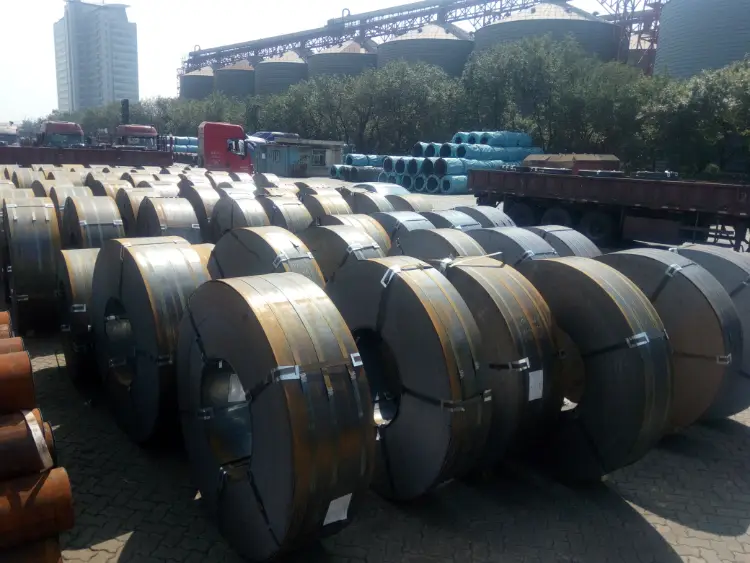
QSTE380TM Hot Rolled Steel Coil
QSTE380TM Hot Rolled Steel Coil - High-Strength Fine-Grain Automotive Structural Steel
Detailed material data for QSTE380TM (Q/BQB 310-2009, SEW 092) including chemical composition, mechanical and physical properties, international equivalents, and typical applications in automotive cold-formed structural parts.
Cold forming (bending, stamping, drawing), welding, cutting, machining
- Phone : +8618037372205
- Email : [email protected]
- WhatsApp: Contact via Whtsapp
- WeChat: +8618037372205
QSTE380TM Hot Rolled Steel Coil Introduction
QSTE380TM is a hot-rolled fine-grain structural steel designed for cold forming, primarily used in automotive manufacturing. It belongs to the family of thermomechanically rolled high-strength low-alloy (HSLA) steels. The designation indicates a minimum yield strength of 380 MPa. The steel exhibits an excellent combination of high strength, good formability, and weldability, making it suitable for chassis and structural components. Its fine microstructure, achieved through controlled rolling and microalloying (typically with niobium, vanadium, or titanium), ensures consistent mechanical properties and good toughness.
- High yield strength: ≥380 MPa for improved structural performance
- Good cold formability: suitable for complex stampings and bending
- Excellent weldability: ideal for automotive assembly
- Fine-grain microstructure: enhanced toughness and fatigue resistance
QSTE380TM Hot Rolled Steel Coil Chemical Composition
Typical chemical composition according to Q/BQB 310-2009 and SEW 092. The steel is microalloyed with niobium, vanadium, or titanium to achieve fine grain strengthening. The sum of Nb, V, and Ti is controlled to ensure optimal precipitation hardening without excessive alloy cost. Residual elements like chromium, nickel, molybdenum, and copper are typically present only as tramp elements and are not intentionally added. Note: Values are maximum unless a range is indicated; the iron balance is the remainder.
| Element | Standard Value (%) | Remarks |
|---|---|---|
| C (Carbon) | ≤ 0.12 | Max |
| Si (Silicon) | ≤ 0.35 | May be slightly higher (≤0.50) in some SEW 092 variants; 0.35 typical |
| Mn (Manganese) | ≤ 1.50 | For 1.50 ≤ thickness ≤ 8.0 mm; may be ≤1.60 for thinner gauges per SEW 092 |
| P (Phosphorus) | ≤ 0.025 | Max |
| S (Sulfur) | ≤ 0.020 | Max (< 0.015 for SEW 092) |
| Al (Aluminum, total) | ≥ 0.015 | Minimum, required for fine grain practice |
| Nb (Niobium) | ≤ 0.09 | Microalloying element |
| V (Vanadium) | ≤ 0.20 | Optional microalloying |
| Ti (Titanium) | ≤ 0.22 | Common microalloying element |
| Nb+V+Ti | ≤ 0.22 | Sum of microalloying elements |
| Fe (Iron) | Balance | Remainder |
QSTE380TM Hot Rolled Steel Coil Physical Properties
Physical properties for QSTE380TM are typical for low-carbon microalloyed steels and are not mandatory according to the material standards. They are provided for design and engineering calculations. Density and elastic properties are essential for structural analysis, while thermal properties support welding and thermal processing simulations. Electrical resistivity may vary slightly with alloy content but remains close to that of pure iron.
| Property | Typical Value | Unit | Condition / Remarks |
|---|---|---|---|
| Density (ρ) | 7.85 | g/cm³ | At 20 °C |
| Modulus of elasticity (E) | 210 | GPa | At 20 °C |
| Shear modulus (G) | 80 | GPa | Calculated from E and ν |
| Poisson's ratio (ν) | 0.3 | – | At 20 °C |
| Thermal expansion coefficient (α) | 12.0 × 10⁻⁶ | 1/K | 20–100 °C |
| Thermal conductivity (λ) | 50 | W/(m·K) | At 20 °C |
| Specific heat capacity (c) | 500 | J/(kg·K) | At 20 °C |
| Electrical resistivity (ρₑ) | 0.25 × 10⁻⁶ | Ω·m | At 20 °C |
QSTE380TM Hot Rolled Steel Coil Mechanical Properties
Mechanical properties are based on standard test specimens taken transverse to the rolling direction, according to Q/BQB 310-2009 and SEW 092. Yield strength and tensile strength depend on product thickness. For thicknesses outside the ranges given, values may be agreed upon. Elongation is measured on a gauge length proportional to 80 mm (A₈₀) for thicknesses < 3 mm, and on 5.65√S₀ (A₅) for thicknesses ≥ 3 mm. Bending test mandrel diameter is expressed as multiples of specimen thickness (a). Impact energy (optional) is typically guaranteed for thicknesses ≥ 6 mm at -20°C.
| Property | Standard Requirement | Unit | Condition / Thickness |
|---|---|---|---|
| Yield strength (ReH) | ≥ 380 | MPa | Thickness ≤ 3.0 mm |
| Yield strength (ReH) | ≥ 340 | MPa | 3.0 < thickness ≤ 8.0 mm |
| Tensile strength (Rm) | 450 – 590 | MPa | All thicknesses |
| Elongation (A₈₀) | ≥ 23 | % | Thickness < 3.0 mm, gauge length 80 mm |
| Elongation (A₅) | ≥ 25 | % | Thickness ≥ 3.0 mm, gauge length 5.65√S₀ |
| Bend test (mandrel diameter) | 0.5a | – | 180° bend, a = specimen thickness |
| Impact energy (KV₂, optional) | ≥ 40 | J | -20°C, longitudinal specimen, thickness ≥ 6 mm |
QSTE380TM Hot Rolled Steel Coil Exact Material Equivalents and Substitutable Grades
| Country / Region | Standard | Grade / Designation | Remarks |
|---|---|---|---|
| Europe | EN 10149-2:2013 | S380MC (1.0974) | Fully equivalent fine-grain steel for cold forming |
| Germany | SEW 092 (historical) | QStE380TM | Original German designation; technically identical to QSTE380TM |
| China | Q/BQB 310-2009 | QSTE380TM | Baosteel's proprietary designation; fully compliant with SEW 092 and EN S380MC |
QSTE380TM Hot Rolled Steel Coil Application Introduction
QSTE380TM is engineered for automotive structural applications requiring higher strength and excellent cold formability. Its fine-grain microstructure enables consistent stamping performance and good fatigue life. The steel is readily weldable with standard fusion welding methods, and its thermomechanically rolled condition eliminates the need for subsequent heat treatment. Typical applications include:
Product Applications: Hot-rolled pickled and oiled coils, Slit strips and cold-formed profiles, Automotive stamped parts, Welded sub-assemblies
Processed into products: Longitudinal beams and cross members, Chassis frames and subframes, Suspension arms and spring brackets, Door impact beams and B-pillar reinforcements, Wheel rims (for light trucks and passenger vehicles), Seat rails and structural tubes
Application industries: Automotive (passenger cars, commercial vehicles), Transportation (rail vehicles, trailers), Agricultural machinery, General engineering (press frames, brackets)
QSTE380TM Hot Rolled Steel Coil Similar / Comparable Material Standards and Grades
| Country / Region | Standard | Grade | Remarks |
|---|---|---|---|
| Europe | EN 10149-2 | S355MC | Lower yield strength (≥355 MPa); similar formability; may substitute if lower strength acceptable |
| China | Q/BQB 310-2009 | QSTE420TM | Higher yield strength (≥420 MPa); next strength level up in same Baosteel family |
| Japan | JIS G 3113 | SAPH440 | Yield ≥305 MPa, tensile ≥440 MPa; commonly used for automotive structural parts but different strength level |
| International | ISO 6930-2 | FeE380TM | ISO equivalent to Europe's S380MC |
| Europe | EN 10149-2 | S460MC | Higher strength (>460 MPa yield); reduced formability; can be used for more demanding structural parts |
Notes:
The steel is typically supplied with a surface finish suitable for painting or coating without additional pretreatment. When specifying QSTE380TM, the ordering document must include the standard, grade, thickness, width, and surface condition (pickled/oiled or mill finish). Third-party inspection and certification to EN 10204 Type 3.1 or 3.2 can be arranged. Welding procedures should account for the low carbon equivalent (CEV typically < 0.25%), ensuring excellent cold cracking resistance. For fatigue-critical parts, post-weld grinding may improve performance. No additional heat treatment is required after cold forming, but stress relieving at 500–600 °C may be applied for heavily deformed parts.
- Share



