
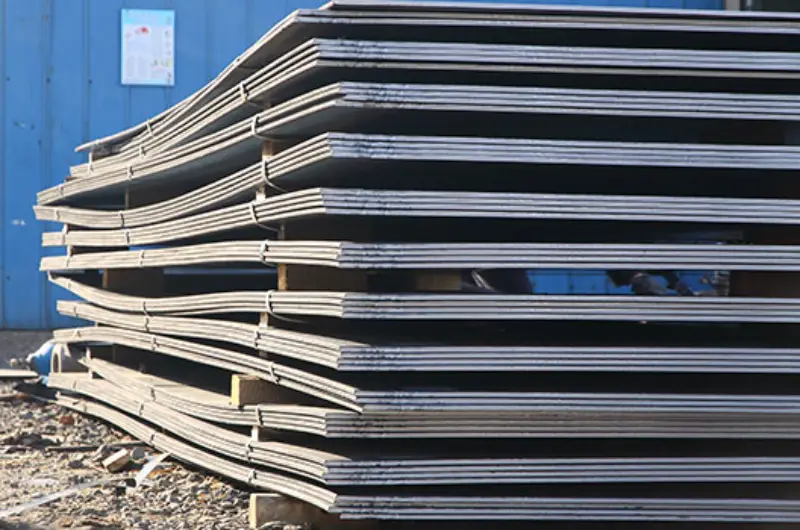
QSTE420TM Hot Rolled High-Strength Low-Alloy Steel for Cold Forming
QSTE420TM Hot Rolled High-Strength Low-Alloy Steel for Cold Forming | Q/BQB 310 / SEW 092
Comprehensive technical data for QSTE420TM hot-rolled high-strength low-alloy steel as per Q/BQB 310-2009 and SEW 092. Includes chemical composition, mechanical and physical properties, international equivalents, and application guidance for automotive structural components.
Cold forming, bending, roll forming, cutting, welding, stamping, punching
- Phone : +8618037372205
- Email : [email protected]
- WhatsApp: Contact via Whtsapp
- WeChat: +8618037372205
QSTE420TM Hot Rolled High-Strength Low-Alloy Steel for Cold Forming Introduction
QSTE420TM is a hot-rolled, fine-grain, high-strength low-alloy (HSLA) steel primarily designed for cold forming and structural applications in the automotive industry. It is specified in Baosteel's Q/BQB 310-2009 standard and closely aligns with the SEW 092 specification. Key features:
- Minimum yield strength of 420 MPa (for thickness ≤ 3.0 mm), enabling weight reduction while maintaining structural integrity.
- Excellent cold formability and weldability, allowing complex part geometries without compromising strength.
- Good fatigue resistance and impact toughness, suitable for chassis and suspension components subjected to dynamic loads.
- Fine grain structure achieved through microalloying with niobium, titanium, or vanadium, ensuring consistent mechanical properties.
QSTE420TM Hot Rolled High-Strength Low-Alloy Steel for Cold Forming Chemical Composition
The chemical composition of QSTE420TM is controlled to achieve high strength and good cold formability. Microalloying elements such as Nb, Ti, and V are used individually or in combination to ensure fine grain size. Maximum limits apply to detrimental elements like phosphorus and sulfur to enhance toughness and weldability.
| Element | Standard Value (max, unless range) | Remarks |
|---|---|---|
| Carbon (C) | 0.12 | Max |
| Silicon (Si) | 0.50 | Max |
| Manganese (Mn) | 1.00 – 1.60 | Range |
| Phosphorus (P) | 0.025 | Max |
| Sulfur (S) | 0.015 | Max |
| Total Aluminum (Altot) | ≥0.015 | Min |
| Niobium (Nb) | ≤0.09 | Optional microalloy, alone or combined |
| Titanium (Ti) | ≤0.15 | Optional microalloy, alone or combined |
| Vanadium (V) | ≤0.20 | Optional microalloy, alone or combined |
| Nb+Ti+V | ≤0.22 | Total microalloying elements, max |
QSTE420TM Hot Rolled High-Strength Low-Alloy Steel for Cold Forming Thermal and Electrical Physical Properties
Physical properties are representative of low-carbon microalloyed steel at room temperature and elevated temperatures. These values are applicable for general engineering calculations but may show slight variations depending on actual composition and processing. Heat treatment is not normally applied; properties are given for the as-delivered condition.
| Property | Standard Required Value | Unit | Test Condition |
|---|---|---|---|
| Density (ρ) | 7.85 | g/cm³ | At 20 °C |
| Elastic Modulus (E) | 210 | GPa | At 20 °C, tension |
| Shear Modulus (G) | 80 | GPa | At 20 °C, calculated |
| Poisson's Ratio (ν) | 0.3 | – | At 20 °C, elastic range |
| Thermal Expansion Coeff. (α) | 11.2 | 10⁻⁶/K | 20 – 100 °C |
| Thermal Expansion Coeff. (α) | 11.8 | 10⁻⁶/K | 20 – 200 °C |
| Thermal Expansion Coeff. (α) | 12.5 | 10⁻⁶/K | 20 – 400 °C |
| Thermal Conductivity (λ) | 50 | W/(m·K) | At 20 °C |
| Thermal Conductivity (λ) | 47 | W/(m·K) | At 200 °C |
| Thermal Conductivity (λ) | 40 | W/(m·K) | At 400 °C |
| Specific Heat Capacity | 460 | J/(kg·K) | At 20 °C |
| Electrical Resistivity (ρe) | 0.13 | ×10⁻⁶ Ω·m | At 20 °C |
QSTE420TM Hot Rolled High-Strength Low-Alloy Steel for Cold Forming Mechanical Properties
Mechanical properties are determined on test pieces taken transverse to the rolling direction. For longitudinal test pieces, slightly higher elongation values may be observed. Yield strength and tensile strength vary with thickness; the minimum values apply to the relevant thickness range. The bending test mandates a 180° bend without cracking around a specified mandrel diameter.
| Property | Standard Required Value | Unit | Test Condition |
|---|---|---|---|
| Yield Strength (ReH) | ≥420 | MPa | Nominal thickness ≤ 3.0 mm, transverse |
| Yield Strength (ReH) | ≥400 | MPa | Nominal thickness 3.0 < t ≤ 6.0 mm, transverse |
| Tensile Strength (Rm) | 480 – 620 | MPa | Nominal thickness ≤ 6.0 mm, transverse |
| Elongation (A80) | ≥19 | % | Gauge length 80 mm, thickness ≤ 3.0 mm |
| Elongation (A5) | ≥24 | % | Gauge length 5.65√So, thickness > 3.0 ≤ 6.0 mm |
| Bend Test (180°) | a ≤ 0.5a (no cracks) | – | Bend mandrel diameter ≤ 0.5 x specimen thickness, t ≤ 6.0 mm |
QSTE420TM Hot Rolled High-Strength Low-Alloy Steel for Cold Forming Completely Equivalent Material Standards and Replaceable Grades
| Country/Region | Standard | Grade | Remarks |
|---|---|---|---|
| Europe | EN 10149-2:2013 | S420MC | Hot rolled flat products of high yield strength for cold forming; identical technical delivery conditions. |
| International | ISO 6930-2:2004 | FeE420 | Comparable high yield strength steel for cold forming; matching requirements. |
| Germany | DIN EN 10149-2 | S420MC | Direct adoption of European standard; completely interchangeable. |
| China (Baosteel) | Q/BQB 310-2009 | QSTE420TM | Original specification; reference to SEW 092 for technical basis. |
QSTE420TM Hot Rolled High-Strength Low-Alloy Steel for Cold Forming Application Introduction
QSTE420TM steel is engineered for weight-critical structural parts that require high strength, excellent cold formability, and good weldability. The following guide outlines its primary industrial uses and component examples.
Product Applications: Hot rolled coils and cut-to-length sheets, Pickled and oiled slit strips for stamping, Welded tubular sections, Chassis and frame assemblies
Processed into products: Longitudinal beams and cross members, Suspension control arms and links, Engine cradles and subframes, Bumper reinforcements, Seat frame and recliner components, Transmission brackets, Agricultural implement frames
Application industries: Automotive (passenger cars and commercial vehicles), Agricultural machinery, Construction equipment, Railway components, General engineering
QSTE420TM Hot Rolled High-Strength Low-Alloy Steel for Cold Forming Similar or Alternative Material Recommendations
| Country/Region | Standard | Grade | Remarks |
|---|---|---|---|
| China | Q/BQB 310-2009 | QSTE380TM | Lower minimum yield strength (380 MPa), same formability class. Suitable when strength requirements are less demanding. |
| China | Q/BQB 310-2009 | QSTE460TM | Higher minimum yield strength (460 MPa), similar chemical and processing characteristics. Use for more severe load conditions. |
| Europe | EN 10149-2 | S355MC | Lower yield strength (355 MPa) but similar formability. Alternative where strength can be compromised. |
| Japan | JIS G 3134 | SPFH590 | Higher tensile strength (590 MPa min) but different formability concept. Not directly equivalent; verify forming requirements. |
Notes:
Additional notes:
- Welding: All standard arc and resistance welding processes are suitable; preheating not required except for very thick sections (>50 mm) under low ambient temperature conditions.
- Surface treatment: The steel can be phosphated, electrocoated, or painted without special preparation when supplied pickled and oiled.
- Fatigue performance: As a fine-grain steel, QSTE420TM exhibits good fatigue strength, particularly when notched details are minimized.
- Coil quality: Delivered with tight dimensional tolerances (thickness, width) and controlled flatness per the standard.
- Hydrogen embrittlement: Not susceptible under normal processing conditions; avoid strong acidic pickling without rinsing.
- Share



