
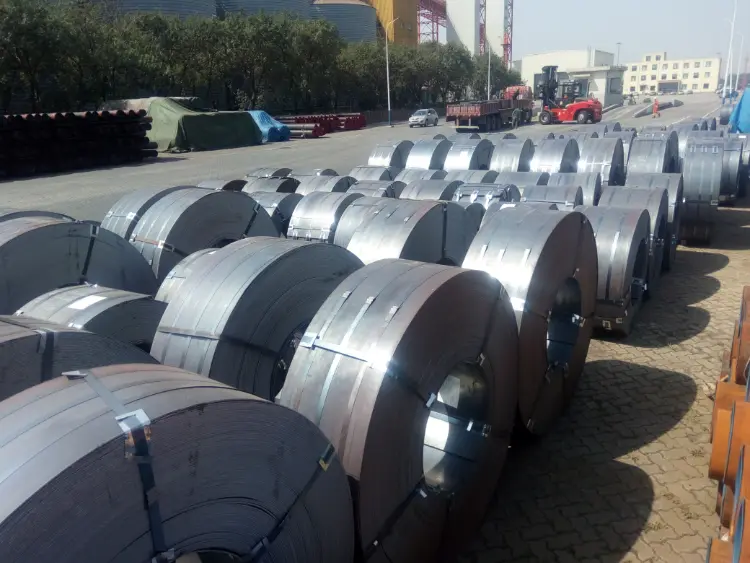
QSTE340TM Hot Rolled Steel Coil for Automotive Structural Applications
QSTE340TM Hot Rolled Steel Coil for Automotive Structural Applications - Q/BQB 310-2009 Standard
QSTE340TM is a hot-rolled high-strength low-alloy fine grain structural steel with minimum yield strength of 340 MPa, designed for cold forming and automotive lightweight structures.
Suitable for cold forming (bending, drawing), shearing, punching, welding (spot, MAG, laser), and limited machining.
- Phone : +8618037372205
- Email : [email protected]
- WhatsApp: Contact via Whtsapp
- WeChat: +8618037372205
QSTE340TM Hot Rolled Steel Coil for Automotive Structural Applications Introduction
QSTE340TM is a hot-rolled fine grain structural steel grade defined in Q/BQB 310-2009 (also covered by SEW 092 as QStE340TM). It belongs to the family of thermomechanically rolled high-strength low-alloy (HSLA) steels. Through microalloying with niobium and/or titanium, and controlled rolling, a fine ferrite grain structure is achieved, providing an excellent combination of high strength, good cold formability, and weldability. Typical applications include automotive chassis parts, suspension arms, and load-bearing reinforcements where weight reduction and structural integrity are critical. The steel is supplied in hot-rolled condition, often pickled and oiled, with a uniform surface quality suitable for subsequent cold forming operations.
QSTE340TM Hot Rolled Steel Coil for Automotive Structural Applications Chemical Composition
Chemical composition according to Q/BQB 310-2009 for QSTE340TM. The steel is microalloyed with Nb and Ti for grain refinement and precipitation strengthening, ensuring a fine ferritic-pearlitic or bainitic microstructure. Maximum limits are stringent to guarantee consistent mechanical properties and weldability.
| Element | Standard Value (wt%) | Remarks |
|---|---|---|
| Carbon (C) | ≤ 0.12 | Controlled for weldability and formability |
| Silicon (Si) | ≤ 0.50 | Deoxidizer, contributes to strength |
| Manganese (Mn) | ≤ 1.30 | Solid solution strengthening |
| Phosphorus (P) | ≤ 0.030 | Restricted to avoid embrittlement |
| Sulfur (S) | ≤ 0.025 | Low level for cleanliness and formability |
| Aluminum (Al) | ≥ 0.015 | Grain refining deoxidizer |
| Niobium (Nb) | ≤ 0.09 | Grain refiner and precipitation strengthener |
| Titanium (Ti) | ≤ 0.22 | Grain refiner and precipitation strengthener |
| Vanadium (V) | (may be added; limited by microalloy total) | Optional strengthening element; not in standard mandatory analysis but allowed |
| Microalloy sum (Nb+Ti+V) | Typically ≤ 0.22 | To control total microalloying for property consistency |
QSTE340TM Hot Rolled Steel Coil for Automotive Structural Applications Thermal and Electrical Physical Properties
These typical values are provided for general engineering calculations and are representative for fine-grained low-alloy steels of this type. They are not part of the mandatory specification but serve as a guideline for design, heat transfer, and electrical applications.
| Property | Typical Value | Unit | Test Condition / Remarks |
|---|---|---|---|
| Density (ρ) | 7.85 | g/cm³ | 20 °C |
| Elastic Modulus (E) | 210 | GPa | 20 °C, tensile |
| Shear Modulus (G) | approx. 81 | GPa | Calculated, 20 °C |
| Poisson's Ratio (ν) | 0.3 | 20 °C, elastic range | |
| Thermal Expansion Coeff. (α) | 12.0 × 10⁻⁶ | K⁻¹ | 20–100 °C |
| Thermal Conductivity (λ) | 50 | W/(m·K) | 20 °C |
| Specific Heat Capacity (cp) | 460 | J/(kg·K) | 20 °C |
| Electrical Resistivity (ρ_e) | 0.13 – 0.17 | Ω·mm²/m | 20 °C |
QSTE340TM Hot Rolled Steel Coil for Automotive Structural Applications Mechanical Properties
Mechanical properties as per Q/BQB 310-2009 for QSTE340TM, valid for hot-rolled strip/plate in delivery condition. The values depend on thickness; transverse samples are typically used. The steel exhibits fine grain and good bendability.
- Yield and tensile strengths are guaranteed at room temperature.
- Elongation is measured on a proportional gauge length of 80 mm for thickness <3 mm, and on 5.65√So for thickness ≥3 mm.
| Property | Standard Requirement | Unit | Test Condition |
|---|---|---|---|
| Yield Strength (ReH) | ≥ 340 | MPa | Thickness ≤ 6 mm, transverse |
| Yield Strength (ReH) | ≥ 330 | MPa | Thickness > 6 to 8 mm, transverse |
| Tensile Strength (Rm) | 420 – 540 | MPa | All thicknesses, transverse |
| Elongation (A80) | ≥ 25 | % | Thickness < 3 mm (gauge length 80 mm), transverse |
| Elongation (A5) | ≥ 27 | % | Thickness ≥ 3 mm (gauge length 5.65√So), transverse |
| Bend Test (180°) | Crack-free with bend diameter = 0.5a | a = specimen thickness; up to 8 mm thick |
QSTE340TM Hot Rolled Steel Coil for Automotive Structural Applications Completely Equivalent Material Standards and Substitutable Grades
| Country / Region | Standard | Grade | Remarks |
|---|---|---|---|
| China (Baosteel) | Q/BQB 310-2009 | QSTE340TM | Original specification for automotive structural hot-rolled coil |
| Germany / Europe | SEW 092 | QStE340TM | Identical predecessor; thermomechanically rolled fine grain steel |
| European Union | EN 10149-2 | S340MC | Direct equivalent with same yield class and microalloying philosophy |
| Japan | JFS A2001 | JSH340R | Equivalent high-strength hot-rolled steel for auto; slight composition differences but interchangeable in many applications |
| International (ISO) | ISO 6930-2 | FeE340 | Fine grain structural steel with comparable mechanical requirements |
QSTE340TM Hot Rolled Steel Coil for Automotive Structural Applications Application Introduction
QSTE340TM is ideally suited for lightweight automotive structural and chassis parts that require a balance of strength, formability, and fatigue resistance. Its fine grain structure enables good cold forming even at relatively high strength levels. The steel is also widely used in non-automotive transport and agricultural machinery where weight reduction and durability are important. Typical manufacturing processes include shearing, blanking, bending, drawing, and various welding methods.
Product Applications: Automotive chassis subframes, Suspension control arms and torsion beams, Longitudinal and cross members, Bumper reinforcement beams, Seat frames and seat structural parts, Wheel rim discs (for appropriate thickness), Truck frame rails and cross-members
Processed into products: Stamped and bent suspension control arms, Welded subframe assemblies, Formed crossmember tubes and profiles, Press-formed chassis brackets and mounts, Laser-welded tailored blanks for body-in-white reinforcements
Application industries: Automotive manufacturing (passenger cars, light commercial vehicles), Heavy transport and trailer construction, Agricultural and construction machinery, Railway vehicle components, General mechanical engineering
QSTE340TM Hot Rolled Steel Coil for Automotive Structural Applications Similar / Recommended Alternative Materials with Close Properties
| Country / Region | Standard | Grade | Remarks |
|---|---|---|---|
| European Union | EN 10149-2 | S355MC | Next higher strength class (min YS 355 MPa); similar formability and weldability; suitable when 340 MPa class is marginally insufficient |
| China (Baosteel) | Q/BQB 310-2009 | QSTE380TM | Higher strength variant (min YS 380 MPa) within same family; slightly reduced elongation but still formable |
| China | Q/BQB 310-2009 | QSTE300TM | Lower strength variant (min YS 300 MPa); better formability if forming severity is higher |
| Japan | JFS A2001 | JSH440R | Higher strength (min YS 440 MPa) but still widely used for similar chassis and structural applications |
Notes:
Surface conditions: The material is typically supplied pickled and oiled (P&O) to ensure cleanliness for subsequent forming. Un-pickled (as-rolled) surface can be agreed upon. Weldability: Excellent arc, resistance spot, and laser welding characteristics due to low carbon equivalent. Preheating is not required under normal conditions. Coating compatibility: Suitable for cataphoretic painting and other protective coatings after appropriate cleaning. Fatigue performance: The fine grain structure and micro-alloyed composition contribute to good fatigue strength, making the grade suitable for dynamically loaded components.
- Share



