
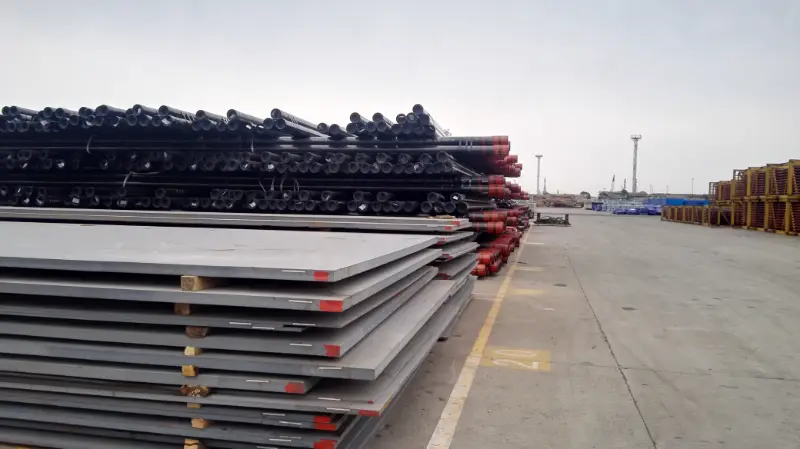
QStE340TM (SEW 092) Automotive Structural Steel
QStE340TM Automobile Structure Steel Plate – SEW092 Fine-Grain Cold-Formable HSLA Steel
Detailed material data for QStE340TM hot-rolled automobile structure steel according to SEW092, including chemical composition, mechanical and physical properties, equivalent grades, and application guidance.
Cold forming, stamping, bending, roll forming, welding, painting, phosphating
- Phone : +8618037372205
- Email : [email protected]
- WhatsApp: Contact via Whtsapp
- WeChat: +8618037372205
QStE340TM Automotive Structural Steel Introduction
QStE340TM is a hot-rolled fine-grain structural steel specified in the German standard SEW092, intended for cold forming and automotive structural applications. It belongs to the family of microalloyed high-strength low-alloy (HSLA) steels with a minimum yield strength of 340 MPa. The 'TM' designation indicates thermomechanical rolling, which refines the grain structure and enhances strength and toughness without excessive alloying. Key characteristics include:
- Excellent cold formability (bending, drawing, stretch forming)
- High strength combined with good weldability
- Consistent mechanical properties across the strip width and length
- Good fatigue and impact resistance for dynamic loads
Typical delivery condition is as-rolled and thermomechanically controlled; post-forming heat treatment is not required.
QStE340TM Automotive Structural Steel Chemical Composition
The following chemical composition limits apply for QStE340TM according to SEW092, which aligns with EN 10149-2 for grade S340MC. The steel is microalloyed with niobium, vanadium, and/or titanium to achieve grain refinement and precipitation strengthening while maintaining low carbon content for excellent weldability and formability.
- Low carbon equivalent ensures good weldability.
- Fine grain practice is mandatory: aluminium is added for deoxidation and grain size control.
- Residual elements (Cr, Ni, Mo, Cu) are not specified but typically restricted to a total of ≤0.60% to maintain consistency.
| Element | Standard Requirement (max %) | Remarks/Notes |
|---|---|---|
| Carbon (C) | ≤0.10 | Low carbon for weldability and formability |
| Silicon (Si) | ≤0.50 | Deoxidation and strength contribution |
| Manganese (Mn) | ≤1.30 | Solid solution strengthener; refines pearlite |
| Phosphorus (P) | ≤0.030 | Typical limit for clean steel |
| Sulfur (S) | ≤0.025 | Controlled for formability and toughness |
| Aluminium (Al) total | ≥0.015 | Fine grain deoxidation; grain refinement |
| Niobium (Nb) | ≤0.09 | Microalloy: precipitation strengthening and grain refinement |
| Vanadium (V) | ≤0.20 | Microalloy: optional precipitation hardening |
| Titanium (Ti) | ≤0.15 | Microalloy: carbide/nitride former for grain control |
QStE340TM Automotive Structural Steel Thermal and Electrical Physical Properties
The physical properties are typical for fine-grain structural steels at room temperature unless otherwise noted. They are not part of the SEW092 mandatory requirements but are useful for design calculations. Density, modulus of elasticity, and thermal expansion coefficient are nearly constant across microalloyed grades. Thermal conductivity and electrical resistivity vary with temperature; values at elevated temperatures (100°C, 200°C, 300°C) are given for reference.
| Property | Typical Value | Unit | Test Condition / Temperature |
|---|---|---|---|
| Density (ρ) | 7.85 | g/cm³ | 20°C |
| Young's Modulus (E) | 210 | GPa | 20°C |
| Shear Modulus (G) | ~81 | GPa | 20°C (calculated from E and ν) |
| Poisson's Ratio (ν) | 0.3 | — | 20°C, elastic range |
| Thermal Expansion Coefficient (α) | 12.0 × 10⁻⁶ | K⁻¹ | 20°C – 100°C |
| Thermal Expansion Coefficient (α) | 12.5 × 10⁻⁶ | K⁻¹ | 20°C – 200°C |
| Thermal Expansion Coefficient (α) | 13.0 × 10⁻⁶ | K⁻¹ | 20°C – 300°C |
| Thermal Conductivity (λ) | 54 | W/(m·K) | 20°C |
| Thermal Conductivity (λ) | 52 | W/(m·K) | 100°C |
| Thermal Conductivity (λ) | 49 | W/(m·K) | 200°C |
| Thermal Conductivity (λ) | 46 | W/(m·K) | 300°C |
| Specific Heat Capacity (cp) | ~460 | J/(kg·K) | 20°C – 200°C |
| Electrical Resistivity (ρe) | 0.25 × 10⁻⁶ | Ω·m | 20°C |
QStE340TM Automotive Structural Steel Mechanical Properties
The mechanical properties of QStE340TM are guaranteed in the as-delivered thermomechanically rolled condition. They correspond to EN 10149-2 S340MC. The values depend on the product thickness. Yield strength is specified for 0.2% offset (Rp0.2) or lower yield strength (ReH). Tensile strength range and minimum elongation are given. The bending test ensures sufficient cold formability. No impact test is required by the standard; toughness is ensured by fine grain practice. For thicknesses outside the ranges listed, please consult the specific standards.
| Property | Standard Requirement | Unit | Test Condition / Thickness Range |
|---|---|---|---|
| Yield Strength (ReH/Rp0.2) | ≥340 | MPa | Thickness ≤ 3 mm |
| Yield Strength (ReH/Rp0.2) | ≥340 | MPa | 3 mm < thickness ≤ 16 mm |
| Yield Strength (ReH/Rp0.2) | ≥320 | MPa | 16 mm < thickness ≤ 25 mm |
| Tensile Strength (Rm) | 410 – 540 | MPa | Thickness ≤ 3 mm |
| Tensile Strength (Rm) | 410 – 540 | MPa | 3 mm < thickness ≤ 16 mm |
| Tensile Strength (Rm) | 400 – 530 | MPa | 16 mm < thickness ≤ 25 mm |
| Elongation (A80) | ≥21 | % | Thickness ≤ 3 mm (gauge length 80 mm) |
| Elongation (A5) | ≥25 | % | 3 mm ≤ thickness ≤ 6 mm (gauge length 5.65√So) |
| Elongation (A5) | ≥25 | % | 6 mm < thickness ≤ 16 mm |
| Elongation (A5) | ≥23 | % | 16 mm < thickness ≤ 25 mm |
| Bend Test (180°) | Crack-free | — | Mandrel diameter ≤ 0.5t (t=thickness), valid for all thicknesses |
QStE340TM Automotive Structural Steel Fully Equivalent Material Standards and Substitute Grades
QStE340TM is directly replaceable by the following international grades that meet identical chemical and mechanical requirements for fine-grain cold-forming steels. The most universal equivalent is EN 10149-2 S340MC, which supersedes the SEW092 designation in current European practice.
| Country/Region | Standard | Grade | Remarks |
|---|---|---|---|
| Germany | SEW092 (historic) | QStE340TM | Original designation; still used in automotive specifications |
| European Union | EN 10149-2:2013 | S340MC | Direct replacement; thermomechanically rolled fine-grain steel for cold forming |
| Japan | JIS G 3134:2018 | SPFH 340 | Hot-rolled high-strength steel sheet for automobile structural use – identical strength class |
| International | ISO 6930-2:2019 | FeE340TM | High yield strength microalloyed steel for cold forming – equivalent to S340MC |
| USA | ASTM A1011/A1011M | HSLAS-F Grade 50 Class 1 | Approximate equivalent; verify chemical and mechanical requirements per agreement |
QStE340TM Automotive Structural Steel Application Introduction
QStE340TM is specifically designed for automotive structural parts that require a combination of high strength, excellent cold formability, and good weldability. Its fine-grain microstructure ensures consistency in mass production. The steel is delivered in the as-rolled condition and can be directly formed, welded, and painted without additional heat treatment. Typical applications include safety-relevant components where controlled energy absorption and fatigue resistance are critical. For more complex geometries, a forming analysis is recommended; springback must be compensated for in tool design.
- Not intended for hot forming above 600°C – thermomechanical properties may degrade.
- Sheared edges should be deburred before forming to avoid cracking.
- Welding: all common methods (MAG, spot resistance, laser) are suitable. Low carbon equivalent ensures crack-free welds without preheating.
Product Applications: Cross members and side members of car body understructure, Chassis frames, subframes, engine cradles, Longitudinal beams for light trucks, Wheel rim flanges and disc parts (inner/outer), Bumper reinforcement beams, Suspension control arms and spring brackets, Floor reinforcements and A/B-pillar reinforcements, Seat structures and sliding tracks
Processed into products: Stamped and bent structural brackets, Deep-drawn tunnel and panel reinforcements, Roll-formed side impact beams, Laser-cut blank body-in-white panels after trimming, Hydroformed tubular cross-car beams, Welded assemblies requiring fatigue resistance
Application industries: Automotive manufacturing (passenger cars, light commercial vehicles), Truck and trailer frames, Agricultural and construction machinery structural parts, Railway vehicle bodies
QStE340TM Automotive Structural Steel Closely Related / Similar Alternative Materials
If the exact grade is not available, the following steels offer comparable properties and may be considered after engineering evaluation. They differ slightly in minimum yield strength or chemical composition limits, but are commonly used for similar automotive structural applications.
| Country/Region | Standard | Grade | Comparability Notes |
|---|---|---|---|
| EU | EN 10149-2 | S315MC | Lower minimum yield strength (315 MPa); same forming and welding behavior. Can replace QStE340TM in less demanding sections. |
| EU | EN 10149-2 | S355MC | Higher strength (355 MPa min yield); may require slightly larger forming forces but provides weight reduction potential. |
| Germany | SEW092 | QStE380TM | Next higher strength class (380 MPa); analogous to S380MC. Suitable upgrade for higher load paths. |
| Japan | JIS G 3134 | SPFH 370 | Yield strength ≥ 370 MPa; similar family, but check thickness-dependent elongation. |
| ISO | ISO 6930-2 | FeE355TM | Comparable to S355MC; often interchangeable with QStE340TM in thin gauges when bend radii are relaxed. |
Notes:
Ordering information: When ordering to EN 10149-2 S340MC, the steel shall be suitable for hot-dip galvanizing if required (class A or B surface). Testing: Tensile test pieces are taken transversely. For strip, the gauge length A80 or A5 is selected according to thickness. Tolerances: Dimensional tolerances according to EN 10051 for hot-rolled strip/plate. Corrosion protection: No inherent corrosion resistance; organic or metallic coatings (e.g., zinc flake, electrophoretic coating) must be applied after forming. Health and safety: Normal practices for handling steel coils apply. Supply condition marking: Typically pickled and oiled surface, coil weight up to 20 metric tons. Edge condition: mill edge or trimmed edge on request.
- Share



