
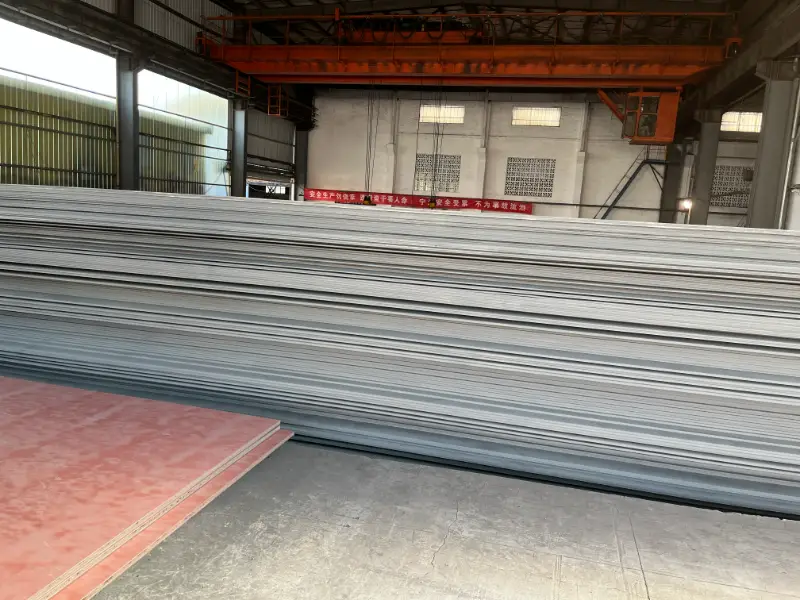
QStE340N High-Strength Automobile Structural Steel Plate
QStE340N High-Strength Automobile Structural Steel Plate - SEW 092
Complete material data for QStE340N according to SEW 092: chemical composition, mechanical properties, thermal and electrical properties, equivalent grades, and application guide for automotive engineering.
Cold forming, bending, profiling, drawing, stamping, welding
- Phone : +8618037372205
- Email : [email protected]
- WhatsApp: Contact via Whtsapp
- WeChat: +8618037372205
QStE340N High-Strength Automobile Structural Steel Plate Introduction
QStE340N is a fine-grain, high-strength low-alloy structural steel defined in the German standard SEW 092, primarily used for cold-formed automobile components. It offers a minimum yield strength of 340 MPa, good weldability, and excellent formability in the normalized or controlled-rolled delivery condition. The steel is characterized by a low carbon content and microalloying elements such as niobium, vanadium, or titanium, which provide grain refinement and precipitation strengthening.
- Excellent balance of strength and ductility
- Suitable for cold bending, profiling, and drawing operations
- Consistent mechanical properties across plate thicknesses
- Widely applied in chassis and structural parts of vehicles
QStE340N High-Strength Automobile Structural Steel Plate Chemical Composition
Chemical composition as specified in SEW 092 for QStE340N. Low carbon content ensures good weldability, while microalloying elements (Nb, V, Ti) contribute to grain refinement and precipitation hardening. Maximum values unless a range is indicated.
| Element | Standard Value | Remarks |
|---|---|---|
| Carbon (C) | ≤ 0.12% | |
| Silicon (Si) | ≤ 0.50% | |
| Manganese (Mn) | ≤ 1.00% | |
| Phosphorus (P) | ≤ 0.030% | |
| Sulfur (S) | ≤ 0.025% | |
| Aluminium (Altot) | ≥ 0.015% | Minimum for fine-grain practice |
| Niobium (Nb) | ≤ 0.09% | Microalloying element |
| Vanadium (V) | ≤ 0.10% | Microalloying element |
| Titanium (Ti) | ≤ 0.15% | Microalloying element |
| Nitrogen (N) | ≤ 0.020% | Bound by Ti/Al |
QStE340N High-Strength Automobile Structural Steel Plate Thermal and Electrical Physical Properties
The physical properties are typical for low-carbon microalloyed steels. The values may vary slightly depending on the exact composition and processing. Thermal conductivity and specific heat capacity are given at room temperature unless otherwise noted.
| Property | Standard Value | Unit | Test Condition |
|---|---|---|---|
| Density (ρ) | 7.85 | g/cm³ | Room temperature |
| Elastic modulus (E) | 210 | GPa | Room temperature |
| Shear modulus (G) | 81 | GPa | Room temperature |
| Poisson's ratio (ν) | 0.3 | Room temperature | |
| Thermal expansion coefficient (α) | 12.0 × 10⁻⁶ | K−1 | 20–200 °C |
| Thermal conductivity (λ) | 45 – 55 | W/(m·K) | Room temperature |
| Specific heat capacity (c) | 460 | J/(kg·K) | Room temperature |
| Electrical resistivity (ρe) | 0.20 – 0.25 | µΩ·m | Room temperature |
QStE340N High-Strength Automobile Structural Steel Plate Mechanical Properties
Mechanical properties according to SEW 092 for hot-rolled QStE340N steel plate. Testing is performed at room temperature on transverse samples. Bend test values are minimum mandrel diameters depending on thickness. Impact toughness is not a requirement but may be agreed upon.
| Property | Standard Value | Unit | Test Condition |
|---|---|---|---|
| Yield strength (ReH) | ≥ 340 | MPa | Transverse, t ≤ 16 mm |
| Tensile strength (Rm) | 420 – 540 | MPa | Transverse |
| Elongation (A80) | ≥ 22 | % | t < 3 mm |
| Elongation (A5) | ≥ 24 | % | t ≥ 3 mm |
| Bend test (mandrel diameter) | 0.5 t | t < 3 mm, 180° | |
| Bend test (mandrel diameter) | 1.0 t | t ≥ 3 mm, 180° |
QStE340N High-Strength Automobile Structural Steel Plate Fully Equivalent Material Standards and Substitutable Grades
| Country/Region | Standard | Grade | Remarks |
|---|---|---|---|
| Germany | SEW 092 | QStE340N | Original designation |
| Europe | EN 10149-2 | S340MC | Thermomechanically rolled, equivalent mechanical and chemical requirements |
| International | ISO 6930-1 | S340MC | Identical to EN 10149-2 |
QStE340N High-Strength Automobile Structural Steel Plate Application Introduction
QStE340N is designed for cold-formed automotive structural components that require high strength, good fatigue resistance, and reliable weldability. The following are typical application areas, products, and specific parts:
Product Applications: Vehicle chassis and subframes, Longitudinal and cross beams, Suspension control arms, Wheel rims and wheel discs, Reinforcement brackets and brackets, Stamped and bent profiles for body-in-white
Processed into products: Front and rear longitudinal rails, Engine cradle beams, Bumper reinforcement beams, Spring brackets, Seat frame components, Cross-car beams
Application industries: Automotive manufacturing (passenger cars, commercial vehicles), Trailer and truck body construction, Agricultural and construction machinery, Railway vehicle structural parts
QStE340N High-Strength Automobile Structural Steel Plate Similar or Alternative Material Recommendations
| Country/Region | Standard | Grade | Remarks |
|---|---|---|---|
| Europe | EN 10149-2 | S355MC | Higher strength (≥355 MPa), else similar. Good substitution when higher load capacity is needed. |
| Japan | JIS G3134 | SPFH340 | 340 MPa class hot-rolled high-strength steel for automotive structural use, similar cold formability. |
| USA | SAE J1392 | 050XL | HSLA steel with min. yield 340 MPa (50 ksi), general structural applications. |
Notes:
Welding: QStE340N can be welded by all common methods (MAG, resistance spot welding, etc.) without significant softening in the heat-affected zone. Preheating is generally not required for thicknesses up to ~30 mm.
Surface condition: Usually supplied as hot-rolled, pickled and oiled, or un-pickled as agreed.
Tolerances: Thickness and flatness tolerances according to EN 10051 or equivalent, by agreement.
Testing: Tensile and bend tests are typically performed on samples taken perpendicular to rolling direction.
- Share



