
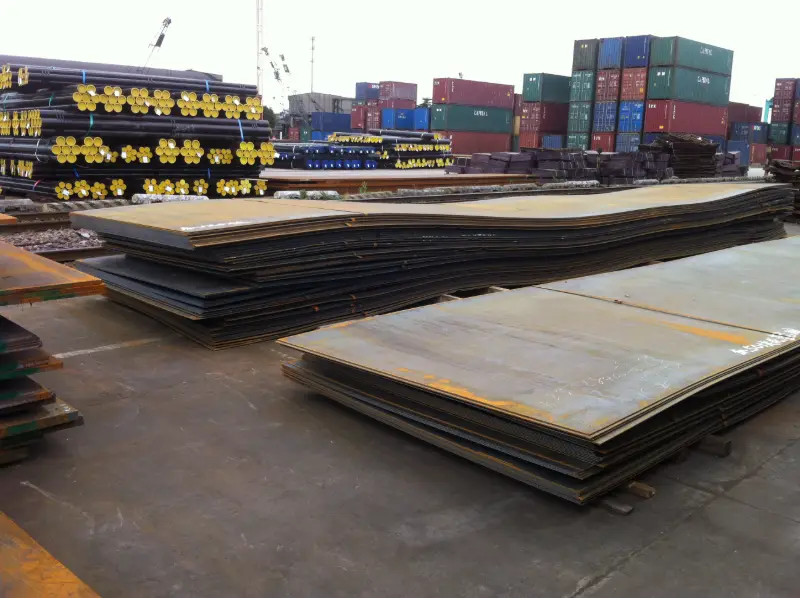
Q/BQB 310-2009 B510DL Automobile Structural Steel Plate
B510DL Automotive Structural Steel Plate - Q/BQB 310-2009 Data Sheet
Comprehensive material properties of B510DL hot-rolled automotive structure steel according to Baosteel Q/BQB 310-2009, covering chemistry, mechanics, and thermal physics.
Hot rolling, controlled rolling, cold forming, welding, machining
- Phone : +8618037372205
- Email : [email protected]
- WhatsApp: Contact via Whtsapp
- WeChat: +8618037372205
Q/BQB 310-2009 B510DL Automobile Structural Steel Plate Introduction
B510DL is a hot-rolled high-strength low-alloy (HSLA) steel for automotive structural parts, specified in Baosteel corporate standard Q/BQB 310-2009.
- It offers a minimum yield strength of 355 MPa (thickness dependent) and tensile strength in the range of 510–630 MPa, ensuring excellent load-bearing capacity.
- The steel is microalloyed with niobium and/or titanium to achieve grain refinement and precipitation strengthening, resulting in good formability and weldability.
- Typical applications include chassis frames, cross members, and longitudinal beams where high strength and fatigue resistance are critical.
- Delivery condition is hot-rolled and controlled rolled, with a pickup-free surface suitable for subsequent cold forming or welding without post-heat treatment in most cases.
It is designed for demanding automotive lightweighting targets while maintaining safety performance.
Q/BQB 310-2009 B510DL Automobile Structural Steel Plate Chemical Composition
The ladle analysis limits per Q/BQB 310-2009 for grade B510DL. Microalloying elements (Nb, Ti) are used for grain refinement and precipitation hardening. The sum of Nb+V+Ti shall not exceed 0.22%.
- Low carbon content ensures good weldability.
- Aluminum is added as a deoxidizer and to fix nitrogen.
| Element | Standard Value (wt%) | Remarks |
|---|---|---|
| Carbon (C) | ≤ 0.16 | |
| Silicon (Si) | ≤ 0.50 | |
| Manganese (Mn) | ≤ 1.60 | |
| Phosphorus (P) | ≤ 0.025 | |
| Sulfur (S) | ≤ 0.015 | |
| Aluminum (Al total) | ≥ 0.015 | |
| Niobium (Nb) | ≤ 0.09 | Optional microalloy |
| Titanium (Ti) | ≤ 0.10 | Optional microalloy |
| Vanadium (V) | ≤ 0.10 (if present) | May be added, included in Nb+V+Ti ≤0.22 |
Q/BQB 310-2009 B510DL Automobile Structural Steel Plate Thermal and Electrical Physical Properties
The following properties are typical for low-alloy hot-rolled steel and are suitable for engineering calculations. Actual values may vary slightly with manufacturing route.
- Data based on room temperature unless otherwise stated.
- Thermal conductivity decreases with increasing temperature.
| Property | Typical Value | Unit | Test Condition |
|---|---|---|---|
| Density (ρ) | 7.85 | g/cm³ | Room temperature |
| Elastic Modulus (E) | 205 – 210 | GPa | Room temperature |
| Shear Modulus (G) | 79 – 81 | GPa | Room temperature |
| Poisson's Ratio (ν) | 0.29 – 0.30 | Room temperature | |
| Thermal Expansion Coefficient (α) | 11.5 – 12.5 | ×10⁻⁶/K | 20 – 200 °C |
| Thermal Conductivity (λ) | 45 – 52 | W/(m·K) | Room temperature |
| Specific Heat Capacity | 460 – 480 | J/(kg·K) | Room temperature |
| Electrical Resistivity (ρ_e) | 0.16 – 0.25 | μΩ·m | Room temperature |
Q/BQB 310-2009 B510DL Automobile Structural Steel Plate Mechanical Properties
Tensile testing according to Q/BQB 310-2009. Values depend on plate thickness (t). Bend test uses 180° bending; larger thicknesses require larger mandrel diameters.
- Yield strength is specified as ReH (upper yield or 0.2% proof).
- Elongation measured on L0=50 mm, b=25 mm gauge length.
No impact test is mandatory in the standard, but typical Charpy V-notch at -20°C exceeds 40 J when specified by agreement.
| Property | Standard Requirement | Unit | Test Condition / Thickness Range |
|---|---|---|---|
| Yield Strength (ReH) | ≥ 355 | MPa | t ≤ 6.0 mm |
| Yield Strength (ReH) | ≥ 345 | MPa | 6.0 mm < t ≤ 8.0 mm |
| Yield Strength (ReH) | ≥ 335 | MPa | 8.0 mm < t ≤ 14.0 mm |
| Tensile Strength (Rm) | 510 – 630 | MPa | All thicknesses |
| Elongation (A) | ≥ 24 | % | t ≤ 3.0 mm |
| Elongation (A) | ≥ 22 | % | 3.0 mm < t ≤ 6.0 mm |
| Elongation (A) | ≥ 20 | % | 6.0 mm < t ≤ 8.0 mm |
| Elongation (A) | ≥ 19 | % | 8.0 mm < t ≤ 14.0 mm |
| Bend Test (180°) | d = 1a | t ≤ 6.0 mm | |
| Bend Test (180°) | d = 1.5a | 6.0 mm < t ≤ 8.0 mm | |
| Bend Test (180°) | d = 2a | 8.0 mm < t ≤ 14.0 mm |
Q/BQB 310-2009 B510DL Automobile Structural Steel Plate Direct Equivalent Standards and Substitutable Grades
| Country/Region | Standard | Grade | Remarks |
|---|---|---|---|
| – | – | No full equivalent | Q/BQB 310-2009 B510DL has no identical international copy. The closest grades differ in tensile strength range and/or microalloying philosophy. |
| Europe | EN 10149-2 | S355MC (1.0976) | Yield strength ≥355 MPa, but tensile is 430–550 MPa (vs. 510–630 MPa for B510DL); thickness-dependent elongation similar. Not a full substitute for all requirements. |
| Japan | JIS G3113 | SAPH440 | Minimum tensile 440 MPa, yield ≥305 MPa; generally lower strength and different chemical approach. Can replace B510DL only in less demanding applications. |
Q/BQB 310-2009 B510DL Automobile Structural Steel Plate Application Introduction
B510DL is designed for automotive structural applications requiring high strength, good fatigue resistance, and excellent weldability. It is commonly used in the manufacture of lightweight commercial vehicle and passenger car frames where thickness reduction and energy absorption are key. The steel can be formed by cold bending, roll forming, and stamping, and is suitable for automated welding processes.
Product Applications: Longitudinal chassis beams, Cross members and subframes, Frame reinforcements and brackets, Wheel rims and disc wheels, Trailer drawbars and safety components
Processed into products: Cold-formed and welded box sections for frames, Stamped structural panels (e.g., engine cradle), Laser-cut flanges and connecting plates, Roll-formed side rails, Fabricated assemblies requiring MIG/MAG welding
Application industries: Automotive (passenger cars, light trucks, heavy trucks), Commercial vehicles (buses, trailers), Construction machinery (crane booms, chassis parts), Agricultural equipment
Q/BQB 310-2009 B510DL Automobile Structural Steel Plate Similar / Near-Equivalent Material Recommendations
| Country/Region | Standard | Grade | Remarks |
|---|---|---|---|
| China | GB/T 3273 | B510L | Chinese national automotive beam steel; similar strength class but different microalloy design; check thickness effect on yield. |
| Europe | EN 10149-2 | S420MC | Higher strength grade (yield ≥420 MPa); may be used if higher static strength is acceptable and formability is sufficient. |
| Germany | SEW 092 / DIN EN 10149-2 | QStE380TM | A thermomechanically rolled steel with min. yield 380 MPa; good cold formability; slightly higher strength than S355MC. |
| USA | ASTM A1011 / A1011M | HSLAS Grade 55 (380) | Hot-rolled HSLA steel with min. yield 380 MPa; tensile 520–650 MPa (overlapping range); weldable and formable. |
| International | ISO 6930-1 | FeE355TM | High yield strength thermomechanical steel; yield ≥355 MPa, tensile 470–630 MPa; closest international range to B510DL. |
Notes:
- Q/BQB 310-2009 has been superseded by newer Q/BQB 310 versions (e.g., Q/BQB 310-2019). The data provided correspond to the 2009 edition and may differ slightly in later revisions. Always consult the latest applicable standard.
- For parts requiring guaranteed impact toughness at low temperature, a supplementary agreement with the mill is recommended; typical Charpy V-notch values at -20°C exceed 40 J (longitudinal).
- Surface quality and dimensional tolerances follow Class A or B as per the standard, with options for pickled and oiled surfaces for improved corrosion protection before painting.
- Share



