
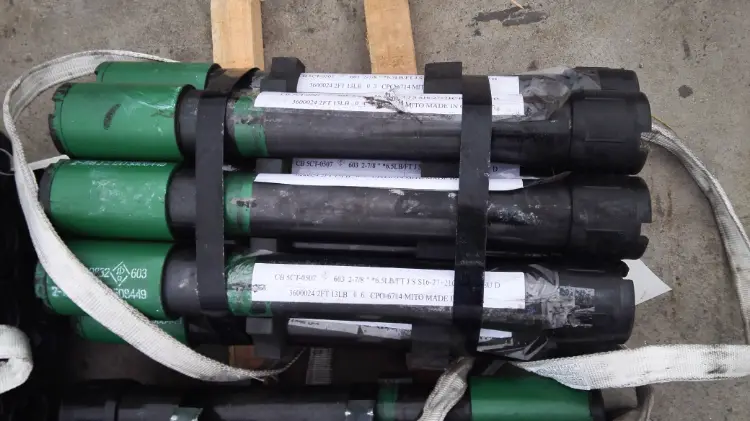
L80 Y95 Oil Special Pipe
L80 Y95 Oil Special Pipe: High Yield Strength OCTG Material Data & Specifications
Comprehensive material data for L80 Y95 oil special pipe, including chemical composition, mechanical properties, thermal properties, equivalent grades, and applications.
Quenching and tempering, hot rolling, cold drawing
- Phone : +8618037372205
- Email : [email protected]
- WhatsApp: Contact via Whtsapp
- WeChat: +8618037372205
L80 Y95 Oil Special Pipe Introduction
L80 Y95 is a high-yield strength variant of the API 5CT L80 grade, specifically designed for demanding oil and gas downhole environments. It exhibits a minimum yield strength of 95 ksi (655 MPa), providing enhanced collapse resistance and load-bearing capacity while maintaining adequate ductility. Typically supplied in quenched and tempered condition, this carbon‑manganese steel is used for casing and tubing in deep wells, where high internal or external pressure ratings are required. The designation Y95 indicates a guaranteed minimum yield strength at the upper limit of the standard L80 range, making it suitable for critical service applications. The material complies with API 5CT requirements and can be tailored for sour service (H₂S) if chemical composition limits according to NACE MR0175 are met.
L80 Y95 Oil Special Pipe Chemical Composition – L80 Type 1, PSL‑2
The chemical composition of L80 Y95 follows the requirements for L80 Type 1, Product Specification Level 2 (PSL‑2) as defined in API 5CT. This ensures tight control of impurities and alloying elements for improved sulfide stress cracking resistance and weldability. Carbon equivalent (CE) is also limited to control hardenability. All values are maximum unless otherwise noted.
| Chemical Element | Standard Value (max %) | Remarks |
|---|---|---|
| Carbon (C) | 0.43 | Maximum content for PSL-2 |
| Manganese (Mn) | 1.90 | Maximum content |
| Phosphorus (P) | 0.020 | PSL-2 limit |
| Sulfur (S) | 0.010 | PSL-2 limit |
| Silicon (Si) | 0.45 | Maximum content |
| Chromium (Cr) | 0.25 | Maximum for PSL-2 |
| Nickel (Ni) | 0.25 | Maximum for PSL-2 |
| Copper (Cu) | 0.35 | Maximum for PSL-2 |
| Molybdenum (Mo) | 0.05 | Maximum for PSL-2 |
| Vanadium (V) | 0.02 | Maximum |
| Carbon Equivalent (CE) | 0.43 | CE = C + Mn/6 + (Cr+Mo+V)/5 + (Ni+Cu)/15, max for PSL-2 |
L80 Y95 Oil Special Pipe Thermal and Electrical Physical Properties
Physical properties are typical for quenched and tempered low‑alloy carbon‑manganese steels similar to L80 Y95. These values are influenced by temperature and exact composition, but serve as good engineering estimates for design calculations.
| Property | Typical Value | Unit | Test Condition |
|---|---|---|---|
| Density (ρ) | 7.85 | g/cm³ | Room temperature |
| Elastic Modulus (E) | 205 | GPa | Room temperature |
| Shear Modulus (G) | 80 | GPa | Room temperature |
| Poisson's Ratio (ν) | 0.30 | – | Room temperature |
| Thermal Expansion Coefficient (α) | 11.7 (20‑100°C) to 14.0 (20‑400°C) | 10⁻⁶/K | Mean linear coefficient over temperature range |
| Thermal Conductivity (λ) | 50 | W/(m·K) | At 20 °C |
| Specific Heat Capacity | 460 | J/(kg·K) | At 20 °C |
| Electrical Resistivity (ρₑ) | 0.2 | µΩ·m | At 20 °C |
L80 Y95 Oil Special Pipe Mechanical Properties
Mechanical properties for L80 Y95 are derived from API 5CT requirements for L80, with the yield strength specifically adjusted to a minimum of 95 ksi (655 MPa). The test conditions follow API 5CT for full‑thickness strip or round specimens. Hardness limits ensure resistance against stress corrosion cracking in sour environments. Impact energy values are per PSL‑2 transverse Charpy V‑notch at 0 °C.
| Property | Required Value | Unit | Test Condition |
|---|---|---|---|
| Yield Strength (ReH) | 655 (min) | MPa | API 5CT strip/round specimen, 0.2% offset (min 95 ksi) |
| Yield Strength (ReH) | 758 (max, typical) | MPa | It is not an API max; for reference, C95 max is 758; L80 Y95 usually between 655‑758 |
| Tensile Strength (Rm) | 655 (min) | MPa | API 5CT requirement (min 95 ksi) |
| Elongation (A) | 18 (min) | % | Gauge length 50 mm (2 in), longitudinal strip specimen |
| Hardness | 23 HRC (max) | HRC | For L80; HBW 241 max equivalent |
| Impact Energy (KV) | 27 (min) | J | Transverse Charpy V‑notch, 0 °C, average of three specimens (PSL‑2) |
L80 Y95 Oil Special Pipe Fully Equivalent Material Standards & Substitute Grades
| Country / Region | Standard | Grade | Remarks |
|---|---|---|---|
| International | ISO 11960 | L80 | Identical to API 5CT L80; Y95 strength spec. may not be explicitly listed but achievable by heat treatment |
| China | GB/T 19830 | L80 (80SS) | Equivalent to API 5CT L80; 80S or 80SS designations may be used |
| Russia | GOST R 53366 | Л80 (L80) | Same requirements as API 5CT L80; for Y95 yield strength, additional heat treatment may be needed |
L80 Y95 Oil Special Pipe Application Introduction
L80 Y95 is tailored for the most demanding downhole environments in the oil and gas industry. Its high yield strength and controlled hardness make it ideal for deep wells, high‑pressure zones, and applications where collapse resistance under external pressure is critical. With proper chemical composition (low P, S, and controlled alloying elements), it can also be used in mildly sour service environments according to NACE MR0175. The material is commonly employed in the form of seamless casing and tubing, as well as in accessories like couplings and pup joints.
Product Applications: API 5CT Casing Pipes (4‑1/2" to 20" OD), API 5CT Tubing Pipes (2‑3/8" to 4‑1/2" OD), Casing and Tubing Couplings, Pup Joints, Line Pipe for Gathering Systems
Processed into products: Production Casing Joints in High‑Pressure Wells, Intermediate and Surface Casing for Collapse‑Critical Zones, Tubing Strings for Oil and Gas Lift, Couplings and Thread Protectors, Packers and Liner Hangers, High‑Pressure Manifold Piping
Application industries: Oil & Gas Exploration and Production, Petrochemical Industry, Geothermal Well Construction, High‑Pressure Fluid Injection Systems
L80 Y95 Oil Special Pipe Similar/Equivalent Alternative Materials
| Country / Region | Standard | Grade | Remarks |
|---|---|---|---|
| International | API 5CT | C95 | Yield strength 655‑758 MPa, provides similar strength but may have slightly different chemistry; typical for high‑collapse casing |
| International | API 5CT | T95 | Yield strength 655‑758 MPa, with enhanced sulfide stress cracking resistance; used in severe sour service |
| International | API 5CT | N80 | Lower yield strength (552‑758 MPa) but widely used; L80‑Y95 falls at the upper end of N80 range |
| International | API 5CT | P110 | Higher yield strength (758‑965 MPa), used where even greater strength is required; lacks inherent sour service rating |
Notes:
- The designation Y95 is not an official API sub‑designation but an industrial indication that the material meets a minimum yield strength of 95 ksi, which is the upper limit of the L80 strength range. It should be ordered as L80 with supplementary requirement specifying yield strength ≥ 95 ksi.
- To achieve consistent 95 ksi yield and maintain ductility, producers may adjust tempering temperature and use fine‑grain practices. Ensure the delivered material satisfies both API 5CT L80 requirements and the additional Y95 target.
- For sour service, compliance with NACE MR0175/ISO 15156 is essential; the steel must satisfy hardness ≤ 22 HRC (some restrictions) and specific chemical limits (e.g., max S ≤ 0.003% sometimes). Verify with producer.
- Typical heat treatment consists of quench + temper to obtain tempered martensite/bainite microstructure with uniform mechanical properties through the wall thickness.
- Share



