
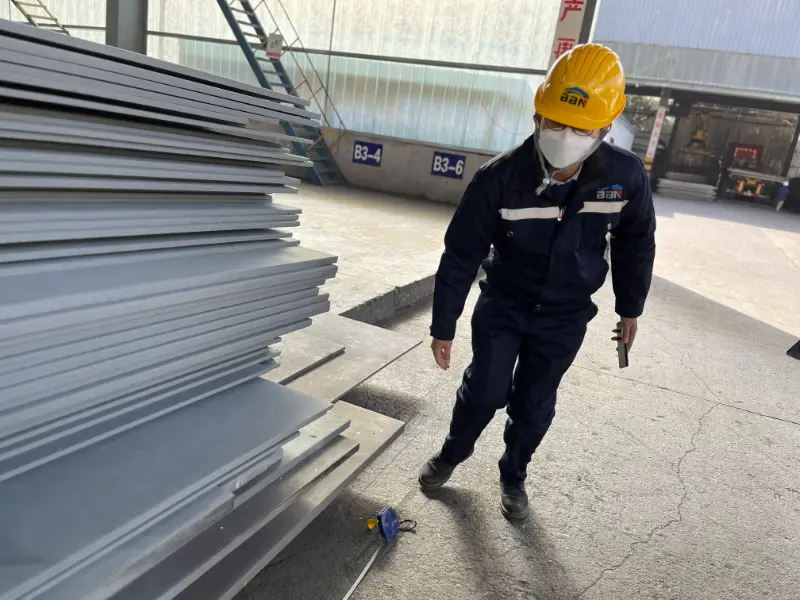
ASTM A514 Grade C Alloy Steel Plate
ASTM A514 Grade C High-Strength Quenched & Tempered Steel for Structural and Wear Applications
Detailed data sheet for ASTM A514/A514M Grade C low-alloy high-strength steel coil: chemical composition, mechanical and physical properties, equivalent grades, and application guidance.
Hot rolling, Quenching and Tempering (Q&T)
- Phone : +8618037372205
- Email : [email protected]
- WhatsApp: Contact via Whtsapp
- WeChat: +8618037372205
ASTM A514 Grade C Alloy Steel Plate Introduction
ASTM A514 Grade C is a high‑strength, quenched and tempered low‑alloy steel designed for structural applications where high yield strength (minimum 690 MPa) and good toughness are required. The grade contains chromium, molybdenum, and a boron addition to ensure deep hardenability in thicker sections. It is typically supplied as coil or plate and is widely used in heavy equipment, mining machinery, bridges, and crane structures. The combination of high strength, excellent weldability (with appropriate practices), and moderate ductility makes it an economical choice for weight‑sensitive and wear‑resistant designs.
ASTM A514 Grade C Alloy Steel Plate Chemical Composition
The chemical composition of ASTM A514 Grade C is controlled to achieve high strength and good hardenability. Boron is added in a small amount to improve the steel's ability to through‑harden in thicker sections. Low phosphorus and sulfur contents ensure good toughness and weldability.
| Element | Standard Value (wt%) | Remarks |
|---|---|---|
| Carbon (C) | 0.10 – 0.20 | Core strengthening element |
| Manganese (Mn) | 1.10 – 1.50 | Improves hardenability and strength |
| Phosphorus (P) | ≤ 0.025 | Maximum limit for toughness |
| Sulfur (S) | ≤ 0.025 | Maximum limit for cleanliness |
| Silicon (Si) | 0.15 – 0.30 | Deoxidizer and strength contributor |
| Chromium (Cr) | 1.00 – 1.50 | Enhances hardenability and wear resistance |
| Molybdenum (Mo) | 0.40 – 0.60 | Improves high‑temperature strength and hardenability |
| Boron (B) | 0.001 – 0.005 | Strongly increases hardenability, even in small amounts |
ASTM A514 Grade C Alloy Steel Plate Thermal and Electrical Physical Properties
The following physical properties are typical for quenched and tempered low‑alloy steels of the A514 grade C type. Actual values may vary slightly with heat treatment and working conditions. These data are useful for design calculations involving heat transfer, thermal expansion, and electromagnetic effects.
| Property | Standard Value | Unit | Test Condition |
|---|---|---|---|
| Density (ρ) | 7850 | kg/m³ | At room temperature |
| Elastic modulus (E) | 205 | GPa | At room temperature |
| Shear modulus (G) | 80 | GPa | At room temperature |
| Poisson's ratio (ν) | 0.29 | – | At room temperature |
| Coefficient of thermal expansion (α) | 12.4 | 10⁻⁶ /K | Between 20 °C and 100 °C |
| Thermal conductivity (λ) | 42 | W/(m·K) | At 100 °C |
| Specific heat capacity (c) | 475 | J/(kg·K) | At room temperature to 100 °C |
| Electrical resistivity (ρ_e) | 0.20 | µΩ·m | At room temperature |
ASTM A514 Grade C Alloy Steel Plate Mechanical Properties
Mechanical properties of ASTM A514 Grade C are guaranteed by the standard for plates and coils in the quenched and tempered condition. Yield strength and tensile strength are minimum and range values, respectively. Bend test requirements vary with thickness. Impact toughness is supplementary and may be specified.
| Property | Required Value | Unit | Test Condition |
|---|---|---|---|
| Yield Strength (ReH) | ≥ 690 | MPa | Thickness ≤ 65 mm (2.5 in) |
| Tensile Strength (Rm) | 760 – 895 | MPa | Thickness ≤ 65 mm |
| Elongation (A) | ≥ 18 | % | Gauge length 50 mm; thickness ≤ 65 mm |
| Bend Test (bending angle 180°) | D = 1.5t (bend diameter) | – | Specimen thickness ≤ 19 mm (¾ in) |
| Bend Test (bending angle 180°) | D = 2t (bend diameter) | – | 19 mm < specimen thickness ≤ 25.4 mm (1 in) |
ASTM A514 Grade C Alloy Steel Plate Fully Equivalent Material Standards and Recommended Replaceable Grades
| Country/Region | Standard | Grade | Remarks |
|---|---|---|---|
| USA | ASTM A514/A514M | Grade C | Exactly the base material |
ASTM A514 Grade C Alloy Steel Plate Application Introduction
ASTM A514 Grade C is an ideal material for demanding structural applications where weight savings, high strength, and moderate impact resistance are required. It can be welded, cut, and formed, though warm working and preheating are recommended to avoid cracking in the heat‑affected zone. Component design should take advantage of the high strength‑to‑weight ratio to reduce dead load.
Product Applications: Bulldozer and excavator buckets, Dump truck bodies and frames, Crane booms and jibs, Structural bridge components (girders, trusses), Heavy‑duty chassis and frames, Lifting and handling equipment, Pressure vessels (with supplementary certifications)
Processed into products: Welded structural members, Cut and bent plates for chassis reinforcements, Bucket wear plates and cutting edges, Pinned joints and brackets for heavy loads, Box section beams for crane booms, Manway covers and flanges for pressure vessels, Grouser bars and track shoe components
Application industries: Heavy equipment manufacturing, Mining and earthmoving equipment, Bridge construction, Crane and lifting equipment, Pressure vessel and storage tank fabrication, Shipbuilding and offshore structures
ASTM A514 Grade C Alloy Steel Plate Similar/Comparable Substitute Material Recommendations
| Country/Region | Standard | Grade | Remarks |
|---|---|---|---|
| Europe | EN 10025-6 | S690QL | High yield strength, quenched and tempered; similar mechanical properties but slightly different alloy concept |
| Japan | JIS G 3128 | SHY685N | High strength steel for welded structures; comparable strength level |
| China | GB/T 16270 | Q690D | Quenched and tempered high strength structural steel; similar mechanical properties |
Notes:
Material is normally supplied with mill test certificates according to EN 10204 type 3.1 or equivalent. Supplementary impact tests at low temperatures (e.g. -20 °C or -40 °C) can be agreed upon at the time of ordering. The steel should be stored in a dry environment and protected from excessive moisture before fabrication.
- Share



