
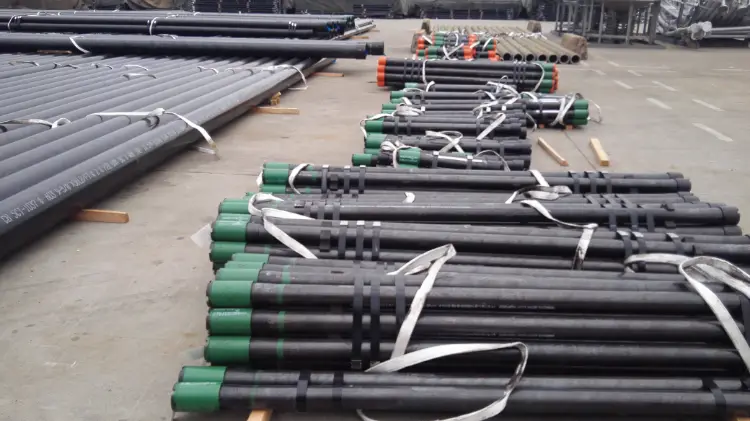
L80 Oil Country Tubular Goods (OCTG) Pipe Steel
L80 Oil Country Tubular Goods (OCTG) Pipe Steel - API 5CT Grade Analysis
Detailed material data for L80 grade steel used in oil country tubular goods per API 5CT standard, covering mechanical strength, hardness limits, typical thermal/physical properties, and application guidelines for sour service environments.
Hot rolling, cold drawing, quenching and tempering (Q&T) or normalizing and tempering (N&T) – heat treatment mandatory to achieve required properties
- Phone : +8618037372205
- Email : [email protected]
- WhatsApp: Contact via Whtsapp
- WeChat: +8618037372205
L80 Oil Country Tubular Goods Pipe Steel Introduction
L80 is a widely used steel grade for oil country tubular goods (OCTG), specified in API Spec 5CT. It is classified as a carbon steel or low-alloy steel (depending on manufacturer practice) designed for casing and tubing in oil and gas wells. The grade is defined primarily by its mechanical properties and hardness limits rather than a fixed chemical composition, allowing mills to select chemistries that meet the strength and hardness requirements. Key features include:
- Minimum yield strength of 80 ksi (552 MPa) with a maximum of 95 ksi (655 MPa), providing controlled strength for downhole applications.
- Maximum hardness of 23 HRC, making L80 suitable for mild sour service environments as per NACE MR0175/ISO 15156.
- Good resistance to sulfide stress cracking under limited H₂S exposure due to the hardness restriction.
- Available in several types: L80 Type 1 (general carbon steel), L80 9Cr, and L80 13Cr for enhanced corrosion resistance in CO₂ environments.
This analysis covers the L80 Type 1 variant, which is the most common for general-purpose sour service applications.
L80 Oil Country Tubular Goods Pipe Steel Chemical Composition
API 5CT does not prescribe mandatory chemical composition limits for L80 Type 1. The grade is defined by mechanical properties and maximum hardness. However, manufacturers typically use a controlled carbon‑manganese steel with residuals to meet strength and hardness. The following table shows typical guidance limits based on common practice; actual values are subject to agreement between purchaser and manufacturer.
- No explicit limits for Si, Cr, Ni, Cu, Mo, etc., are given; they may be present as residual elements from scrap or deliberate additions to achieve hardenability.
- For sour service, sulfur and phosphorus levels are usually kept very low to improve resistance to sulfide stress cracking.
| Chemical Element | Typical Guidance Value (max unless noted) | Remarks |
|---|---|---|
| Carbon (C) | 0.43% (typical max; often 0.30–0.35) | Not mandatory per API 5CT; chosen to ensure strength and hardenability |
| Manganese (Mn) | 1.90% (typical max; often 1.20–1.60) | Added for hardenability; not mandatory |
| Phosphorus (P) | ≤ 0.030% (recommended ≤ 0.020%) | Low level for sour service; not mandatory |
| Sulfur (S) | ≤ 0.030% (recommended ≤ 0.010%) | Low level for sour service; not mandatory |
| Silicon (Si) | Not specified (typical 0.15–0.35) | Deoxidizer; not required by API 5CT |
| Chromium (Cr) | Not specified (typical residual < 0.25) | May be present as residual |
| Nickel (Ni) | Not specified (typical residual < 0.25) | May be present as residual |
| Molybdenum (Mo) | Not specified (typical < 0.10) | Occasionally added for hardenability |
L80 Oil Country Tubular Goods Pipe Steel Thermal and Electrical Physical Properties
The following physical properties are typical for a medium‑carbon low‑alloy steel in the quenched and tempered condition. They are not part of the API 5CT specification and are provided to assist in design calculations. Actual values may vary slightly depending on exact chemistry and heat treatment.
- Thermal conductivity decreases moderately with increasing alloy content.
- Specific heat capacity is typical for steel at room temperature.
- Electrical resistivity is in the range of common carbon steels.
| Property | Typical Value | Unit | Test Condition / Temperature |
|---|---|---|---|
| Density (ρ) | 7.85 | g/cm³ | 20°C |
| Density (ρ) | 7850 | kg/m³ | 20°C |
| Elastic modulus (E) | 200 – 210 | GPa | Room temperature |
| Shear modulus (G) | 77 – 81 | GPa | Room temperature |
| Poisson's ratio (ν) | 0.27 – 0.30 | dimensionless | Room temperature |
| Thermal expansion coefficient (α) | 11.7 × 10⁻⁶ | 1/K | 20–100°C |
| Thermal expansion coefficient (α) | 12.5 × 10⁻⁶ | 1/K | 20–200°C |
| Thermal conductivity (λ) | ≈ 50 | W/(m·K) | 20°C |
| Thermal conductivity (λ) | ≈ 45 | W/(m·K) | 100°C |
| Specific heat capacity | 460 – 480 | J/(kg·K) | 20°C |
| Electrical resistivity (ρ_e) | 0.20 – 0.25 | μΩ·m | 20°C |
L80 Oil Country Tubular Goods Pipe Steel Mechanical Properties
Mechanical testing is performed on specimens taken from the pipe body or coupling stock after final heat treatment. Properties are independent of pipe size within standard limitations. Hardness is the key quality control parameter for sour service.
- Yield strength limits are 80–95 ksi (552–655 MPa), measured by 0.2% offset method.
- Tensile strength minimum is 95 ksi (655 MPa).
- Elongation requirements depend on specimen orientation and wall thickness.
- Charpy V‑notch impact tests are supplementary and often required for PSL‑2 or when specified by the purchaser; typical minimum absorbed energy is 20–27 J at 0°C.
| Property | Standard Requirement | Unit | Test Condition |
|---|---|---|---|
| Yield strength (0.2% offset) | 80 – 95 | ksi | Room temperature, pipe body transverse or longitudinal |
| Yield strength (0.2% offset) | 552 – 655 | MPa | Room temperature |
| Tensile strength | ≥ 95 | ksi | Room temperature |
| Tensile strength | ≥ 655 | MPa | Room temperature |
| Elongation (round specimen, 2 in gauge length) | ≥ 18.5 (for wall ≤ 0.500 in) | % | Transverse/longitudinal, base metal |
| Elongation (round specimen, 2 in gauge length) | ≥ 19 (for wall > 0.500 in) | % | Transverse/longitudinal, base metal |
| Elongation (strip specimen, 2 in gauge length) | ≥ 13 | % | Base metal, as per API 5CT |
| Hardness (Rockwell C) | ≤ 23 | HRC | At any location throughout pipe wall |
| Charpy impact energy (supplementary) | ≥ 20 (single) / ≥ 27 (average) | J | At 0°C (32°F), transverse specimen, PSL‑2 typical |
L80 Oil Country Tubular Goods Pipe Steel Fully Equivalent Material Standards and Substitutable Grades
| Country/Region | Standard | Grade | Remarks |
|---|---|---|---|
| Global | ISO 11960 | L80 Type 1 | Identical to API 5CT L80; direct equivalent |
| Russia / CIS | GOST Р 53366 | L80 | Mechanical properties aligned; minor chemistry and dimension adjustments may apply |
| China | SY/T 6194 | L80 | Chinese standard essentially adopts API 5CT L80; interchangeable |
| Canada | CAN/CSA Z245.1 | L80 | Harmonized with API 5CT; identical mechanical requirements |
L80 Oil Country Tubular Goods Pipe Steel Application Introduction
L80 Type 1 is specifically designed for oil and gas upstream applications where moderate strength and resistance to sulfide stress cracking (SSC) in mild sour environments are required. Its hardness limitation makes it compliant with NACE MR0175/ISO 15156 for service in H₂S-containing fluids, subject to environmental severity (pH, H₂S partial pressure). The grade is not intended for highly corrosive CO₂ environments; for such conditions, the chromium-bearing L80 9Cr or L80 13Cr variants are recommended.
Product Applications: Production casing strings, Tubing strings (production tubing), Intermediate and surface casing, Liner strings, Pup joints, Couplings and integral connections
Processed into products: Casing pipes (standard and premium connections), Tubing pipes (internally coated or bare), Couplings with corrosion‑resistant alloy or bare steel, Weld‑on connectors, Perforating gun bodies (when hardness restrictions apply), Drill pipe tool joints (API 7; as a material option)
Application industries: Onshore and offshore oil and gas exploration and production, Geothermal energy (casing and tubing), Gas storage wells, Injection wells for enhanced oil recovery (with adequate corrosion evaluation)
L80 Oil Country Tubular Goods Pipe Steel Similar/Alternative Materials with Comparable Performance
| Country/Region | Standard | Grade | Remarks |
|---|---|---|---|
| Global | API 5CT | N80 Type 1 | Same minimum yield strength as L80 but higher maximum yield (110 ksi) and no hardness limit; not suitable for sour service |
| Global | API 5CT | C95 | Minimum yield 95 ksi, higher strength; used in deeper wells; hardness limit not specified, but generally not for sour service |
| Global | API 5CT | T95 | 0.5% yield 95–110 ksi, controlled hardness (max 25.4 HRC) for sour service; substitute for higher strength needs in sour wells |
| Global | API 5CT | L80 9Cr / L80 13Cr | Corrosion‑resistant variants with added chromium; 9Cr for moderate CO₂, 13Cr for higher CO₂; suitable when L80 Type 1 corrosion resistance is insufficient |
| Germany | DIN EN 10297‑1 | 25CrMo4 (1.7218) | Similar strength level after Q&T, but chemical composition is precisely defined (Cr‑Mo alloy); not a direct OCTG grade |
Notes:
Processing and quality considerations:
- Full‑body hardness testing is mandatory to ensure maximum 23 HRC; this is a critical quality check for sour service qualification.
- The steel must be fully killed and fine‑grain practice (ASTM grain size #5 or finer) to ensure uniform properties.
- Supplementary testing (Charpy impact, non‑destructive electromagnetic inspection) is often required by end‑user specifications.
- Welded L80 pipes are permissible only when the purchaser specifies supplementary requirements, and the weld must be heat treated to match base metal properties.
- Typical heat treatment consists of austenitizing at 850–900°C, quenching in water or polymer, and tempering at 600–680°C to achieve the desired hardness and strength.
- Share



