
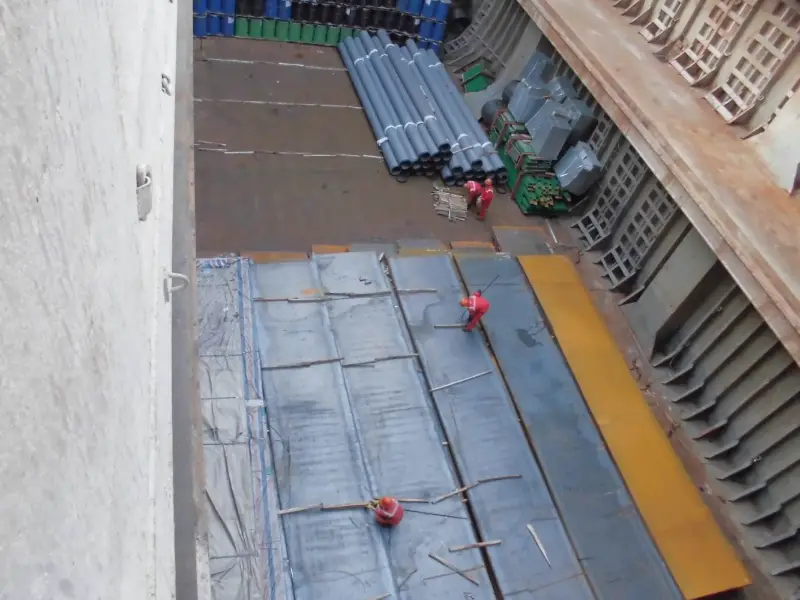
ASTM A514 Grade B Steel
ASTM A514 Grade B Steel: High-Strength Quenched & Tempered Alloy for Heavy Structures
Comprehensive material data for ASTM A514/A514M Grade B carbon and low-alloy high-strength steel coil, including chemical composition, mechanical properties, thermal and electrical physical properties, and international equivalents. Ideal for welded structures, bridges, and machinery.
Hot rolling, quenching and tempering, cutting, welding, forming
- Phone : +8618037372205
- Email : [email protected]
- WhatsApp: Contact via Whtsapp
- WeChat: +8618037372205
ASTM A514 Grade B Steel Introduction
ASTM A514 Grade B is a quenched and tempered, high-strength, low-alloy structural steel plate and coil designed for welded applications where weight savings and high strength are critical. It offers a minimum yield strength of 690 MPa (100 ksi) and excellent notch toughness, making it suitable for heavy-duty structural components.
- High yield strength reduces weight in mobile equipment.
- Good weldability with low carbon equivalent.
- Supplied in quenched and tempered condition for optimal mechanical properties.
Typical applications include construction equipment, crane booms, bridges, and pressure vessels.
ASTM A514 Grade B Steel Chemical Composition
The chemical composition of ASTM A514 Grade B is controlled to achieve high strength and good weldability. Key elements such as chromium, molybdenum, and boron enhance hardenability, while low carbon content minimizes weld cracking. Maximum limits apply unless a range is given.
| Element | Standard Value | Remarks |
|---|---|---|
| Carbon (C) | 0.12 – 0.21 | Heat analysis |
| Manganese (Mn) | 0.70 – 1.00 | Heat analysis |
| Phosphorus (P) | ≤ 0.025 | Maximum |
| Sulfur (S) | ≤ 0.025 | Maximum |
| Silicon (Si) | 0.20 – 0.35 | Heat analysis |
| Chromium (Cr) | 0.40 – 0.65 | Heat analysis |
| Molybdenum (Mo) | 0.15 – 0.25 | Heat analysis |
| Vanadium (V) | 0.03 – 0.08 | Heat analysis |
| Titanium (Ti) | 0.01 – 0.03 | Heat analysis |
| Boron (B) | 0.0005 – 0.005 | Heat analysis |
ASTM A514 Grade B Steel Thermal and Electrical Physical Properties
The following physical properties are typical for quenched and tempered low-alloy steels at room temperature. They may vary slightly with exact composition and processing. Data serve as engineering reference.
| Property | Typical Value | Unit | Condition / Temperature |
|---|---|---|---|
| Density (ρ) | 7.85 | g/cm³ | 20°C |
| Modulus of Elasticity (E) | 205 | GPa | 20°C |
| Shear Modulus (G) | 80 | GPa | 20°C |
| Poisson's Ratio (ν) | 0.30 | 20°C | |
| Thermal Expansion Coefficient (α) | 11.7 × 10^-6 | /K | 20–100°C |
| Thermal Conductivity (λ) | 45 | W/(m·K) | 20°C |
| Specific Heat Capacity | 500 | J/(kg·K) | 20°C |
| Electrical Resistivity (ρ_e) | 0.22 | μΩ·m | 20°C |
ASTM A514 Grade B Steel Mechanical Properties
Mechanical tests are performed on transverse specimens. Tensile properties apply to the prescribed thickness ranges. Grade B is typically supplied in thicknesses up to 32 mm (1.25 in.) under ASTM A514, though the standard covers greater thicknesses; properties may vary for heavier sections. The values below are minimum or range requirements per the standard.
| Property | Standard Requirement | Unit | Test Condition |
|---|---|---|---|
| Yield Strength (ReH) | ≥ 690 | MPa | 0.2% offset, thickness ≤ 20 mm (0.75 in.) |
| Tensile Strength (Rm) | 760 – 895 | MPa | Thickness ≤ 20 mm (0.75 in.) |
| Elongation (A) | ≥ 18 | % | In 200 mm (8 in.) gauge length |
| Elongation (A) | ≥ 20 | % | In 50 mm (2 in.) gauge length |
| Bend Test | d=3a (180°) | Bend diameter = 3 × specimen thickness, no cracks | |
| Charpy V-Notch Impact (KV) | ≥ 27 (typical supplemental requirement) | J | At -20°C, longitudinal, if specified |
ASTM A514 Grade B Steel Exact Equivalent Material Standards and Alternative Grades
| Country/Region | Standard | Grade | Remarks |
|---|---|---|---|
| Europe | EN 10025-6 | S690Q | Same delivery condition, close chemical & mechanical properties |
| International | ISO 4950-2 | E690DD | High-strength structural steel, Q&T |
| Japan | JIS G 3128 | SHY 685 | Comparable yield strength, used for welded structures |
| China | GB/T 16270 | Q690D | Quenched and tempered high-strength structural steel |
ASTM A514 Grade B Steel Application Introduction
ASTM A514 Grade B is engineered for demanding structural applications where high strength-to-weight ratio and good weldability are essential. It is delivered in quenched and tempered condition and can be fabricated using standard practices.
- Welding: Low-hydrogen practices recommended; preheating typically not required for thinner sections.
- Forming: Can be cold formed to moderate radii; hot forming should be followed by re-heat treatment.
Product Applications: Excavator booms and arms, Crane lattice structures, Heavy-duty truck frames, Offshore platform components, Bridge girders, Blast-resistant structures
Processed into products: Welded structural beams, Lifting lugs and attachments, Bearing plates, Chassis rails, Telescopic crane sections, High-pressure cylindrical shells
Application industries: Heavy construction machinery, Offshore and marine engineering, Bridge building, Mining equipment, Pressure vessels (per ASTM A517 Grade B), Mobile crane manufacturing
ASTM A514 Grade B Steel Similar Grade Recommendations with Slightly Different Properties
| Country/Region | Standard | Grade | Remarks |
|---|---|---|---|
| USA | ASTM A514 | Grade H | Similar strength but different alloy concept; often interchangeable |
| USA | ASTM A514 | Grade F | Higher toughness at lower temperatures; similar yield strength |
| Europe | EN 10025-6 | S690QL | Better low-temperature toughness (L-grade), otherwise very close |
| USA | ASTM A517 | Grade B | Identical composition to A514 Grade B but for pressure vessel application (different standard) |
Notes:
Note: For thicknesses above 32 mm, the standard mechanical properties may be reduced; consult the full ASTM A514/A514M specification. Supplementary requirements (e.g., Charpy impact, ultrasonic testing) should be agreed upon at the time of ordering. The product is typically supplied with a mill test report (MTR) certifying chemical and mechanical results.
- Share



