
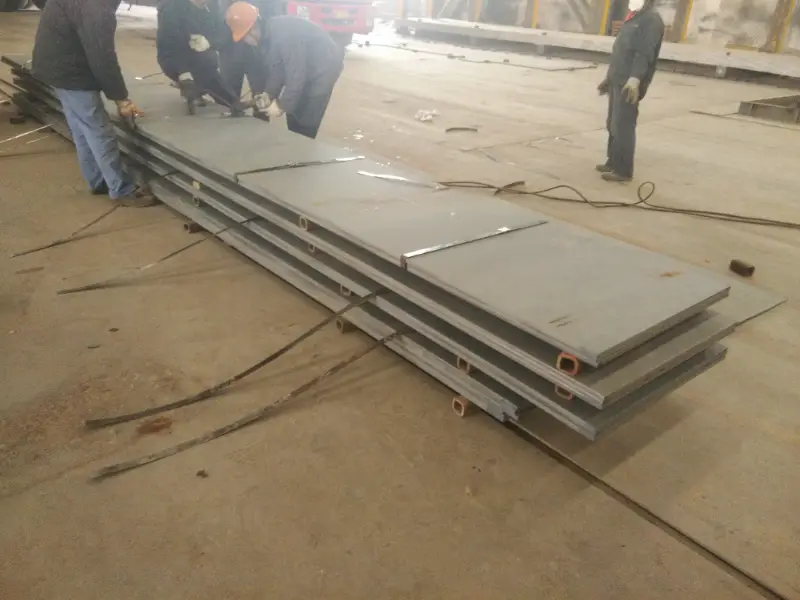
ASTM A514 Grade A High Strength Quenched & Tempered Steel
ASTM A514 Grade A High-Strength Quenched & Tempered Steel: Data & Equivalents
Complete technical data for ASTM A514 Grade A low-alloy high-strength steel: chemical composition, mechanical and physical properties, international equivalents, and application guidance.
Hot rolling, cold forming, welding, machining (after appropriate thermal treatment)
- Phone : +8618037372205
- Email : [email protected]
- WhatsApp: Contact via Whtsapp
- WeChat: +8618037372205
ASTM A514 Grade A High Strength Quenched & Tempered Steel Introduction
ASTM A514 Grade A is a quenched and tempered low-alloy high-strength steel plate designed for structural applications requiring high yield strength (minimum 100 ksi / 690 MPa) combined with good weldability and notch toughness. Grade A is distinguished by its zirconium and boron microalloying, which promotes hardenability and fine grain size. It is supplied in the quenched and tempered condition and is used in heavy-duty machinery, pressure vessels, and welded structures. Key features:
- Minimum yield strength 690 MPa (100 ksi)
- Controlled chemistry with Zr and B for deep hardening
- Good formability and weldability with proper procedures
- Available as coil or cut plate up to 6 in. (150 mm) thick
ASTM A514 Grade A High Strength Quenched & Tempered Steel Chemical Composition
The chemical composition of ASTM A514 Grade A as specified by ASTM A514/A514M. Zirconium and boron are key microalloying elements that enhance hardenability. Note: Phosphorus and sulfur limits reflect the current standard practice for clean steel. Actual values may be tighter for specific thicknesses to meet mechanical properties.
| Element | Required Value (wt%) | Remarks |
|---|---|---|
| Carbon (C) | 0.15 – 0.21 | Core hardening element |
| Manganese (Mn) | 0.80 – 1.10 | Deoxidizer and strength contributor |
| Phosphorus (P) | 0.025 max | Residual element, controlled for toughness |
| Sulfur (S) | 0.025 max | Residual element, controlled for formability |
| Silicon (Si) | 0.40 – 0.80 | Deoxidizer and solid solution strengthener |
| Chromium (Cr) | 0.50 – 0.80 | Improves hardenability and corrosion resistance |
| Molybdenum (Mo) | 0.18 – 0.28 | Suppresses temper embrittlement, adds strength |
| Zirconium (Zr) | 0.05 – 0.15 | Microalloy for grain refinement and hardenability |
| Boron (B) | 0.0025 max | Strongly improves hardenability at low levels |
ASTM A514 Grade A High Strength Quenched & Tempered Steel Thermal and Electrical Physical Properties
Physical properties are typical for quenched and tempered low-alloy steel. Values may vary slightly with exact heat treatment and thickness. Density is standard for steel; thermal expansion and conductivity are approximate and useful for engineering calculations. Electrical resistivity is typical for alloyed ferritic steel.
| Property | Typical Value | Unit | Test Condition |
|---|---|---|---|
| Density (ρ) | 7.85 | g/cm³ | Ambient temperature |
| Elastic Modulus (E) | 205 | GPa | Tension, room temperature |
| Shear Modulus (G) | 80 | GPa | Calculated from E and Poisson's ratio |
| Poisson's Ratio (ν) | 0.30 | – | Within elastic range |
| Thermal Expansion Coeff. (α) | 11.7 | 10⁻⁶ /K | 20–100 °C |
| Thermal Expansion Coeff. (α) | 12.5 | 10⁻⁶ /K | 20–200 °C |
| Thermal Expansion Coeff. (α) | 13.2 | 10⁻⁶ /K | 20–300 °C |
| Thermal Conductivity (λ) | 42 | W/(m·K) | At 20 °C |
| Specific Heat Capacity | 475 | J/(kg·K) | Room temperature |
| Electrical Resistivity (ρₑ) | 0.22 | 10⁻⁶ Ω·m | At 20 °C |
ASTM A514 Grade A High Strength Quenched & Tempered Steel Mechanical Properties
Mechanical properties are guaranteed for plate thicknesses up to 6 in. (150 mm). Tensile properties are measured on standard specimens; yield strength is the 0.2% offset (or 0.5% under load if specified). Bend test requirements depend on thickness. Charpy V-notch impact tests are not mandatory but can be supplied to supplementary requirements, typically with values > 27 J at -20 °C for some grades.
| Property | Required Value | Unit | Test Condition |
|---|---|---|---|
| Yield Strength (ReH) | 690 min | MPa | 0.2% offset, room temperature |
| Tensile Strength (Rm) | 760 – 895 | MPa | Room temperature |
| Elongation (A) | 18 min | % | Gauge length 2 in. (50 mm) |
| Bend Test (Diameter) | 2t (t ≤ 3/4 in.) | – | Bent 180°; t = plate thickness |
| Bend Test (Diameter) | 2.5t (3/4 in. < t ≤ 1 in.) | – | Bent 180° |
| Bend Test (Diameter) | 3t (1 in. < t ≤ 2 in.) | – | Bent 180° |
| Bend Test (Diameter) | Consult supplier (t > 2 in.) | – | May require larger bend radius |
ASTM A514 Grade A High Strength Quenched & Tempered Steel Exact Equivalent Material Standards and Replacement Grades
ASTM A514 Grade A has a unique chemistry with zirconium and boron, which is not exactly replicated in other international standards. The grades listed below represent the closest exact matches within recognized systems. Where no direct equivalent exists, the grade is still identified under its UNS number.
| Country/Region | Standard | Grade | Remarks |
|---|---|---|---|
| USA | ASTM A514/A514M | Grade A | Original specification; UNS K11856 |
| – | – | – | No ISO, EN, JIS or GB equivalent with identical chemistry |
ASTM A514 Grade A High Strength Quenched & Tempered Steel Application Introduction
ASTM A514 Grade A is primarily used where high strength-to-weight ratio, good weldability, and reliable toughness are required. Its ability to be formed and welded after quenching and tempering makes it suitable for complex welded fabrications. Typical applications include:
- Mobile crane booms and lattice structures
- Heavy-duty truck frames and trailers
- Excavator and mining equipment components
- Pressure vessels and storage tanks (with supplementary impact testing)
- Offshore platform and shipbuilding structures where weight savings are critical
Product Applications: Welded structural beams and columns, Mobile crane telescopic booms, Heavy-haul truck chassis, Excavator arms and buckets, Armored vehicle hulls, Storage tanks for low-temperature service (with supplementary requirements)
Processed into products: Boom sections and lattice chords, Frame rails and cross-members, Welded box sections and hollow profiles, Cutting edges and wear plates, Circumferential welds in pressure shells, Lifting lugs and attachment brackets
Application industries: Construction and heavy civil engineering, Crane and lifting equipment, Mining and earthmoving machinery, Transportation and trailer manufacturing, Pressure vessel and boiler fabrication, Shipbuilding and offshore engineering
ASTM A514 Grade A High Strength Quenched & Tempered Steel Similar / Alternative Materials
While exact chemical equivalence is rare, the following grades offer similar minimum yield strength (690 MPa) and are often considered for alternative sourcing. Note: Each substitute may differ in weldability, toughness, or available dimensions, and must be evaluated for the specific application.
| Country/Region | Standard | Grade | Remarks |
|---|---|---|---|
| EU | EN 10025-6 | S690Q | Quenched & tempered, no Zr/B requirement; similar strength range |
| EU | EN 10149-2 | S700MC | Thermomechanically rolled; higher yield, different chemistry and delivery condition |
| USA | ASTM A514/A514M | Grade B, E, F, H, etc. | Other A514 grades with slightly different chemistry; same strength requirements |
| Japan | JIS G 3128 | SHY685 | High yield strength steel for welded structures; similar mechanical properties |
| China | GB/T 16270 | Q690D / Q690E | Quenched and tempered structural steel; chemistry may differ; verify impact requirements |
Notes:
Delivery condition: Quenched and tempered (plate is heat treated by the manufacturer). Welding: Low-hydrogen practices are essential; preheating and interpass control may be required depending on thickness. Post-weld heat treatment (PWHT): Not normally needed for service in ambient conditions, but if required, the temperature should not exceed the original tempering temperature. Impact testing: Charpy V-notch requirements are not part of the base specification; they must be added by supplementary requirement (e.g., ASTM A6/A6M S5). Typical supplementary toughness values are > 27 J at -20 °C for many structural applications.
- Share



