
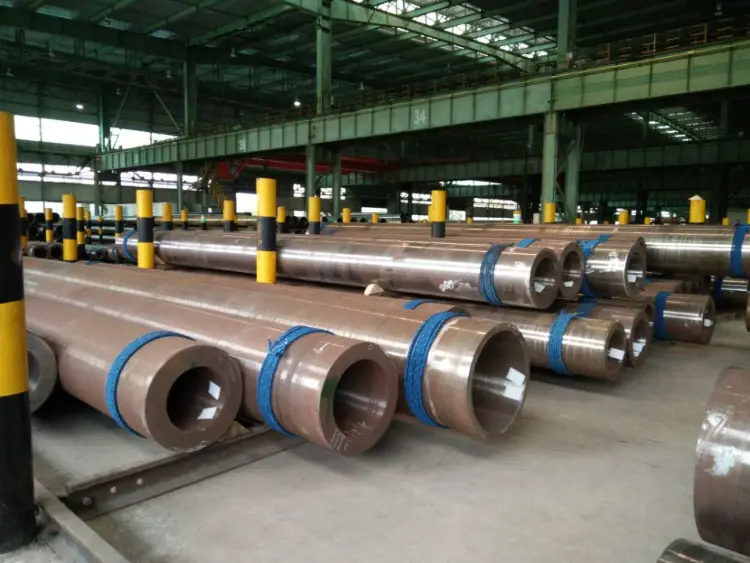
L450 SSAW Line Pipe
L450 SSAW Line Pipe: Comprehensive Guide to GB/T 9711-2011 PSL1 X65 Equivalent Steel
Explore detailed chemical, mechanical and physical properties of L450 steel grade for spiral submerged arc welded pipe according to GB/T 9711-2011 PSL1, with full equivalent material substitutions and application insights.
Thermo-mechanical controlled process (TMCP), hot rolling, normalizing; welding by submerged arc process
- Phone : +8618037372205
- Email : [email protected]
- WhatsApp: Contact via Whtsapp
- WeChat: +8618037372205
L450 SSAW Line Pipe Introduction
L450 is a high-strength low-alloy (HSLA) steel grade specified in GB/T 9711-2011 (equivalent to ISO 3183) for use in petroleum and natural gas pipeline systems. This grade, designated as PSL1 in the standard, is primarily delivered as spiral submerged arc welded (SSAW) pipe. Key characteristics include:
- Minimum yield strength of 450 MPa (65 ksi), often referred to as X65 in API 5L terminology.
- Good weldability and low-temperature toughness when specified.
- Excellent balance of strength and ductility for transporting hydrocarbons under high pressure over long distances.
- Manufactured through thermomechanical rolling or normalizing processes.
The material is widely used in onshore and offshore pipeline projects due to its reliable performance and cost-effectiveness.
L450 SSAW Line Pipe Chemical Composition
The chemical composition limits for L450 steel under GB/T 9711-2011 PSL1 are defined to ensure adequate strength, weldability, and toughness. Key restrictions include:
- Maximum carbon content ensures good weldability.
- Microalloying elements (Nb, V, Ti) are added to achieve high strength through grain refinement.
- Phosphorus and sulfur are strictly controlled to avoid embrittlement.
- Carbon equivalent (CEV or Pcm) may be imposed by supplementary agreement to guarantee field weldability.
The exact composition is left to the manufacturer's discretion within the prescribed limits. The table below represents the maximum allowed values for heat analysis, unless a range is indicated.
| Element | Specified Value (max %) | Remarks |
|---|---|---|
| Carbon (C) | 0.28 | Typical range 0.05–0.15 for X65/L450 |
| Silicon (Si) | No specified limit | Usually ≤0.40; may be reported for product analysis |
| Manganese (Mn) | 1.40 | Minimum typically around 1.00 |
| Phosphorus (P) | 0.030 | Lower values improve toughness |
| Sulfur (S) | 0.030 | Controlled for inclusion shape control |
| Niobium (Nb) | — | Sum of Nb+V+Ti ≤ 0.15% |
| Vanadium (V) | — | Sum of Nb+V+Ti ≤ 0.15% |
| Titanium (Ti) | — | Sum of Nb+V+Ti ≤ 0.15% |
| Niobium + Vanadium + Titanium | 0.15 | Total microalloy content |
| Aluminum (Al) | — | Usually added for deoxidation; Al/N ratio crucial for grain refinement |
| Nitrogen (N) | — | No max specified, but typically ≤0.012% |
| Others | As per agreement | Possible additions: Cu, Ni, Cr, Mo ≤0.50% each |
L450 SSAW Line Pipe Thermal and Electrical Physical Properties
The physical property data below are typical for low-carbon, low-alloy line pipe steels like L450 / X65. These values are not mandated by GB/T 9711-2011 but are commonly used in engineering design. The properties can vary with temperature and specific heat treatment.
- Density is nearly constant at room temperature.
- Thermal expansion and thermal conductivity influence pipeline design and insulation requirements.
- Electrical resistivity is important for cathodic protection systems.
The values are valid at approximately 20 °C unless a temperature range is given.
| Property | Typical Value | Unit | Test Conditions / Temperature |
|---|---|---|---|
| Density (ρ) | 7.85 | g/cm³ | 20 °C |
| Young's Modulus (E) | 205 – 210 | GPa | 20 °C, tension |
| Shear Modulus (G) | 79 – 81 | GPa | 20 °C, derived from E and Poisson's ratio |
| Poisson's ratio (ν) | 0.30 | — | 20 °C, within elastic range |
| Thermal expansion coefficient (α) | 11.7 | 10⁻⁶ /K | 20–100 °C |
| Thermal conductivity (λ) | 50 | W/(m·K) | 20 °C |
| Specific heat capacity (c_p) | 460 – 480 | J/(kg·K) | 20 °C |
| Electrical resistivity (ρ_e) | 0.15 – 0.20 | μΩ·m | 20 °C |
L450 SSAW Line Pipe Mechanical Properties
Mechanical properties as mandated by GB/T 9711-2011 PSL1 for L450 steel. The tensile test specimens are taken transverse to the pipe axis.
- Yield strength and tensile strength shall be within the specified ranges to prevent under- or over-strength conditions.
- Elongation values apply to rectangular test pieces with a gauge length of 50 mm; alternative elongation formulas are permitted for strip specimens.
- Bend test is a measure of formability; the specimen must bend 180° without cracking.
- Charpy V-notch impact test is not mandatory for PSL1 unless agreed upon; typical values for reference are provided.
All tests are carried out at room temperature unless otherwise stated.
| Property | Required Value | Unit | Test Conditions |
|---|---|---|---|
| Yield Strength (ReH) | 450 – 600 | MPa | Transverse, round bar or strip, 0.2% offset or ReH |
| Tensile Strength (Rm) | 535 – 760 | MPa | Transverse, to fracture |
| Elongation after fracture (A) | ≥ 22 | % | Gauge length 50 mm, transverse strip specimen |
| Yield to tensile ratio (ReH/Rm) | ≤ 0.90 (typical) | — | No mandatory max in PSL1, but often limited by supplementary specification |
| Bend test (180°) | No cracks | — | Mandrel diameter: 2T (T=wall thickness) for T ≤12.7 mm; larger bend radius for thicker wall |
| Charpy V-notch impact energy (KV) | ≥ 27 J (if specified) | J | Transverse, at 0 °C or design temperature; not required for PSL1 unless by agreement |
L450 SSAW Line Pipe Exact Equivalent Material Standards and Substitutable Grades
| Country/Region | Standard | Grade | Remarks |
|---|---|---|---|
| International (ISO) | ISO 3183:2007 | L450 | Identical technical requirements; PSL1 designation |
| USA | API Spec 5L (46th Edition) | X65 | PSL1 equivalent; widely used in oil and gas industry |
| European Union | EN 10208-2 | L450MB | For gas supply pipes; similar mechanical properties, PSL1 not explicitly defined but comparable |
| Canada | CSA Z245.1 | Grade 450 | PSL1 category covers the same strength level |
| Russia/CIS | GOST R ISO 3183 | K55 (L450 analog) | Harmonized with ISO 3183; grade designation differs |
L450 SSAW Line Pipe Application Introduction
L450 spiral submerged arc welded pipe is designed for long-distance transportation of liquid and gaseous hydrocarbons. Its high strength-to-weight ratio and excellent weldability make it a preferred choice in modern pipeline infrastructure.
- When selecting this material, consider operating pressure, temperature, and environmental conditions.
- The PSL1 specification covers basic quality requirements; additional testing (PSL2) may be invoked for critical service.
Product Applications: Spiral submerged arc welded (SSAW) pipes from 406 mm to 2500 mm outside diameter, Coated line pipes with 3-layer PE or FBE coating, Offshore pipeline sections with concrete weight coating, Induction bends and fittings derived from L450 base material
Processed into products: Line pipe main body for cross-country pipelines, Girth-welded joints and field connections, Pipe-to-fitting transitions (tees, reducers, elbows), Hot induction bends (API 5L X65 equivalent) with quench and tempering, Pipeline repair clamps and mechanical connectors
Application industries: Oil and Gas: Onshore and offshore trunk pipelines, gathering lines, Water Utilities: High pressure water transmission mains, Structural Engineering: Piling, offshore jacket legs, risers, Mining: Slurry transport pipelines
L450 SSAW Line Pipe Comparable / Substitutional Material Recommendations
| Country/Region | Standard | Grade | Remarks |
|---|---|---|---|
| China | GB/T 9711-2011 | L415 (X60) | Lower strength grade; may be used in less demanding applications where reduced wall thickness is acceptable |
| USA | API 5L | X70 (L485) | Higher strength grade; allows thinner wall but requires careful welding procedure qualification |
| European Union | EN 10208-2 | L415MB | Similar to X60; can replace L450 where design pressure is lower |
| International (ISO) | ISO 3183 | L485 (X70) | For higher strength requirements; increased alloy content and CEV |
Notes:
- For sour service (H₂S containing environments), supplementary requirements for HIC and SSC resistance must be applied; L450 PSL1 is generally not suitable without testing.
- When ordering, the purchaser can specify additional inspections like ultrasonic testing of weld seam, Charpy impact at low temperatures, and drop weight tear test (DWTT).
- Carbon equivalent (CE PCM or CE IIW) is often restricted to ≤0.22% (Pcm) to ensure field weldability, though not mandatory in PSL1.
- Wall thickness and pipe dimension tolerances shall comply with GB/T 9711-2011, and hydrostatic testing is required for each length of pipe.
- Share



