
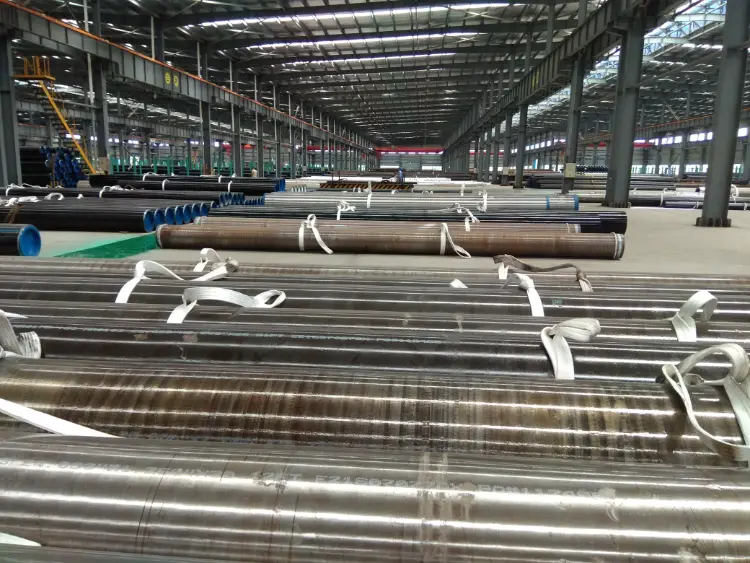
L485 (X70) SSAW Pipeline Steel Pipe
L485 (X70) SSAW Pipeline Steel Pipe: High-Strength Solution for Oil and Gas Transmission
Delve into the specifics of GB/T 9711-2011 PSL1 L485 steel pipe, a cornerstone for modern pipeline systems. Detailed analysis of chemical composition, mechanical and physical properties, international equivalents, and application insights.
Controlled rolling, normalizing, spiral welding, submerged arc welding, post-weld heat treatment (if required)
- Phone : +8618037372205
- Email : [email protected]
- WhatsApp: Contact via Whtsapp
- WeChat: +8618037372205
L485 SSAW Pipeline Steel Pipe Introduction
GB/T 9711-2011 L485 (PSL1) is a low-alloy high-strength steel primarily used for spiral submerged arc welded (SSAW) pipes in oil and gas transmission. As a PSL 1 grade, it ensures reliable baseline performance with a specified minimum yield strength of 485 MPa and tensile strength between 570 and 760 MPa. The material exhibits excellent weldability, good toughness at low temperatures, and resistance to ductile fracture propagation, making it suitable for long-distance high-pressure pipelines. It conforms to the Chinese national standard which is technically identical to ISO 3183, ensuring international compatibility. Being a PSL 1 product, the mandatory testing focuses on tensile properties, while impact and bend tests are not required unless separately agreed. The typical microstructure is fine-grained ferrite with dispersed pearlite or bainite, achieved through controlled rolling and microalloying with niobium, vanadium, or titanium. This steel grade is widely used in onshore and offshore pipeline projects, providing a cost-effective balance between strength and toughness.
L485 SSAW Pipeline Steel Pipe Chemical Composition
The chemical composition is based on heat analysis as per GB/T 9711-2011 for PSL 1 L485. Only carbon, manganese, phosphorus, and sulfur are strictly limited. To achieve the required strength and toughness, manufacturers often add microalloying elements such as niobium, vanadium, or titanium; their contents are not specified by the standard and are subject to the manufacturer's own practice. The carbon equivalent is controlled to ensure good field weldability.
| Element | Standard Value (wt%) | Remarks |
|---|---|---|
| Carbon (C) | ≤ 0.28 | Heat analysis |
| Manganese (Mn) | ≤ 1.40 | Heat analysis |
| Phosphorus (P) | ≤ 0.030 | Heat analysis |
| Sulfur (S) | ≤ 0.030 | Heat analysis |
| Other microalloying elements (Nb, V, Ti, etc.) | By agreement | Added as needed to meet mechanical properties; no specified limits |
L485 SSAW Pipeline Steel Pipe Thermal, Electrical and Physical Properties
These physical properties are typical for low‑alloy pipeline steels and are provided as design reference values. They are not mandatory certification parameters under GB/T 9711-2011. Slight variations may occur depending on exact chemical composition and heat treatment condition.
| Property | Typical Value | Unit | Condition / Reference |
|---|---|---|---|
| Density (ρ) | 7.85 | g/cm³ | 20 °C |
| Modulus of Elasticity (E) | 206 | GPa | 20 °C |
| Shear Modulus (G) | 79.3 | GPa | 20 °C, calculated from E and ν |
| Poisson's Ratio (ν) | 0.3 | — | — |
| Thermal Expansion Coefficient (α) | 11.7 × 10⁻⁶ | 1/K | 20–100 °C |
| Thermal Conductivity (λ) | 50 | W/(m·K) | 20 °C |
| Specific Heat Capacity | 460 | J/(kg·K) | 20 °C |
| Electrical Resistivity (ρ_e) | 1.5 × 10⁻⁷ | Ω·m | 20 °C |
L485 SSAW Pipeline Steel Pipe Mechanical Properties
The tensile properties are mandatory for PSL 1 L485 pipes. Testing is performed on transverse specimens taken from the pipe body. Elongation requirements depend on wall thickness. Bend testing is not required for PSL 1 products, and impact testing (Charpy V-notch) is not mandatory unless agreed upon between the purchaser and manufacturer. The values below are the minimum acceptance criteria per GB/T 9711-2011.
| Property | Standard Required Value | Unit | Test Condition |
|---|---|---|---|
| Yield Strength (ReH) | 485 – 635 | MPa | Transverse, round bar tensile test, GB/T 228.1 |
| Tensile Strength (Rm) | 570 – 760 | MPa | Transverse, round bar tensile test, GB/T 228.1 |
| Elongation after Fracture (A) | min. 20% for t ≤ 20 mm; min. 22% for t > 20 mm | % | Gauge length 50 mm, transverse rectangular or round specimen |
| Bend Test (Guided Bend) | Not required (PSL 1) | — | — |
| Charpy Impact Energy (KV) | Not required (PSL 1); typical value 27 J min at -10°C if agreed | J | — |
L485 SSAW Pipeline Steel Pipe Equivalent Standards and Substitutable Grades
| Country/Region | Standard | Grade | Remarks |
|---|---|---|---|
| International | ISO 3183:2007 | L485 PSL 1 | Technically identical to GB/T 9711 |
| USA | API 5L (46th Edition) | X70 PSL 1 | Fully equivalent in strength and chemical requirements |
| Europe | EN 10208-2:2009 | L485MB | Closest EN grade; note that EN 10208‑2 usually applies to PSL 2 type products |
| Russia | GOST R 52079-2003 | K60 | Strength equivalent; composition may differ slightly |
L485 SSAW Pipeline Steel Pipe Application Introduction
L485 (X70) PSL 1 pipeline steel is engineered for severe operating conditions where high internal pressure, resistance to ductile fracture and good field weldability are essential. It is the material of choice for long‑distance oil and gas trunk lines, particularly in SSAW form for large‑diameter pipes. The PSL 1 designation allows cost‑effective production while maintaining mandatory tensile requirements. Typical applications include onshore transmission systems, offshore risers, station piping, and structural members. Welding procedures must control heat input to preserve heat‑affected zone toughness, and field welding is usually carried out with cellulosic or low‑hydrogen electrodes. Due to its good formability, the material can also be used for factory‑made induction bends and fittings.
Product Applications: Spiral submerged arc welded (SSAW) pipes (most common), Longitudinally submerged arc welded (LSAW) pipes, Seamless pipes (less frequent for this grade), Induction bends, elbows, tees, reducers, Prefabricated pipeline spools and tie‑ins
Processed into products: Mainline pipeline segments (up to 48 inch diameter), Offshore riser sections and J‑tubes, Scraper trap barrels and launcher/receiver components, Tie‑in spools and expansion loops, Heavy‑wall fittings and flanges
Application industries: Onshore and offshore oil & gas transmission, Petrochemical and refinery piping, Municipal water & wastewater pressure mains, Structural engineering (piling, bridge supports), Offshore platform construction
L485 SSAW Pipeline Steel Pipe Similar-Grade Pipesteels for Comparison
| Country/Region | Standard | Grade | Remarks |
|---|---|---|---|
| China | GB/T 9711-2011 | L450 (X65) PSL 1 | Lower yield strength (450 MPa), used where lower pressure or thinner wall is acceptable |
| USA | API 5L | X65 PSL 1 | Direct lower‑strength alternative to X70 |
| International | ISO 3183 | L555 (X80) PSL 1 | Higher strength grade for high‑pressure lines, higher carbon equivalent |
| Europe | EN 10208-2 | L450MB | Lower yield, good toughness; suitable for similar environment at reduced stress |
Notes:
- PSL 1 vs. PSL 2: PSL 1 L485 does not require impact testing, weld seam non‑destructive testing (NDT), or hardness control unless specified in the purchase order. For more stringent applications, customers may specify PSL 2 (e.g., L485M or L485Q) which adds mandatory toughness and NDT requirements.
- Weldability: The carbon equivalent (CE) is typically kept below 0.43% to ensure good field weldability without preheat. For SSAW pipes, the seam weld metal toughness should be verified if impact properties are specified.
- Coating & Protection: External anti‑corrosion coatings (3LPE, FBE) are normally applied to SSAW pipes for buried service.
- Certification: EN 10204 type 3.1 or 3.2 certificates are typically required; mill test reports must include heat analysis and tensile test results.
- Share



