
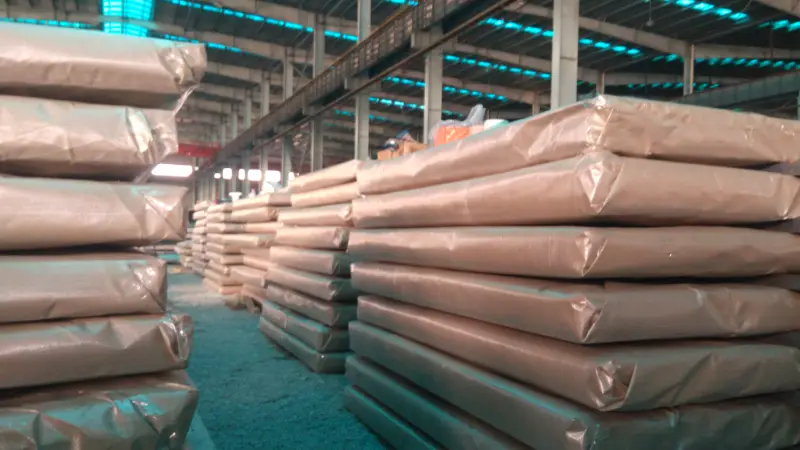
JIS G3115 SPV410 Pressure Vessel Steel Plate
SPV410 Steel: Medium-Temperature Pressure Vessel Plate to JIS G3115
Detailed technical data for JIS G3115 SPV410 steel plate used in pressure vessels and boilers. Includes chemical composition, mechanical properties, thermal & electrical characteristics, and international equivalents.
Hot rolling, normalizing, welding, oxy-fuel cutting, plasma cutting, cold and hot forming, machining
- Phone : +8618037372205
- Email : [email protected]
- WhatsApp: Contact via Whtsapp
- WeChat: +8618037372205
JIS G3115 SPV410 Pressure Vessel Steel Plate Introduction
JIS G3115 SPV410 is a weldable carbon steel plate specifically designed for pressure vessels and boilers operating at intermediate temperatures. It combines good tensile strength (410–550 MPa) with assured yield strength (min. 235 MPa for thicknesses up to 50 mm), providing reliable structural integrity under moderate pressure conditions. The steel is produced with strict limits on carbon, silicon, manganese, phosphorus and sulfur to enhance weldability, toughness and resistance to brittle fracture. Typical applications include storage tanks, reactors, heat exchangers and process columns in petrochemical, chemical and power generation industries. SPV410 is normally supplied in the normalized condition, which refines the grain structure and improves mechanical uniformity. It can also be delivered in the as-rolled state subject to agreement. The grade is widely recognized by international standards, with equivalents such as ASTM A516 Grade 60, EN P265GH (having higher yield), and GB Q245R, making it suitable for global procurement and fabrication.
JIS G3115 SPV410 Pressure Vessel Steel Plate Chemical Composition
The chemical composition of SPV410 steel is tailored to ensure good weldability, adequate strength and toughness for pressure vessel applications. The limits on carbon and manganese provide the required mechanical properties while keeping the carbon equivalent low to avoid cold cracking during welding. Phosphorus and sulfur are restricted to enhance cleanliness and ductility.
| Element | Standard Value | Remarks |
|---|---|---|
| C | ≤ 0.18 | Carbon content controlled for weldability |
| Si | ≤ 0.75 | Silicon for deoxidation; may be specified as 0.15–0.75 |
| Mn | ≤ 1.60 | Manganese contributes to strength and toughness |
| P | ≤ 0.030 | Phosphorus limited to avoid embrittlement |
| S | ≤ 0.030 | Sulfur limited to avoid hot cracking and improve ductility |
JIS G3115 SPV410 Pressure Vessel Steel Plate Thermal and Electrical Physical Properties
Physical properties are typical for carbon steel and not directly specified in JIS G3115. They are provided here as design references. Values are at room temperature unless stated otherwise.
| Property | Typical Value | Unit | Test Condition |
|---|---|---|---|
| Density (ρ) | 7.85 | g/cm³ | 20 °C |
| Modulus of elasticity (E) | 210 | GPa | 20 °C |
| Shear modulus (G) | 81 | GPa | 20 °C |
| Poisson's ratio (ν) | 0.3 | — | 20 °C |
| Thermal expansion coefficient (α) | 12 × 10⁻⁶ | /K | 20–100 °C |
| Thermal conductivity (λ) | 50 | W/(m·K) | 20 °C |
| Specific heat capacity | 460 | J/(kg·K) | 20 °C |
| Electrical resistivity (ρₑ) | 0.15 | Ω·mm²/m | 20 °C |
JIS G3115 SPV410 Pressure Vessel Steel Plate Mechanical Properties
Mechanical properties of SPV410 are determined according to JIS G3115. The tensile test requirements depend on plate thickness. Elongation is measured using JIS No.5 test piece for plates ≤ 50 mm thick and JIS No.10 test piece for thicker plates. Bending test confirms formability and absence of cracks. Impact toughness may be agreed upon at the time of order.
| Property | Required Value | Unit | Test Condition |
|---|---|---|---|
| Yield strength (ReH) | ≥ 235 | MPa | Plate thickness 6–50 mm, transverse |
| Yield strength (ReH) | ≥ 215 | MPa | Plate thickness > 50–100 mm, transverse |
| Tensile strength (Rm) | 410–550 | MPa | All thicknesses, transverse |
| Elongation (A), JIS No.5 | ≥ 21 | % | Plate thickness 6–50 mm, gauge 50 mm |
| Elongation (A), JIS No.10 | ≥ 17 | % | Plate thickness > 50–100 mm, gauge 200 mm |
| Bending test | No cracks | — | Thickness ≤ 50 mm, bend diameter = 1.5a (a = plate thickness), 180° |
| Bending test | No cracks | — | Thickness > 50–100 mm, bend diameter = 2.0a, 180° |
JIS G3115 SPV410 Pressure Vessel Steel Plate Internationally Equivalent Material Standards and Grades
| Country/Region | Standard | Grade | Remarks |
|---|---|---|---|
| Japan | JIS G3115 | SPV410 | Original standard grade |
| China | GB/T 713 | Q245R | Comparable tensile strength; yield min. 245 MPa, slightly higher |
| USA | ASTM A516/A516M | Grade 60 | Approximate equivalent; verify impact test requirements |
| Europe | EN 10028-2 | P265GH | Higher minimum yield (265 MPa); may require design adjustment |
| International | ISO 9328-2 | P265GH | Same as EN P265GH |
JIS G3115 SPV410 Pressure Vessel Steel Plate Application Introduction
SPV410 steel plates are engineered for medium-temperature pressure equipment operating typically between -10 °C and 400 °C. The material offers a good balance of strength, ductility and weldability, making it suitable for a wide range of welded structures.
Product Applications: Horizontal and vertical pressure vessels, Steam drums and boiler shells, Liquefied gas storage tanks, Heat exchanger shells and channels, Reactors and columns for chemical processes, Piping components (when fabricated from plate)
Processed into products: Cylindrical shells, cones and domed ends (ellipsoidal, torispherical, hemispherical), Tube sheets and baffles, Nozzles and reinforcement pads, Internal vessel components (trays, supports), Pipe fittings (when cut from plate and welded), Flanges and blind covers (machined from thick plate)
Application industries: Petrochemical refineries, Chemical processing plants, Oil & gas upstream and downstream facilities, Power generation (thermal, nuclear auxiliary systems), Fertilizer and pharmaceutical industries, Boiler and heat exchanger manufacturing
JIS G3115 SPV410 Pressure Vessel Steel Plate Similar or Closely Related Material Grades for Reference
| Country/Region | Standard | Grade | Remarks |
|---|---|---|---|
| Japan | JIS G3115 | SPV355 | Lower strength grade (tensile 355–490 MPa) in same standard |
| Japan | JIS G3115 | SPV450 | Higher strength grade (tensile 450–590 MPa) in same standard |
| USA | ASTM A516/A516M | Grade 65 | Higher tensile strength (450–585 MPa); may substitute with caution |
| USA | ASTM A285/A285M | Grade C | Lower strength firebox quality plate; not for pressure vessels with same design margins |
| Europe | EN 10028-2 | P295GH | Significantly higher yield (295 MPa) and tensile (460–580 MPa); only for upgraded design |
Notes:
- Welding: Low hydrogen processes are recommended; preheat may be required for thick sections or low ambient temperatures. Post-weld heat treatment (PWHT) should follow applicable codes (e.g., ASME Section VIII) when thickness exceeds specified limits.
- Optional impact testing: Charpy V-notch tests at agreed temperatures (e.g., 0 °C, -10 °C) can be specified; typical minimum average values are 27 J transverse.
- Surface condition: Plates are supplied with a mill finish; additional ultrasonic testing per ASTM A435 or EN 10160 can be ordered.
- Dimensional tolerances: According to JIS G3193 (hot-rolled steel plate tolerances).
- Share



