
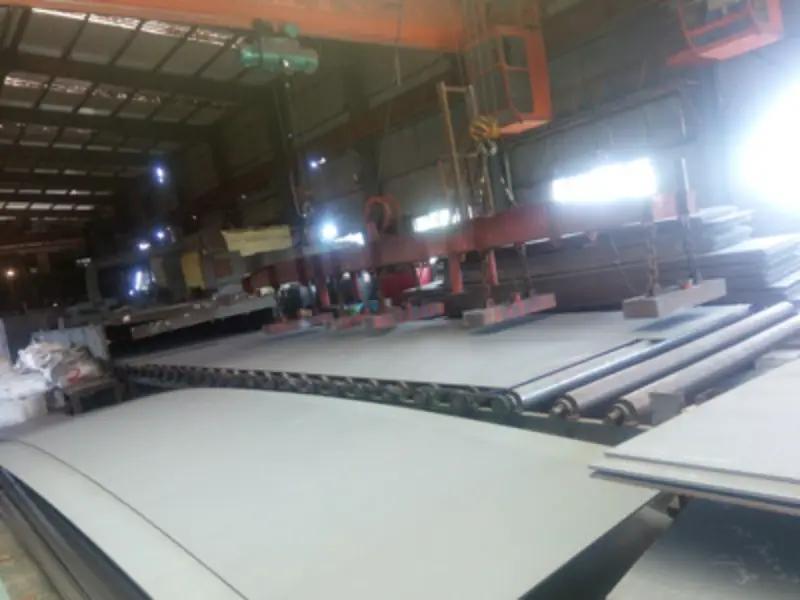
JIS G3115 SPV355 Pressure Vessel And Boiler Steel Plate
SPV355 Pressure Vessel Steel Plate per JIS G3115 – Properties & Equivalents
Complete material data for JIS G3115 SPV355 steel plate used in pressure vessels and boilers, covering chemical composition, mechanical and thermal properties, international equivalents, and application guidance.
Hot rolling, normalizing (N), stress relieving, and other heat treatments as agreed
- Phone : +8618037372205
- Email : [email protected]
- WhatsApp: Contact via Whtsapp
- WeChat: +8618037372205
JIS G3115 SPV355 Pressure Vessel And Boiler Steel Plate Introduction
JIS G3115 SPV355 is a normalized carbon‑manganese steel plate specifically developed for welded pressure vessels and boilers operating at moderate temperatures. The steel is produced in accordance with Japanese Industrial Standard JIS G3115, which specifies requirements for hot‑rolled plates intended for pressure‑containing equipment.
Key characteristics:
- Minimum yield strength of 355 MPa for thicknesses up to 60 mm, with gradual reduction for heavier gauges.
- Tensile strength in the range 520–640 MPa, ensuring a good balance between strength and ductility.
- Excellent notch toughness at 0 °C, with Charpy V‑notch impact energy guaranteed ≥ 27 J, making it suitable for sour service and low‑ambient storage applications.
- Good weldability using conventional methods; preheating and post‑weld heat treatment are recommended depending on thickness and service conditions.
- Supplied in normalized condition (N), which refines the grain structure and delivers uniform mechanical properties across the plate thickness.
SPV355 is often selected for oil & gas separators, LPG spherical tanks, heat exchanger shells, and boiler drums. It is widely replaceable by international equivalents such as EN 10028‑3 P355N, ASTM A516 Grade 70, and GB/T 713 Q345R when the design code allows substitution.
JIS G3115 SPV355 Pressure Vessel And Boiler Steel Plate Chemical Composition
The chemical composition below complies with JIS G3115:2010. Values represent ladle analysis. The steel is essentially carbon‑manganese with restricted phosphorus and sulfur to ensure good weldability and low‑temperature toughness. Microalloying elements such as Nb, V, or Ti may be added by the manufacturer for grain refinement, subject to agreement. Ceq (carbon equivalent) is usually controlled to improve weldability; typical Ceq ≈ 0.40–0.45 %.
| Chemical Element | Standard Value (%) | Remarks |
|---|---|---|
| Carbon (C) | ≤0.20 | |
| Silicon (Si) | 0.15 ~ 0.55 | |
| Manganese (Mn) | ≤1.60 | |
| Phosphorus (P) | ≤0.030 | |
| Sulfur (S) | ≤0.030 | |
| Others (Nb, V, Ti, etc.) | By agreement | Optional grain‑refining elements |
JIS G3115 SPV355 Pressure Vessel And Boiler Steel Plate Thermal and Electrical Physical Properties
The data listed below are typical reference values for normalised C‑Mn pressure vessel steel and are not mandatory requirements of JIS G3115. They are provided for design calculations and may vary slightly depending on exact composition and manufacturing route. Thermal expansion increases with temperature; typical values for the three temperature intervals commonly used in pressure vessel design are given. Electrical resistivity corresponds to that of typical mild steel at ambient temperature.
| Property | Typical Value | Unit | Test Condition |
|---|---|---|---|
| Density (ρ) | 7.85 | g/cm³ | at 20 °C |
| Modulus of elasticity (E) | 205 | GPa | at 20 °C, typical for C‑Mn steel |
| Shear modulus (G) | 80 | GPa | at 20 °C, typical |
| Poisson's ratio (ν) | 0.3 | — | at 20 °C, typical |
| Thermal expansion coefficient (α) | 11.5 × 10⁻⁶ | K⁻¹ | 20–100 °C |
| Thermal expansion coefficient (α) | 12.5 × 10⁻⁶ | K⁻¹ | 20–300 °C |
| Thermal expansion coefficient (α) | 13.5 × 10⁻⁶ | K⁻¹ | 20–500 °C |
| Thermal conductivity (λ) | 48 | W/(m·K) | at 100 °C, typical |
| Specific heat capacity | 486 | J/(kg·K) | at 20 °C, typical |
| Electrical resistivity (ρₑ) | 0.22 | μΩ·m | at 20 °C, typical |
JIS G3115 SPV355 Pressure Vessel And Boiler Steel Plate Mechanical Properties
Mechanical testing is performed on normalized material at room temperature unless stated otherwise. Yield strength decreases with increasing plate thickness, as shown in the multi‑value rows. Tensile strength applies to both longitudinal and transverse directions. Elongation values depend on the gauge length of the test piece (JIS No.5: gauge length 50 mm; JIS No.4: gauge length proportional to √A). Charpy impact energy is measured on standard 10 mm × 10 mm V‑notch specimens in the longitudinal direction at 0 °C. Bend tests are carried out with a 180° bending angle; the required former diameter (d) is expressed in multiples of the specimen thickness (a).
| Property | Specified Value | Unit | Test Condition / Thickness Range |
|---|---|---|---|
| Yield Strength (ReH) | ≥355 | MPa | t ≤ 60 mm |
| Yield Strength (ReH) | ≥335 | MPa | 60 mm < t ≤ 100 mm |
| Yield Strength (ReH) | ≥315 | MPa | 100 mm < t ≤ 160 mm |
| Tensile Strength (Rm) | 520 ~ 640 | MPa | t ≤ 100 mm |
| Tensile Strength (Rm) | 510 ~ 640 | MPa | 100 mm < t ≤ 160 mm |
| Elongation (A) | ≥19 | % | t ≤ 50 mm, JIS No.5 test piece |
| Elongation (A) | ≥23 | % | 50 mm < t ≤ 100 mm, JIS No.4 test piece |
| Elongation (A) | ≥24 | % | 100 mm < t ≤ 160 mm, JIS No.4 test piece |
| Charpy Impact Energy (KV) | ≥27 | J | 0 °C, longitudinal, V‑notch |
| Bend Test (180°) – former diameter | d = 1.5a | — | t ≤ 25 mm |
| Bend Test (180°) – former diameter | d = 2.0a | — | 25 mm < t ≤ 50 mm |
| Bend Test (180°) – former diameter | d = 2.5a | — | 50 mm < t ≤ 100 mm |
| Bend Test (180°) – former diameter | d = 3.0a | — | 100 mm < t ≤ 160 mm |
JIS G3115 SPV355 Pressure Vessel And Boiler Steel Plate Fully Equivalent Standards & Substitute Grades
| Country/Region | Standard | Grade | Remarks |
|---|---|---|---|
| Europe | EN 10028‑3 | P355N | Normalized pressure vessel steel with comparable strength and toughness; also available as P355NH and P355NL1 for elevated or low temperature service. |
| United States | ASTM A516 / A516M | Grade 70 | Standard pressure vessel plate in the normalized condition; widely recognized in ASME code construction. |
| China | GB/T 713 | Q345R | Pressure vessel steel with minimum yield 345 MPa and similar tensile range; suitable for identical applications. |
| International | ISO 9328‑2 | P355N | Harmonized standard for steel flat products for pressure vessels; properties align with EN 10028‑3 P355N. |
JIS G3115 SPV355 Pressure Vessel And Boiler Steel Plate Application Introduction
SPV355 is engineered for primary load‑bearing components in welded pressure equipment. Its balanced chemistry and normalized condition ensure reliable through‑thickness properties, making it a preferred choice for medium‑duty reactors, separators, and storage spheres. The steel is easily formable, machinable, and weldable by all common methods, allowing efficient fabrication of complex geometries.
Product Applications: LPG and ammonia spherical storage tanks, Oil‑water‑gas three‑phase separators, Boiler drums and mud drums, Heat exchanger shells and channel boxes, Reactor vessels for moderate pressure and temperature, Pressure accumulator vessels
Processed into products: Cylindrical shell courses and welded joints, Dished and ellipsoidal heads (formed hot or cold), Nozzles and reinforcing pads, Pipe flanges and blind flanges, Tube sheets for shell‑and‑tube exchangers, Structural supports and lifting lugs welded directly to the vessel
Application industries: Oil & Gas (upstream and downstream), Petrochemical processing, Power generation (boilers, feedwater heaters), Chemical and fertiliser plants, Industrial refrigeration and LPG storage
JIS G3115 SPV355 Pressure Vessel And Boiler Steel Plate Similar / Comparable Material Grades
| Country/Region | Standard | Grade | Remarks |
|---|---|---|---|
| Japan | JIS G3115 | SPV410 | Higher strength pressure vessel steel (min. yield 410 MPa); suitable when design requires greater load‑bearing but similar notch toughness. |
| Europe | EN 10025‑2 | S355J2+N | Structural steel with comparable yield strength; not inherently certified for pressure vessels and requires supplementary testing for pressure‑retaining applications. |
| United States | ASTM A572 / A572M | Grade 50 | HSLA structural steel (yield ~345 MPa); often used in non‑cryogenic fabrication, but not approved for ASME pressure vessels without additional qualification. |
| China | GB/T 1591 | Q355D | Low‑alloy high‑strength structural steel with good low‑temperature toughness; intended for welded structures, not default pressure vessel grade. |
Notes:
Notes:
- All data are based on JIS G3115:2010 and should be confirmed against the latest standard revision at the time of procurement.
- For plates exceeding 160 mm thickness, consult the steel manufacturer for tailored mechanical properties.
- Welding procedures typically require preheat (≥75 °C for thickness >25 mm) and post‑weld heat treatment (PWHT) in accordance with service conditions and fabrication codes (e.g., ASME Section VIII).
- The steel is generally suitable for moderate sour service (HIC/SSC resistant) when supplied with specific calcium treatment and low sulfur levels; additional testing is recommended.
Material certification will include heat analysis, tensile and impact test results, and (when agreed) ultrasonic testing per JIS G0801 or equivalent.
- Share



