
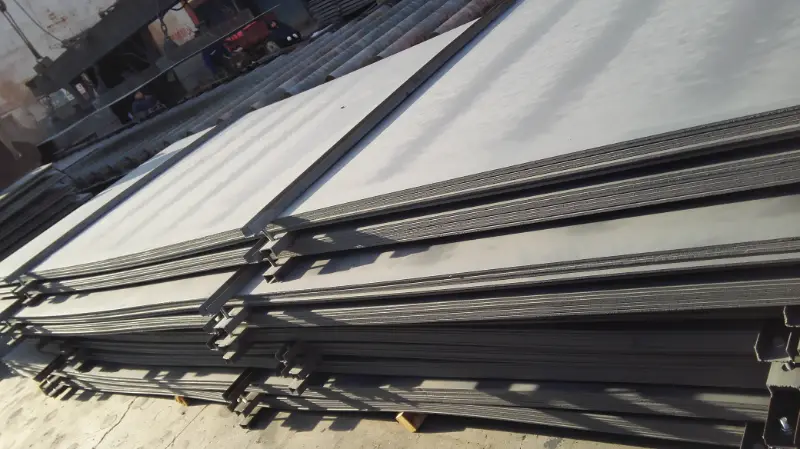
JIS G3114 SMA490BW Weather Resistant Steel
JIS G3114 SMA490BW Weather Resistant Steel: Full Data Sheet & International Cross-Reference
Comprehensive technical profile of SMA490BW hot-rolled atmospheric corrosion-resistant steel plate according to JIS G3114, with chemical composition, mechanical properties at various thicknesses, physical data, global equivalents, and application guidance.
Hot rolling, cold forming, welding, machining, drilling, cutting
- Phone : +8618037372205
- Email : [email protected]
- WhatsApp: Contact via Whtsapp
- WeChat: +8618037372205
JIS G3114 SMA490BW Weather Resistant Steel Introduction
SMA490BW is a hot-rolled atmospheric corrosion-resistant steel for welded structures, standardized under JIS G3114. It belongs to the SMA series, offering a minimum tensile strength of 490 MPa with guaranteed impact toughness at 0°C (BW class). The addition of copper, chromium, and nickel forms a dense, protective oxide layer that significantly retards further atmospheric corrosion, eliminating the need for painting in many environments. Typical applications include bridges, buildings, railway vehicles, and port structures.
Key characteristics:
- Atmospheric corrosion resistance: stable patina formation reduces maintenance
- Good weldability: controlled carbon equivalent ensures reliable fabrication
- Guaranteed notch toughness: Charpy V-notch energy ≥ 47 J at 0°C
- Varied thickness ranges: yield strength and elongation values tailored for plates up to 100 mm
- Typical delivery condition: as-rolled, normalized rolling, or thermomechanical controlled processing
JIS G3114 SMA490BW Weather Resistant Steel Chemical Composition
The chemical composition of SMA490BW is designed to provide excellent atmospheric corrosion resistance while maintaining good weldability. Copper, chromium, and nickel are the primary alloying elements that promote a protective patina. Phosphorus and sulfur are kept low to ensure toughness and weld quality. Carbon equivalent (CEV) or cold-cracking parameter (PCM) is often agreed upon at the time of ordering to match the intended welding procedure.
| Element | Standard Value (wt%) | Remarks |
|---|---|---|
| C | ≤ 0.18 | Carbon |
| Si | 0.15 – 0.65 | Silicon, for deoxidation and strength |
| Mn | 0.90 – 1.40 | Manganese, for strength and hardenability |
| P | ≤ 0.035 | Phosphorus, controlled for toughness |
| S | ≤ 0.035 | Sulfur, controlled for ductility |
| Cu | 0.30 – 0.50 | Copper, key element for atmospheric corrosion resistance |
| Cr | 0.45 – 0.75 | Chromium, enhances patina formation and strength |
| Ni | 0.05 – 0.30 | Nickel, improves toughness and balances copper's effects |
| Others | Agreed between producer and purchaser (e.g., V, Nb, Ti) | Microalloying elements may be added for grain refinement and precipitation strengthening |
JIS G3114 SMA490BW Weather Resistant Steel Thermal and Electrical Physical Properties
The following physical properties are typical for low-alloy weather-resistant steels and are suitable for design calculations. These values are not specified in JIS G3114 but are based on published data for comparable structural steels. Slight variations may occur depending on exact composition and processing.
| Property | Typical Value | Unit | Test Condition / Remarks |
|---|---|---|---|
| Density (ρ) | 7850 | kg/m³ | At 20°C |
| Modulus of Elasticity (E) | 205 | GPa | At 20°C, dynamic method |
| Shear Modulus (G) | 80 | GPa | At 20°C |
| Poisson's Ratio (ν) | 0.3 | – | At 20°C |
| Coefficient of Thermal Expansion (α) | 12.0 × 10⁻⁶ | 1/K | Between 20°C and 100°C |
| Thermal Conductivity (λ) | 45 | W/(m·K) | At 20°C |
| Specific Heat Capacity (cp) | 470 | J/(kg·K) | At 20°C |
| Electrical Resistivity (ρₑ) | 0.16 | µΩ·m | At 20°C |
JIS G3114 SMA490BW Weather Resistant Steel Mechanical Properties
Mechanical properties depend on plate thickness. Yield strength decreases slightly as thickness increases, while elongation requirements become more stringent. The Charpy impact test is mandatory for the BW suffix, with a minimum absorbed energy of 47 J at 0°C on longitudinal specimens. Bending tests ensure formability with a mandrel diameter related to plate thickness.
| Property | Required Value | Unit | Test Condition / Remarks |
|---|---|---|---|
| Yield Strength (ReH) | ≥ 365 | MPa | Plate thickness t ≤ 16 mm |
| Yield Strength (ReH) | ≥ 355 | MPa | 16 mm < t ≤ 40 mm |
| Yield Strength (ReH) | ≥ 335 | MPa | 40 mm < t ≤ 75 mm |
| Yield Strength (ReH) | ≥ 325 | MPa | 75 mm < t ≤ 100 mm |
| Tensile Strength (Rm) | 490 – 610 | MPa | All thicknesses (t ≤ 100 mm) |
| Elongation (A) | ≥ 15 | % | No.5 specimen, t ≤ 5 mm, gauge length 50 mm |
| Elongation (A) | ≥ 17 | % | No.1A specimen, 5 mm < t ≤ 16 mm, gauge length 200 mm |
| Elongation (A) | ≥ 21 | % | No.1A specimen, t > 16 mm, gauge length 200 mm |
| Bend Test (180°) | No cracks | – | Mandrel diameter: 1.5 × t for t ≤ 16 mm; 2.0 × t for 16 mm < t ≤ 100 mm |
| Charpy Impact (KV2) | ≥ 47 | J | 0°C, V-notch, longitudinal specimen |
JIS G3114 SMA490BW Weather Resistant Steel Completely Equivalent Material Standards and Substitute Grades
| Country / Region | Standard | Grade | Remarks |
|---|---|---|---|
| Japan | JIS G3114 | SMA490BW | Original standard grade – welded structures, 0°C impact |
| International | ISO 4952-1 | E355DD | Thermo-mechanically rolled structural weathering steel – comparable mechanical properties |
| China | GB/T 4171 | Q355NHD | Hot-rolled atmospheric corrosion resisting steel – yield 355 MPa, tensile 490–630 MPa, -20°C impact typical; closest Chinese equivalent |
| USA | ASTM A588/A588M | Grade B | High-strength low-alloy structural steel with atmospheric corrosion resistance – yield ≥345 MPa, tensile ≥485 MPa; similar patina formation |
| Europe | EN 10025-5 | S355J2W | Hot rolled products of structural steels – improved atmospheric corrosion resistance, J2 guarantees 27 J at -20°C, tensile 470–630 MPa, comparable weldability |
JIS G3114 SMA490BW Weather Resistant Steel Application Introduction
SMA490BW is ideally suited for load-bearing structures exposed to the atmosphere where painting is either difficult or maintenance costs must be reduced. The stable oxide layer (patina) develops over time and protects the steel from further corrosion. It is extensively used in civil engineering and transportation infrastructure. When welding, appropriate low-hydrogen processes and preheating may be required based on thickness and carbon equivalent. Designers should consider the eventual colour and texture of the patina for aesthetic applications.
Product Applications: Uncoated bridge girders and trusses, Weathering steel bridge decks, Architectural cladding and green bridges, Container chassis and corner castings, Railway wagon side frames and bolsters, Transmission line towers, Permanent shoring and retaining wall elements
Processed into products: Welded I-beams and box girders, Bridge bearings and expansion joints, Tubular lattice sections for towers, Formed plates for ship unloaders and cranes, Stiffened plate panels for caissons, Flanges and web plates for built-up sections, Brackets and connecting plates in structural frameworks
Application industries: Bridge engineering (road and railway bridges), Architectural and public buildings (stadiums, towers, facades), Railway vehicle manufacturing (carriages, underframes), Container and freight frame production, Port and marine infrastructure (piers, jetties, breakwater gates), Electric power transmission (lattice towers and poles), Mining and material handling equipment
JIS G3114 SMA490BW Weather Resistant Steel Similar / Closely-Related Material Recommendations
| Country / Region | Standard | Grade | Remarks |
|---|---|---|---|
| Japan | JIS G3114 | SMA490AW | Same strength class, atmosphere resistance, but without mandatory impact test (A class) |
| Japan | JIS G3114 | SMA490BP | Same strength class, for painted structures (P), impact test optional or 0°C not guaranteed |
| Japan | JIS G3106 | SM490A/B/C | Non-weathering structural steel with similar strength, no Cu-Cr-Ni; requires painting |
| China | GB/T 4171 | Q355NH | Weathering steel with similar composition, 0°C impact may be specified, tensile 490–630 MPa |
| Europe | EN 10025-5 | S355J0W | Atmospheric corrosion resistant steel, 0°C impact at 27 J, tensile 470–630 MPa, widely used in welded structures |
| USA | ASTM A588/A588M | Grade A | Equivalent strength class, slight composition variation, widely used for bridge and building applications |
Notes:
- Welding: Low hydrogen electrodes (AWS E7018 or equivalent) are recommended. Preheat and interpass temperature should be controlled based on plate thickness and carbon equivalent; typically preheat to 50–150°C for thicknesses > 25 mm to avoid hydrogen cracking.
- Patina development: Uniform dark brown appearance forms after 2–5 years of exposure in most non‑marine atmospheres. In coastal or heavy industrial environments, performance should be evaluated case‑by‑case.
- Detailing: To ensure uniform wet/dry cycles, design details should avoid water traps (e.g., flat horizontal surfaces, constant damp areas). Drainage and ventilation are critical for durable patina.
- Bending: The material can be cold‑formed with a minimum inside radius of 3 to 4 times thickness, depending on thickness and bending direction relative to rolling direction.
- Share



