
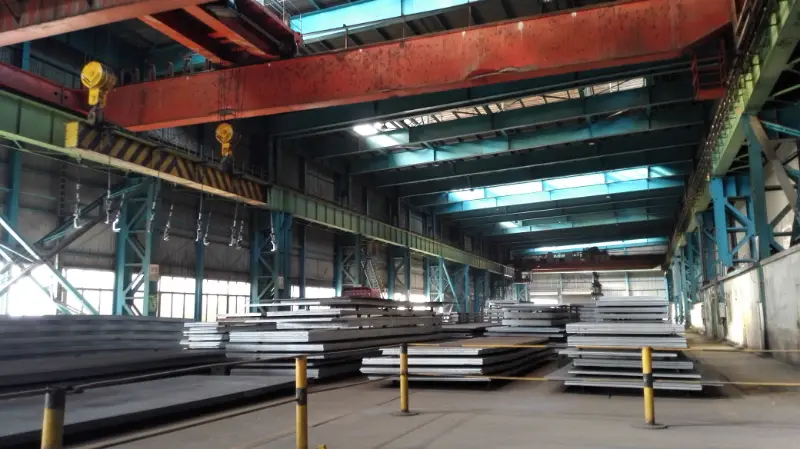
JIS G3103 SB480 Pressure Vessel & Boiler Steel Plate
JIS G3103 SB480 Pressure Vessel & Boiler Steel Plate - Material Data
Complete technical data for JIS G3103 SB480 carbon steel plate used in boilers and pressure vessels: chemical composition, mechanical properties, thermal properties, international equivalents, and application guide.
Hot rolling, normalizing, stress relieving, welding, machining
- Phone : +8618037372205
- Email : [email protected]
- WhatsApp: Contact via Whtsapp
- WeChat: +8618037372205
JIS G3103 SB480 Pressure Vessel & Boiler Steel Plate Introduction
JIS G3103 SB480 is a carbon steel plate grade specified in Japanese Industrial Standard for boilers and pressure vessels. This steel offers a minimum tensile strength of 480 MPa and reliable weldability, making it suitable for medium-temperature and moderate-pressure service. Key features include good toughness, excellent forming characteristics, and compliance with strict safety requirements for pressure-containing equipment. Typically supplied in normalized or as-rolled condition, SB480 exhibits a balanced combination of strength and ductility, with yield strength assured at ≥265 MPa for thin gauges. Its controlled carbon content (≤0.28%) ensures weldability without excessive hardening.
- Good weldability with standard arc processes
- Reliable tensile properties up to 150 mm thickness
- Cost-effective for general pressure vessel fabrication
JIS G3103 SB480 Pressure Vessel & Boiler Steel Plate Chemical Composition
The chemical composition of SB480 steel is designed to ensure adequate strength while maintaining good weldability. Carbon is kept below 0.28% to avoid excessive hardening in the heat-affected zone. Silicon is added for deoxidation and contributes to strength. The content of impurities such as phosphorus and sulfur is strictly controlled to preserve ductility and toughness. For heavy plates (>50 mm), a slightly higher silicon range is permitted to maintain through-thickness properties. Residual elements like Cu, Cr, Ni, and Mo are limited to avoid unintended effects on weldability and toughness.
| Element | Standard Value (wt%) | Remark |
|---|---|---|
| C | ≤0.28 | Ladle analysis |
| Si | 0.15~0.30 (thickness ≤50 mm) | For thickness >50 mm: 0.15~0.35 |
| Mn | 0.50~0.85 | Ladle analysis; may be adjusted for thickness |
| P | ≤0.035 | |
| S | ≤0.040 | |
| Cu | ≤0.30 | Residual element |
| Cr | ≤0.30 | Residual element |
| Ni | ≤0.30 | Residual element |
| Mo | ≤0.08 | Residual element; not intentionally added |
JIS G3103 SB480 Pressure Vessel & Boiler Steel Plate Thermal and Electrical Physical Properties
The following thermal and electrical properties are typical for carbon steel of this composition. They are not mandated by JIS G3103 but provide guidance for design calculations. Values may vary slightly depending on actual chemical composition and heat treatment condition.
| Property | Typical Value | Unit | Test Condition |
|---|---|---|---|
| Density (ρ) | 7.85 | g/cm³ | at 20°C |
| Elastic modulus (E) | 200~210 | GPa | at ambient temperature |
| Shear modulus (G) | ~80 | GPa | estimated from E and ν |
| Poisson's ratio (ν) | 0.29~0.30 | - | at room temperature |
| Thermal expansion (α) | 11.5~12.0 | ×10⁻⁶/°C | 20~100°C |
| Thermal expansion (α) | 12.0~12.5 | ×10⁻⁶/°C | 20~200°C |
| Thermal expansion (α) | 12.5~13.0 | ×10⁻⁶/°C | 20~300°C |
| Thermal conductivity (λ) | ~52 | W/(m·K) | at 20°C |
| Thermal conductivity (λ) | ~49 | W/(m·K) | at 200°C |
| Thermal conductivity (λ) | ~42 | W/(m·K) | at 400°C |
| Specific heat capacity (c) | ~486 | J/(kg·K) | 20~100°C |
| Electrical resistivity (ρₑ) | ~0.15~0.20 | μΩ·m | at 20°C |
JIS G3103 SB480 Pressure Vessel & Boiler Steel Plate Mechanical Properties
Mechanical properties are evaluated at room temperature using standard test specimens. Yield strength and tensile strength are specified for different thickness ranges to account for the effect of hot rolling and microstructural variation. Elongation is measured on proportional test pieces (No.1A with gauge length 200 mm, or No.10 with gauge length 50 mm for thin plates). The bend test ensures ductility by requiring crack-free bending through 180° over specified mandrel diameters.
| Property | Standard Value | Unit | Test Condition |
|---|---|---|---|
| Yield strength (ReH) | ≥265 | N/mm² | thickness ≤50 mm, as-rolled or normalized |
| Yield strength (ReH) | ≥255 | N/mm² | thickness >50~100 mm |
| Yield strength (ReH) | ≥245 | N/mm² | thickness >100~150 mm |
| Tensile strength (Rm) | 480~620 | N/mm² | all thickness ranges |
| Elongation (A) | ≥26 | % | thickness ≤6 mm, test piece No.10 (GL=50 mm) |
| Elongation (A) | ≥21 | % | 6< t ≤20 mm, test piece No.1A (GL=200 mm) |
| Elongation (A) | ≥21 | % | 20< t ≤50 mm, test piece No.1A |
| Elongation (A) | ≥19 | % | 50< t ≤100 mm, test piece No.1A |
| Elongation (A) | ≥17 | % | 100< t ≤150 mm, test piece No.1A |
| Bend test (180°) | No cracks | - | thickness ≤25 mm, inside diameter 0.5×t |
| Bend test (180°) | No cracks | - | 25< t ≤50 mm, inside diameter 1.0×t |
| Bend test (180°) | No cracks | - | 50< t ≤100 mm, inside diameter 1.5×t |
| Bend test (180°) | No cracks | - | 100< t ≤150 mm, inside diameter 2.0×t |
JIS G3103 SB480 Pressure Vessel & Boiler Steel Plate Direct Equivalent Standards and Substitutable Grades
| Country/Region | Standard | Grade | Remark |
|---|---|---|---|
| Japan | JIS G3103:2003 | SB480 | Original specification |
| USA | ASTM A516/A516M-17 | Grade 70 | Tensile strength 485~620 MPa, yield ≥260 MPa; comparable pressure vessel quality but higher Mn content (0.85~1.20%) |
| USA | ASME SA516/SA516M | Grade 70 | Same as ASTM A516 Grade 70; accepted under ASME Boiler and Pressure Vessel Code |
JIS G3103 SB480 Pressure Vessel & Boiler Steel Plate Application Introduction
SB480 steel plates are primarily used in the fabrication of unfired pressure vessels and boilers operating at moderate temperatures and pressures. They are suitable for service up to approximately 400°C, where the steel retains adequate strength and oxidation resistance. The material is easily weldable using common arc welding methods, and post-weld heat treatment (PWHT) is often applied to relieve residual stresses. Typical applications include:
Product Applications: Steam boilers, Pressure vessels (separators, accumulators), Heat exchangers, Storage tanks for liquefied gases, Reactor shells (non-corrosive service)
Processed into products: Shell plates and courses, Dished heads and hemispherical heads, Nozzle reinforcements, Integral and loose flanges, Tube sheets, Baffle plates, Support skirts and saddles
Application industries: Power Generation, Petrochemical, Oil & Gas, Chemical Processing, Industrial Boiler Manufacturing
JIS G3103 SB480 Pressure Vessel & Boiler Steel Plate Similar/Close Alternative Materials
| Country/Region | Standard | Grade | Remark |
|---|---|---|---|
| EU | EN 10028-2:2017 | P355GH | Higher yield (≥355 MPa for t≤16) but similar tensile range 490~630 MPa; re-check weldability and design codes |
| China | GB/T 713-2014 | Q345R | Yield ≥345 MPa, tensile 490~620 MPa; chemically similar but higher strength; verify code compliance |
| India | IS 2002:2003 | Gr 60 | Tensile 410~530 MPa, lower strength; not recommended for direct substitution |
Notes:
The property values are extracted from JIS G3103:2003 and are subject to revision. For actual procurement, refer to the latest edition of the standard. Impact test requirements, additional quality classes, and ultrasonic testing may be agreed between purchaser and manufacturer. PWHT is generally required for thick sections (>30 mm) to ensure proper toughness. When substituting SB480 with A516 Grade 70, verify the impact of higher manganese content on welding procedures and mechanical properties.
- Share



