
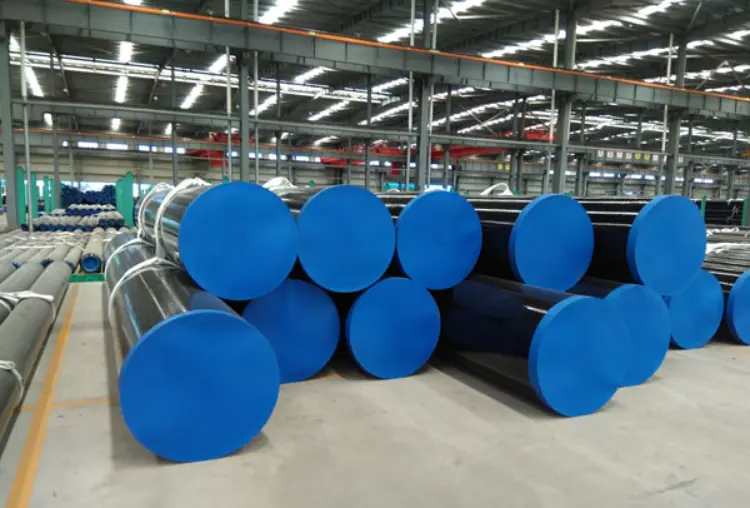
JIS G3101 SS540 SSAW Pipe
JIS G3101 SS540 SSAW Pipe: High-Strength Structural Carbon Steel for Welded Applications
Full material data for JIS G3101 SS540 SSAW pipe including chemical composition, mechanical properties, thermal and electrical characteristics, equivalent grades, and application guide.
Hot rolling, welding, cold forming (limited), machining, and gas cutting
- Phone : +8618037372205
- Email : [email protected]
- WhatsApp: Contact via Whtsapp
- WeChat: +8618037372205
JIS G3101 SS540 SSAW Pipe Introduction
JIS G3101 SS540 is a general structural carbon steel with a minimum tensile strength of 540 MPa. It is widely used in welded structures such as SSAW (Spiral Submerged Arc Welded) pipes, bridges, and building frames. The steel offers good weldability and moderate formability, making it suitable for heavy-duty structural applications. Key features:
- High strength (tensile ≥540 MPa)
- Good weldability with standard procedures
- Available in plates, strips, and pipes
- Often supplied in as-rolled condition
JIS G3101 SS540 SSAW Pipe Chemical Composition
The chemical composition of SS540 is not tightly specified for carbon and manganese, as they are adjusted by the manufacturer to meet mechanical properties. Only phosphorus and sulfur are restricted. Typical values for carbon and silicon are not standardized.
- Phosphorus and sulfur are limited to ensure weldability and toughness.
- Carbon equivalent (CE) is not mandated by JIS G3101 but is often controlled for welding.
| Chemical Element | Standard Value | Remarks |
|---|---|---|
| Carbon (C) | Not specified | Typical 0.20–0.30% depending on thickness |
| Silicon (Si) | Not specified | Usually 0.15–0.40% for deoxidation |
| Manganese (Mn) | Not specified | Commonly 1.00–1.60% to achieve strength |
| Phosphorus (P) | ≤0.050% | Maximum limit |
| Sulfur (S) | ≤0.050% | Maximum limit |
| Others | ― | Residual elements per manufacturer |
JIS G3101 SS540 SSAW Pipe Thermal and Electrical Physical Properties
These values are typical for carbon structural steels and are not mandated by JIS G3101. They serve as general engineering references.
- Properties are density, elastic modulus, thermal expansion, conductivity, etc.
- Actual values may vary with composition and heat treatment.
| Property | Standard Value | Unit | Test Condition |
|---|---|---|---|
| Density (ρ) | 7.85 | g/cm³ | Room temperature |
| Elastic Modulus (E) | 200–210 | GPa | Room temperature |
| Shear Modulus (G) | 80 | GPa | Room temperature |
| Poisson's Ratio (ν) | 0.3 | - | Room temperature |
| Thermal Expansion (α) | 12.1 × 10⁻⁶ | /K | 20–100°C |
| Thermal Expansion (α) | 13.0 × 10⁻⁶ | /K | 20–200°C |
| Thermal Expansion (α) | 13.9 × 10⁻⁶ | /K | 20–300°C |
| Thermal Conductivity (λ) | 50–55 | W/(m·K) | Room temperature |
| Specific Heat Capacity | 460–480 | J/(kg·K) | Room temperature |
| Electrical Resistivity (ρe) | 0.20–0.25 | μΩ·m | Room temperature |
JIS G3101 SS540 SSAW Pipe Mechanical Properties
Mechanical properties per JIS G3101:2015 for SS540 are thickness-dependent. Values are for as-rolled condition at room temperature.
- Yield strength (ReH) is only guaranteed when specified by the purchaser; otherwise, tensile test is the primary requirement.
- Bend test uses 180° bending angle with inside radius as specified.
- Charpy impact test is not mandatory unless agreed.
| Property | Standard Requirement | Unit | Test Conditions |
|---|---|---|---|
| Yield Strength (ReH), min | ≥ 400 | MPa | Thickness ≤ 16 mm (if required) |
| Yield Strength (ReH), min | ≥ 390 | MPa | Thickness 16–40 mm (if required) |
| Yield Strength (ReH), min | ≥ 380 | MPa | Thickness 40–100 mm (if required) |
| Tensile Strength (Rm), min | 540–740 | MPa | All thicknesses |
| Elongation (A), min | ≥ 17 | % | Thickness ≤ 5 mm (Gauge length: 5.65√S0) |
| Elongation (A), min | ≥ 21 | % | Thickness >5–16 mm (Gauge length: 200 mm) |
| Elongation (A), min | ≥ 16 | % | Thickness >16–50 mm (Gauge length: 200 mm) |
| Elongation (A), min | ≥ 23 | % | Thickness >40–100 mm (Gauge length: 200 mm) |
| Bend Test (180°) | Bend radius: 2.0t | - | Thickness ≤ 16 mm |
| Bend Test (180°) | Bend radius: 3.0t | - | Thickness >16–100 mm |
| Charpy Impact (KV) | Not specified | J | Optional; typical >27 J at 0°C for structural use |
JIS G3101 SS540 SSAW Pipe Full Equivalent International Standards and Replaceable Grades
| Country/Region | Standard | Designation | Remarks |
|---|---|---|---|
| Japan | JIS G3101 | SS540 | Original standard |
| Korea | KS D 3503 | SS540 | Identical technical content |
JIS G3101 SS540 SSAW Pipe Application Introduction
SS540 SSAW pipe and structural shapes are primarily used in heavy construction due to their high strength and good weldability. Typical applications include:
- Load-bearing columns, beams, and trusses in high-rise buildings
- Bridge girders and deck supports
- Ship hulls and offshore platform framework
- Pressure vessels and storage tanks (when normalized)
- Transmission towers and wind turbine towers
Product Applications: SSAW (spiral welded) pipes for water, oil, and gas transportation, Heavy welded H-beams and box columns, Built-up plate girders, Long-span roofing trusses, Pressure vessel shells
Processed into products: Column base plates, Gusset plates for bracing, Ship longitudinal stiffeners, Tower flanges and shells, Crane runway beams
Application industries: Civil engineering and construction, Bridge building, Shipbuilding and marine engineering, Energy (oil & gas pipelines, wind energy), Transportation (railway wagons, truck frames)
JIS G3101 SS540 SSAW Pipe Similar / Alternative Materials Recommendation
| Country/Region | Standard | Designation | Remarks |
|---|---|---|---|
| USA | ASTM A572/A572M | Grade 55 | High-strength low-alloy; tensile ≥ 485 MPa, yield ≥ 380 MPa |
| EU | EN 10025-2 | S450J0 | Structural steel; yield 440–450 MPa, tensile 550–700 MPa |
| China | GB/T 1591 | Q390 | High-strength structural steel; yield ≥ 390 MPa, tensile 490–650 MPa |
| International | ISO 630-2 | Fe 540 | ISO grade with similar strength, not widely adopted |
Notes:
- For welded SSAW pipes, welding procedure qualification is essential due to thickness and strength level.
- Preheat may be required for thick sections (e.g., >30 mm) to prevent hydrogen cracking.
- Impact test requirements should be agreed upon between purchaser and manufacturer if needed for low-temperature service.
- Surface quality and dimensional tolerances follow JIS G3193 (for plates) and JIS G3444 (for structural pipes).
- Share



