
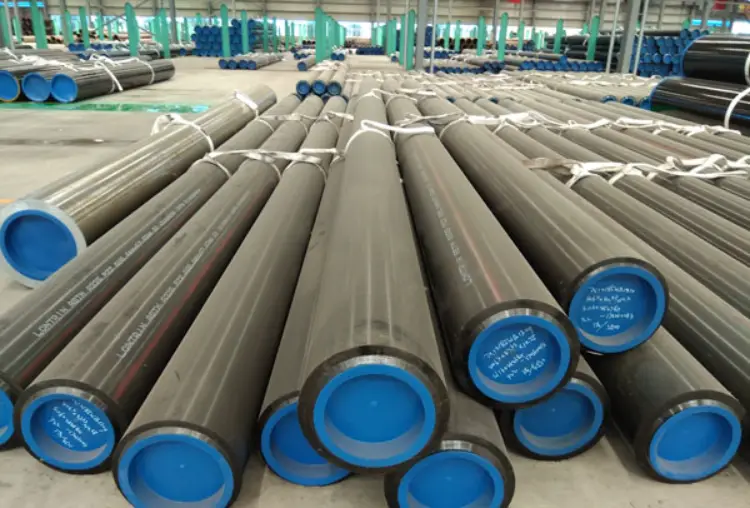
JIS G3101 SS330 Carbon Steel for SSAW Pipe
JIS G3101 SS330 Carbon Steel for SSAW Pipe - Properties, Equivalents and Applications
Detailed material data for JIS G3101 SS330 steel used in spiral submerged arc welded (SSAW) pipes, including chemical composition, mechanical properties, thermal properties, international equivalents, and application guidance.
Hot rolling, cold forming, welding (including spiral submerged arc welding for pipe production), cutting, bending, machining
- Phone : +8618037372205
- Email : [email protected]
- WhatsApp: Contact via Whtsapp
- WeChat: +8618037372205
JIS G3101 SS330 Carbon Steel for SSAW Pipe Introduction
SS330 is a Japanese standard carbon structural steel grade defined in JIS G3101 (Rolled Steels for General Structure). It is characterized by a minimum tensile strength of 330 MPa and good weldability. Typically supplied as hot-rolled plates, sheets, strips, or sections, SS330 is widely applied in construction, bridges, vehicles, and general structural components. In the form of SSAW (Spiral Submerged Arc Welded) pipe, it offers reliable performance for conveying water, oil, gas, and other fluids. The steel provides a balance of moderate strength, ductility, and cost-effectiveness, making it suitable for a variety of structural and piping applications.
JIS G3101 SS330 Carbon Steel for SSAW Pipe Chemical Composition
The chemical requirements for SS330 according to JIS G3101:2015 are shown below. The steel is non-alloyed with controlled levels of carbon, manganese, silicon, phosphorus, and sulfur to ensure good weldability and ductility. No other elements are intentionally added, and residual elements are regulated only by agreement.
| Element | Standard Value (max %) | Remarks |
|---|---|---|
| Carbon (C) | 0.15 | Maximum |
| Silicon (Si) | 0.30 | Maximum |
| Manganese (Mn) | 0.60 | Maximum |
| Phosphorus (P) | 0.050 | Maximum |
| Sulfur (S) | 0.050 | Maximum |
JIS G3101 SS330 Carbon Steel for SSAW Pipe Thermal & Electrical Physical Properties
Physical properties are not mandated by JIS G3101. The values below are typical for plain carbon steel and can be used for engineering calculations involving SS330. Actual values may vary slightly with exact composition and temperature. All data are approximate and for informational purposes only.
| Property | Typical Value | Unit | Test Condition / Temperature |
|---|---|---|---|
| Density (ρ) | 7.85 | g/cm³ | Ambient |
| Modulus of Elasticity (E) | 200 – 210 | GPa | Ambient |
| Shear Modulus (G) | 80 – 84 | GPa | Ambient |
| Poisson's Ratio (ν) | 0.29 – 0.30 | — | Ambient |
| Thermal Expansion Coefficient (α) | 11.7 – 12.5 × 10⁻⁶ | K⁻¹ | 20 – 100 °C |
| Thermal Expansion Coefficient (α) | 12.8 – 13.5 × 10⁻⁶ | K⁻¹ | 20 – 200 °C |
| Thermal Conductivity (λ) | 53 – 58 | W/(m·K) | Ambient |
| Specific Heat Capacity (cp) | 0.49 | kJ/(kg·K) | Ambient |
| Electrical Resistivity (ρe) | 0.15 – 0.20 | μΩ·m | Ambient |
JIS G3101 SS330 Carbon Steel for SSAW Pipe Mechanical Properties
Mechanical properties are specified for SS330 in the as-rolled condition. The values are thickness-dependent. Yield strength, tensile strength, and elongation are the primary requirements. No impact test or bend test is mandated by the standard for this grade. Data below reflect the JIS G3101:2015 limits. Note: For SSAW pipe, the actual properties may be influenced by the forming and welding process; pipe standards (e.g., JIS G3457, API 5L) should be consulted for pipe-specific requirements.
| Property | Standard Requirement | Unit | Test Condition |
|---|---|---|---|
| Yield Strength (ReH) | ≥ 165 | MPa | Thickness ≤ 16 mm |
| Yield Strength (ReH) | ≥ 155 | MPa | 16 mm < thickness ≤ 40 mm |
| Yield Strength (ReH) | ≥ 145 | MPa | 40 mm < thickness ≤ 100 mm |
| Tensile Strength (Rm) | 330 – 430 | MPa | All thicknesses |
| Elongation (A) | ≥ 26 | % | Thickness ≤ 5 mm, gauge length 50 mm |
| Elongation (A) | ≥ 21 | % | 5 mm < thickness ≤ 16 mm, L0 = 50 mm |
| Elongation (A) | ≥ 26 | % | 16 mm < thickness ≤ 40 mm, No. 1A test piece |
| Elongation (A) | ≥ 28 | % | Thickness > 40 mm, No. 1A test piece |
JIS G3101 SS330 Carbon Steel for SSAW Pipe Exact Equivalent Material Standards & Substitutable Grades
While there is no globally identical grade that matches SS330 in every aspect, the following standards define steels with comparable chemistry and minimum tensile strength around 330–360 MPa. Direct substitution requires checking the actual technical delivery conditions.
| Country/Region | Standard | Grade | Remarks |
|---|---|---|---|
| International (ISO) | ISO 630 | E235B (Fe360B) | Similar tensile range; yield strength min 235 MPa, slightly higher than SS330 |
| Europe (EU) | EN 10025-2 | S235JR | Same yield class but different tensile requirements; widely interchangeable |
| USA | ASTM A283 | Grade C | Tensile 380–515 MPa, yield ≥205 MPa, for general structural use |
| USA | ASTM A570 (withdrawn) | Grade 30 | Earlier standard; tensile 340 MPa min |
| China | GB/T 700 | Q235B | Tensile 370–500 MPa, yield ≥235 MPa; closely matches common applications |
JIS G3101 SS330 Carbon Steel for SSAW Pipe Application Introduction
SS330 is a versatile carbon structural steel used in a wide range of general engineering and construction applications. Its moderate strength, good ductility, and excellent weldability make it ideal for structural components and welded pipe manufacturing.
When fabricated into SSAW (Spiral Submerged Arc Welded) pipe, SS330 serves in fluid transportation systems and structural pilings. The spiral welding process allows production of large-diameter pipes with efficient material utilization.
Product Applications: SSAW steel pipes (spiral-welded pipes), Structural beams, columns, and channels, Bridge components (girders, trusses), Vehicle frames and chassis, Pipe piles and structural tubulars, Storage tanks and pressure vessels (non-cryogenic)
Processed into products: Spiral-welded pipe for water mains, sewage systems, and oil/gas pipelines, Lattice towers and transmission poles, Welded structural frames and brackets, Bull-dozer blade supports and earth-moving equipment parts, Tubular scaffoldings and formwork, Crane booms and hoist beams, Ship hull stiffeners and deck plates
Application industries: Construction and civil engineering (buildings, bridges, towers), Shipbuilding and marine structures, Automotive and railway vehicle manufacturing (structural parts), Oil, gas, and water transmission (pipeline industry), Machinery and equipment fabrication, Foundation engineering (piling, casing)
JIS G3101 SS330 Carbon Steel for SSAW Pipe Similar Alternative Materials
The grades listed below share comparable overall performance (strength, weldability, formability) with SS330 but may have slight differences in specification minimums or typical compositions.
| Country/Region | Standard | Grade | Remarks |
|---|---|---|---|
| Japan | JIS G3101 | SS400 | Higher tensile (400–510 MPa), often replaces SS330 where higher strength is needed |
| USA | ASTM A36 | A36 | Tensile 400–550 MPa, yield ≥250 MPa; more widely available, slightly stronger |
| International | ISO 630 | E195 | Lower tensile class, suitable for less demanding applications |
| China | GB/T 700 | Q195 | Lower carbon version for cold forming; tensile 315–430 MPa |
| Europe | EN 10025-2 | S275JR | Medium strength; transitional option between S235 and S355 |
Notes:
- For SSAW pipe production, supplementary requirements (hydrostatic test, non-destructive testing, dimensional tolerances) are typically specified per pipe standards such as JIS G3457 (Arc Welded Carbon Steel Pipes) or API 5L.
- SS330 does not guarantee impact toughness; when toughness is required, consider SS330 with a Charpy agreement or use a higher-grade steel.
- Welding consumables should match the base metal strength; pre-heating is generally not necessary for thicknesses below 30 mm.
- The grade is not intended for heat treatment, but normalizing can be applied to refine grain structure if needed.
- Always consult the latest edition of JIS G3101 for full technical conditions.
- Share



