
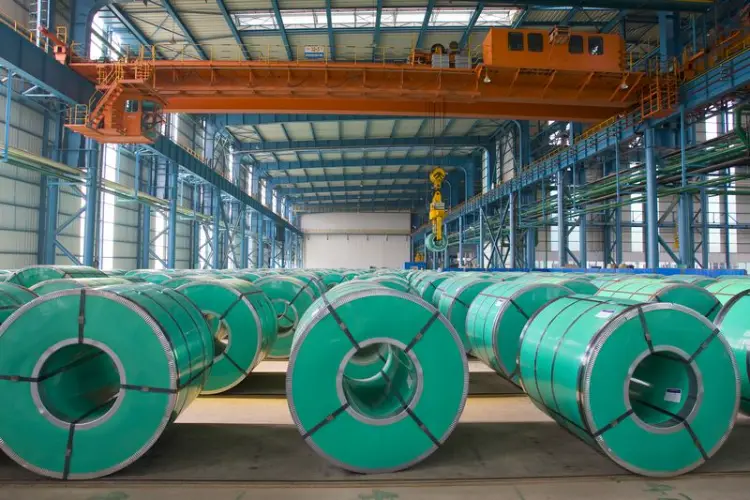
HP345 Steel Coil for Gas Cylinders
HP345 Steel Coil for Gas Cylinders - Q/BQB 329-2009 High Strength Low Alloy Material Data
Detailed material properties of HP345 steel coil under Baosteel standard Q/BQB 329-2009 for gas cylinders and gas vessels, including chemical composition, mechanical and physical properties, international equivalents, and application guidance.
Hot rolling, controlled rolling, normalizing (optional), cold forming, welding
- Phone : +8618037372205
- Email : [email protected]
- WhatsApp: Contact via Whtsapp
- WeChat: +8618037372205
HP345 Steel Coil for Gas Cylinders Introduction
HP345 is a hot-rolled high-strength low-alloy (HSLA) steel grade specifically developed for welded gas cylinders and pressure vessels, standardized under Q/BQB 329-2009 (Baosteel enterprise standard). It provides a minimum yield strength of 345 MPa with excellent toughness and weldability. The steel is supplied as coil in the hot-rolled or controlled-rolled condition, and may be delivered in the normalized condition when specified.
- Controlled sulfur and phosphorus levels ensure good cleanliness and resistance to brittle fracture.
- Microalloyed with Nb, V, and Ti for grain refinement and precipitation strengthening.
- Suitable for manufacturing high-pressure LPG cylinders, industrial gas bottles, and similar welded pressure vessels requiring reliable ductility and low-temperature impact toughness.
HP345 Steel Coil for Gas Cylinders Chemical Composition of HP345
The chemical composition of HP345 steel is designed to achieve the required strength, toughness, and weldability for gas cylinder applications. Microalloying elements such as Nb, V, and Ti are added for grain refinement and precipitation strengthening. Low sulfur and phosphorus contents enhance cleanliness and resistance to cracking.
| Element | Standard Value (%) | Remarks |
|---|---|---|
| Carbon (C) | ≤ 0.18 | Max |
| Silicon (Si) | ≤ 0.35 | Max |
| Manganese (Mn) | 0.50 – 1.40 | - |
| Phosphorus (P) | ≤ 0.020 | Max |
| Sulfur (S) | ≤ 0.015 | Max |
| Aluminum (total Al) | ≥ 0.020 | Min |
| Niobium (Nb) | ≤ 0.05 | Max |
| Vanadium (V) | ≤ 0.05 | Max |
| Titanium (Ti) | ≤ 0.03 | Max |
| Nb+V+Ti | ≤ 0.12 | Combined max |
| Nitrogen (N) | ≤ 0.012 | Max (typically not specified but controlled) |
| Residual Elements (Cr+Ni+Cu) | ≤ 0.30 each | Informative |
HP345 Steel Coil for Gas Cylinders Thermal and Electrical Physical Properties
The following physical properties are typical for the HP345 type steel (carbon-manganese microalloyed). Actual values can vary slightly with heat treatment and composition, but these data are suitable for engineering design and thermal analysis.
| Property | Typical Value | Unit | Test Condition |
|---|---|---|---|
| Density (ρ) | 7.85 | g/cm³ | Room temperature |
| Elastic Modulus (E) | 210 | GPa | Room temperature |
| Shear Modulus (G) | 81 | GPa | Calculated |
| Poisson's Ratio (ν) | 0.3 | - | - |
| Thermal Expansion Coefficient (α) | 11.5 | 10⁻⁶/K | 20 – 100°C |
| Thermal Expansion Coefficient (α) | 12.5 | 10⁻⁶/K | 20 – 200°C |
| Thermal Conductivity (λ) | 50 | W/(m·K) | Room temperature |
| Specific Heat Capacity (cp) | 460 | J/(kg·K) | Room temperature |
| Electrical Resistivity (ρe) | 0.22 | μΩ·m | 20°C |
HP345 Steel Coil for Gas Cylinders Mechanical Properties of HP345
Mechanical properties are determined on transverse or longitudinal test pieces as per the standard. The values apply to the as-delivered condition (hot-rolled, controlled-rolled, or normalized). Impact tests are performed on Charpy V-notch specimens at -20°C, with a minimum absorbed energy of 27 J for longitudinal direction.
| Property | Standard Requirement | Unit | Test Condition |
|---|---|---|---|
| Yield Strength (ReH) | ≥ 345 | MPa | Thickness ≤ 6 mm |
| Yield Strength (ReH) | ≥ 335 | MPa | Thickness > 6 – 10 mm |
| Tensile Strength (Rm) | 490 – 620 | MPa | All thicknesses |
| Elongation after Fracture (A) | ≥ 24 | % | Longitudinal, thickness ≤ 6 mm, gauge length L0=5.65√S0 |
| Elongation after Fracture (A) | ≥ 22 | % | Longitudinal, thickness > 6 – 10 mm |
| Bend Test (Diameter 'a' = specimen thickness) | d = 2a, 180° | - | No cracks; test piece width ≥ 35 mm |
| Impact Energy (KV2, -20°C) | ≥ 27 | J | Longitudinal, Charpy V-notch |
| Impact Energy (KV2, -20°C) | ≥ 18 | J | Transverse (informative) |
HP345 Steel Coil for Gas Cylinders Exact Equivalent Material Standards and Designations for HP345
| Country / Region | Standard | Grade | Remarks |
|---|---|---|---|
| Europe | EN 10120 | P355NB (1.0557) | Yield strength ≥355 MPa; the closest European gas cylinder steel, often used interchangeably |
| International | ISO 4978 | P355NB | Same as EN grade; suitable for welded gas cylinders |
| Japan | JIS G3116 | SG365 | Yield strength ≥365 MPa; slightly higher strength, equivalent in application |
| China | GB/T 6653 | HP345 | Chinese standard based on Q/BQB 329; identical grade |
HP345 Steel Coil for Gas Cylinders Application Introduction
HP345 steel coils are primarily used in the fabrication of welded gas cylinders and pressure vessels that require high ductility, consistent mechanical properties, and good low-temperature toughness. The material is optimized for cold forming, deep drawing, and automatic welding processes (MIG/MAG, SAW). Strict control of surface quality and thickness tolerances ensures reliable production of cylinder bodies and end closures.
- Typical end-use sectors include industrial gas storage, automotive (CNG/LPG), and medical gas cylinders.
- Can be processed into cylinder shells, heads, and valve boss reinforcements.
Product Applications: Welded Steel LPG Cylinders (domestic and industrial), Seamless-refillable Gas Bottles (with welded modifications), CNG Vehicle Cylinders (Type 1 all-steel cylinders), Industrial Acetylene Cylinders, Fire Suppression Tanks
Processed into products: Cylinder body shells (rolled and welded from strip), Deep-drawn end heads (spun or pressed), Foot rings and neck rings, Valve boss and weld-on reinforcements, Welded joints (longitudinal and circumferential seams)
Application industries: Industrial Gas, Medical Gas Storage, Alternative Fuel Vehicles (CNG/LPG), Fire Extinguisher Manufacturing, Pressure Vessel Fabrication
HP345 Steel Coil for Gas Cylinders Similar/Alternative Material Recommendations
| Country / Region | Standard | Grade | Remarks |
|---|---|---|---|
| Europe | EN 10120 | P310NB | Lower yield strength (≥310 MPa); can be used where HP345 overmatches requirements |
| Japan | JIS G3116 | SG325 | Yield strength ≥325 MPa; good alternative for less demanding pressure levels |
| USA | ASTM A1011 / A1018 | SS Grade 55 (380 MPa) | Structural HSLA steel; not specifically for gas cylinders but may be adapted with qualification |
| China | GB/T 6653 | HP295 | Lower carbon and lower strength; used for standard LPG cylinders |
Notes:
Welding recommendations: Use low-hydrogen welding processes and suitable filler metals (e.g., ER70S-6, E71T-1) matched to the tensile strength. Preheating is generally not required for thicknesses below 15 mm. Post-weld stress relieving may be applied at 550-600°C depending on vessel design codes. Forming: Excellent cold-forming capability allows drawing and rolling with minimum springback concerns. Hot forming, if used, should not exceed normalizing temperature (920-950°C) to avoid grain coarsening.
- Share



