
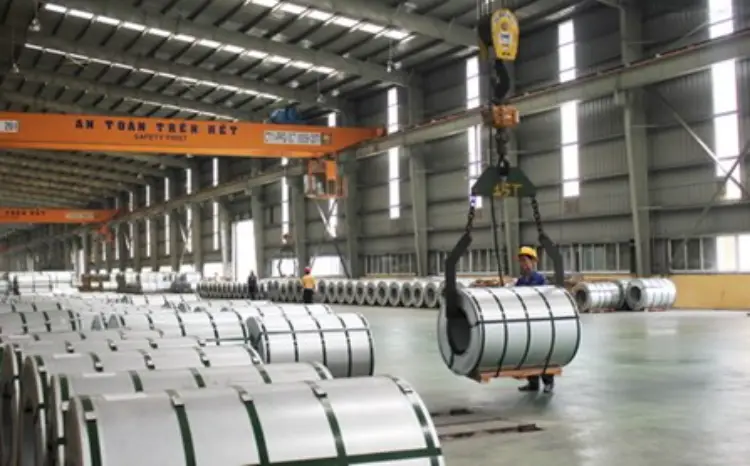
P245NB (EN 10120) Steel Coil for Welded Gas Cylinders
P245NB (EN 10120) Steel Coil for Welded Gas Cylinders: Strength & Formability
EN 10120 P245NB is a normalized or normalizing rolled non-alloy steel for welded gas cylinders, offering minimum yield strength 245 MPa, good weldability and formability.
Cutting, blanking, deep drawing, bending, welding, normalizing
- Phone : +8618037372205
- Email : [email protected]
- WhatsApp: Contact via Whtsapp
- WeChat: +8618037372205
P245NB Steel Coil for Welded Gas Cylinders Introduction
EN 10120 P245NB is a European standard hot-rolled steel coil specifically designed for the manufacture of welded gas cylinders for compressed, liquefied, and dissolved gases. It belongs to the non-alloy fine-grain steel category with controlled chemical composition and normalizing rolling delivery condition. The steel ensures a minimum yield strength of 245 MPa at room temperature and good toughness at low temperatures (typically -20°C). Its excellent weldability, high formability, and uniform mechanical properties across the coil make it ideal for deep drawing and welding operations in cylinder production. The steel is fully killed and aluminum fine-grain treated, providing reliable performance under pressure.
- Key features: balanced strength and ductility, good impact toughness, suitability for gas cylinder body and head forming, compliance with EU Pressure Equipment Directive (PED).
- Common delivery condition: normalized rolling (+N) or normalizing annealed.
P245NB Steel Coil for Welded Gas Cylinders Chemical Composition
The chemical composition ensures fine-grain practice and good weldability. Aluminum is added for grain refinement and to tie up nitrogen. Residual elements such as Cr, Ni, Cu, Mo are restricted to maintain toughness and formability. The sum of residual elements (Cr+Ni+Cu+Mo) is typically limited to ≤0.70%. All values are according to EN 10120:2017, unless otherwise agreed.
| Element | Standard Value (max or range) | Remarks |
|---|---|---|
| Carbon (C) | ≤ 0.16% | Ladle analysis; controlled for weldability |
| Silicon (Si) | ≤ 0.35% | Deoxidation and strength |
| Manganese (Mn) | 0.50 - 1.30% | Provides strength and hardenability control |
| Phosphorus (P) | ≤ 0.025% | Kept low for toughness |
| Sulfur (S) | ≤ 0.015% | Low sulfur for formability and cleanliness |
| Aluminum (Al total) | ≥ 0.020% | Fine grain practice, ensures fine austenitic grain |
| Niobium (Nb) | ≤ 0.05% | Microalloying optional |
| Vanadium (V) | ≤ 0.05% | Microalloying optional |
| Titanium (Ti) | ≤ 0.03% | Microalloying optional |
| Chromium (Cr) | ≤ 0.30% | Residual element |
| Nickel (Ni) | ≤ 0.30% | Residual element |
| Molybdenum (Mo) | ≤ 0.08% | Residual element |
| Copper (Cu) | ≤ 0.30% | Residual element |
| Nitrogen (N) | ≤ 0.012% | Controlled for aging |
P245NB Steel Coil for Welded Gas Cylinders Thermal and Electrical Physical Properties
These values are typical for carbon-manganese constructional steels and serve as design references. Actual properties may vary slightly depending on exact composition and processing. Data are valid around room temperature (20°C) unless stated otherwise. Thermal expansion is linear and expressed per °C. Specific heat capacity and thermal conductivity are useful for heat transfer calculations during welding or service.
| Property | Typical Value | Unit | Test Condition / Remarks |
|---|---|---|---|
| Density (ρ) | 7.85 | g/cm³ | At 20°C |
| Elastic modulus (E) | 210 | GPa | At 20°C, static |
| Shear modulus (G) | 81 | GPa | Approximate, ~ E/(2(1+ν)) |
| Poisson ratio (ν) | 0.30 | — | Elastic range |
| Thermal expansion coefficient (α) | 12.0 × 10⁻⁶ | K⁻¹ | 20°C to 100°C |
| Thermal expansion coefficient (α) | 12.5 × 10⁻⁶ | K⁻¹ | 20°C to 200°C |
| Thermal expansion coefficient (α) | 13.0 × 10⁻⁶ | K⁻¹ | 20°C to 300°C |
| Thermal conductivity (λ) | 50 | W/(m·K) | At 20°C |
| Thermal conductivity (λ) | 47 | W/(m·K) | At 100°C |
| Specific heat capacity (cp) | 460 | J/(kg·K) | At 20°C to 100°C |
| Electrical resistivity (ρe) | 0.18 | µΩ·m | At 20°C (typical low alloy steel) |
P245NB Steel Coil for Welded Gas Cylinders Mechanical Properties
Mechanical properties depend on product thickness. Values are for normalized rolling (+N) delivery condition and tested on transverse specimens unless otherwise specified. Impact energy (KV2) is measured at -20°C, with a minimum average of 27 J on Charpy V-notch specimens. Bending tests are performed at 180° according to EN ISO 7438.
- For thickness ≤ 16 mm, the bend mandrel diameter is 2a (a = specimen thickness).
- For thicker sections, larger mandrels apply.
| Property | Standard Requirement | Unit | Test Condition / Thickness (e) |
|---|---|---|---|
| Yield Strength (ReH) | ≥ 245 | MPa | e ≤ 16 mm |
| Yield Strength (ReH) | ≥ 235 | MPa | 16 mm < e ≤ 25 mm |
| Yield Strength (ReH) | ≥ 225 | MPa | 25 mm < e ≤ 40 mm |
| Tensile Strength (Rm) | 360 - 480 | MPa | e ≤ 16 mm |
| Tensile Strength (Rm) | 360 - 480 | MPa | 16 mm < e ≤ 25 mm |
| Tensile Strength (Rm) | 350 - 480 | MPa | 25 mm < e ≤ 40 mm |
| Elongation after fracture (A) | ≥ 24 | % | e ≤ 16 mm, gauge length 5.65√So |
| Elongation after fracture (A) | ≥ 23 | % | 16 mm < e ≤ 25 mm |
| Elongation after fracture (A) | ≥ 22 | % | 25 mm < e ≤ 40 mm |
| Bend test (180°) | Mandrel diameter = 2a | — | e ≤ 16 mm, no cracks |
| Bend test (180°) | Mandrel diameter = 3a | — | 16 mm < e ≤ 25 mm |
| Impact energy (KV2, -20°C) | ≥ 27 (average of 3 specimens) | J | Transverse, Charpy V, -20°C |
P245NB Steel Coil for Welded Gas Cylinders International Standards – Identical / Directly Equivalent Grades
| Country/Region | Standard | Grade Designation | Remarks |
|---|---|---|---|
| European Union | EN 10120 | P245NB | Original standard; normalized or normalizing rolled |
| International | ISO 4978 | P245NB | Technically identical to EN 10120 |
| Germany | DIN EN 10120 | P245NB | Adopted European standard |
| United Kingdom | BS EN 10120 | P245NB | Adopted European standard |
| France | NF EN 10120 | P245NB | Adopted European standard |
| Italy | UNI EN 10120 | P245NB | Adopted European standard |
P245NB Steel Coil for Welded Gas Cylinders Application Introduction
P245NB steel is designed for welded pressure vessels subjected to internal gas pressure. The normalized microstructure ensures uniform properties across large coils, making it suitable for automated cylinder production lines. It is easily formed into cylindrical bodies and dished ends by cold forming or hot spinning. After forming, the halves are welded using standard arc welding processes. Post-weld heat treatment (stress relieving) is typically applied if required by design codes. The steel complies with the essential safety requirements of the EU Pressure Equipment Directive (2014/68/EU).
Product Applications: LP Gas cylinders (domestic and industrial), Acetylene cylinders, Oxygen, nitrogen, argon high-pressure cylinders, CNG type-1 cylinders, Refrigerant recovery cylinders, Welded pressure drums
Processed into products: Cylinder body (cylindrical shell) – deep-drawn or roll-bent and welded, Upper and lower dished ends (heads) – hot or cold pressed, Neck ring and valve boss – machined from forged ring or integrated plate, Foot ring and shroud – formed from strip stock, Bosses and reinforcement pads – welded attachments
Application industries: Gas cylinder manufacturing, Liquefied Petroleum Gas (LPG) distribution, Industrial gas supply, Medical gas storage and transport, CNG vehicle fuel systems, Refrigerant containers, Fire extinguisher bodies
P245NB Steel Coil for Welded Gas Cylinders Similar Pressure Vessel Steels with Close Chemical and Mechanical Properties
| Country/Region | Standard | Grade | Remarks |
|---|---|---|---|
| China | GB/T 6653 | HP245 | Welded gas cylinder steel; similar YS and composition; impact at 0°C typically |
| Japan | JIS G 3116 | SG255 | Steel sheets for welded gas cylinders; ReH ≥ 255 MPa; slightly higher strength |
| India | IS 6240 | SG 255 | Similar to JIS SG255 |
| USA | ASTM A572/A572M | Grade 42 (290) | HSLA structural steel; not specifically for gas cylinders but similar strength; require evaluation for pressure use |
| Korea | KS D 3521 | SG255 | Adopted from JIS; for welded gas cylinders |
Notes:
Normative references: Testing according to EN ISO 6892-1 (tensile), EN ISO 148-1 (impact), EN ISO 7438 (bend). Surface condition: Suitable for painting or galvanizing after cylinder manufacturing. Flattening test: For certain applications, a flattening test or drift expanding test may be agreed upon at the time of order. Weldability: Excellent with all conventional welding methods; preheating generally not required for small thicknesses. Hydrogen embrittlement: Not susceptible under normal service conditions due to low carbon and controlled alloying.
- Share



