
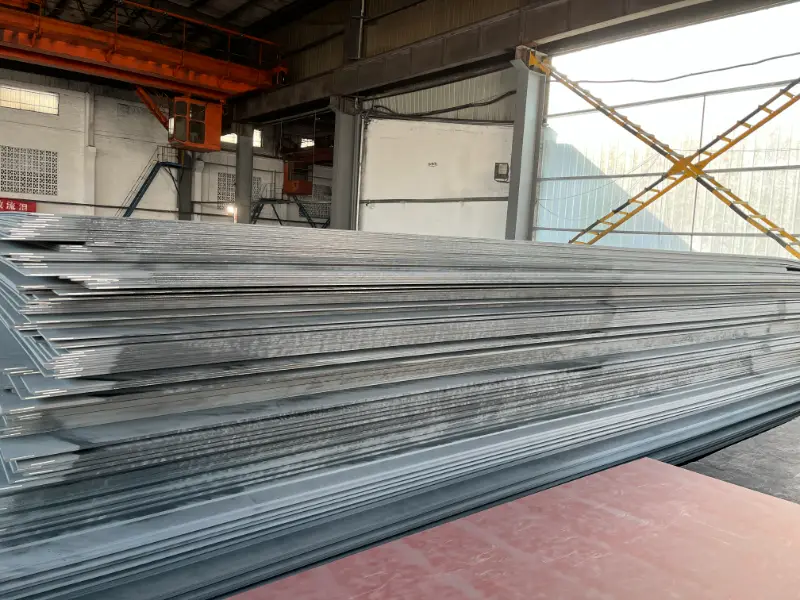
HP325 Steel for Gas Cylinders
HP325 Steel for Gas Cylinders | Q/BQB 329-2009 Properties & Equivalents
Detailed material data for HP325 steel coil according to Baosteel standard Q/BQB 329-2009, including chemical composition, mechanical and thermal properties, international equivalents, and application guidance.
Hot rolling, pickling, slitting, cold forming, welding, normalizing, stress-relieving
- Phone : +8618037372205
- Email : [email protected]
- WhatsApp: Contact via Whtsapp
- WeChat: +8618037372205
HP325 Steel for Gas Cylinders Introduction
HP325 is a hot-rolled steel coil specifically developed for the manufacture of welded gas cylinders and pressure vessels, conforming to Q/BQB 329-2009 (Baosteel enterprise standard). It features a carefully controlled chemical composition that ensures excellent weldability, high strength, and good low-temperature toughness. The steel is primarily used to produce cylinders for storing and transporting industrial and domestic gases such as LPG, acetylene, and oxygen. Typical processing includes cold forming of cylinder shells, welding of longitudinal seams and end closures, followed by normalizing or stress-relief heat treatment to achieve the required mechanical properties and safety integrity.
HP325 Steel for Gas Cylinders Chemical Composition
The chemical composition of HP325 is designed to provide a fine-grained structure and excellent weldability. The limits are as specified in Q/BQB 329-2009. Microalloying elements such as Nb, V, or Ti may be added singly or in combination to refine the grain and improve strength and toughness. All values are maximum unless a range is indicated.
| Element | Specified Value | Remarks |
|---|---|---|
| C | ≤0.20 | |
| Si | ≤0.35 | |
| Mn | 0.50~1.50 | |
| P | ≤0.025 | |
| S | ≤0.015 | |
| Alt (total Al) | ≥0.015 | Sufficient for fine grain |
| Nb, V, Ti (optional) | Added individually or in combination | Microalloying, content subject to agreement |
HP325 Steel for Gas Cylinders Thermal and Electrical Physical Properties
These physical properties are typical for low-carbon microalloyed steel and apply at room temperature unless otherwise specified. They are provided as guidance for design and processing calculations.
| Property | Typical Value | Unit | Test Condition / Remarks |
|---|---|---|---|
| Density (ρ) | 7.85 | g/cm³ | 20 °C |
| Elastic modulus (E) | 207 | GPa | 20 °C |
| Shear modulus (G) | 79.3 | GPa | Estimated from E and Poisson's ratio |
| Poisson's ratio (ν) | 0.29 | - | |
| Thermal expansion coefficient (α) | 11.5 | 10⁻⁶/K | 20 – 100 °C |
| Thermal conductivity (λ) | 50 | W/(m·K) | 20 °C |
| Specific heat capacity (cp) | 460 | J/(kg·K) | 20 °C |
| Electrical resistivity (ρ_e) | 0.15 | µΩ·m | 20 °C |
HP325 Steel for Gas Cylinders Mechanical Properties
The mechanical properties are determined on transverse specimens taken from the delivered condition or after a simulated normalizing heat treatment, as per the standard. The values represent minimum requirements; actual values may be agreed upon for specific thickness ranges. Impact test temperature is usually -20°C or as agreed.
| Property | Standard Required Value | Unit | Test Condition / Remarks |
|---|---|---|---|
| Lower yield strength (ReL) | ≥325 | MPa | Transverse, all thicknesses |
| Tensile strength (Rm) | 490~650 | MPa | Transverse |
| Elongation after fracture (A) | ≥21 | % | Thickness ≤3 mm, transverse, gauge length L0=5.65√S0 |
| Elongation after fracture (A) | ≥22 | % | Thickness >3 mm, transverse |
| Bend test (180°) | d = 2a | - | Bend diameter d, specimen thickness a, for thickness ≤10 mm |
| Impact energy (KV2) | ≥27 (average) | J | -20 °C, transverse, V-notch, individual min 19 J |
HP325 Steel for Gas Cylinders Fully Equivalent Material Standards and Alternative Grades
There are no international standards that are fully identical to Q/BQB 329-2009 HP325. However, the grades listed below are closely comparable in chemical composition and mechanical requirements and are often used interchangeably after mutual agreement.
| Country/Region | Standard | Grade | Remarks |
|---|---|---|---|
| China | Q/BQB 329-2009 | HP325 | Reference standard |
| International (ISO) | ISO 4978 | HP325 | Similar composition and strength level, may differ in impact requirements |
| Europe | EN 10120 | P310NB | Comparable strength; check Nb content and impact test temperature |
| Japan | JIS G3116 | SG325 | Gas cylinder steel; similar mechanical properties, chemical limits may vary slightly |
HP325 Steel for Gas Cylinders Application Introduction
HP325 steel is predominantly used in the gas cylinder industry, where reliable mechanical properties and weldability are critical. Its balanced composition allows efficient cold forming and welding, while the normalized condition ensures uniform strength and toughness. Typical processing steps: uncoiling → cutting → cold drawing or rolling of shell → welding of longitudinal seam → forming and welding of ends → heat treatment (normalizing) → hydraulic testing. Industries and products include:
Product Applications: Liquefied petroleum gas (LPG) cylinders (domestic and commercial), Compressed natural gas (CNG) vehicle cylinders, Acetylene cylinders, High-pressure industrial gas cylinders (oxygen, nitrogen, argon), Refrigerant gas cylinders, Fire extinguisher bodies
Processed into products: Cylinder shells (cylindrical sections), Dished ends / heads, Longitudinal seam welds, Neck ring inserts, Foot ring base plates
Application industries: Gas cylinder manufacturing, Pressure vessel fabrication, Automotive (CNG vehicle cylinders), Industrial gas packaging, Medical gas storage, Fire extinguisher cylinders
HP325 Steel for Gas Cylinders Similar / Alternative Material Recommendations
If the exact HP325 grade is unavailable, the following steels may be considered as functional alternatives, provided that the specific manufacturing and safety certification requirements are verified.
| Country/Region | Standard | Grade | Remarks |
|---|---|---|---|
| China | Q/BQB 329-2009 | HP295 | Lower yield strength (≥295 MPa); suitable for less demanding cylinder designs |
| China | GB/T 6653 | HP295 | National standard for welded gas cylinders; lower strength than HP325 |
| Europe | EN 10120 | P265NB | Lower strength; widely used for gas cylinders |
| USA | ASTM A414 / A414M | Grade G | Higher tensile strength, but different product form; verify suitability for gas cylinders |
Notes:
- All specified values are based on Q/BQB 329-2009; for final design, refer to the official standard or manufacturer's certificate.
- For critical applications, additional testing (e.g., burst test, cyclic pressure test) is mandatory according to gas cylinder regulations.
- The steel is suitable for phosphating and painting after fabrication.
- When ordering, specify the required thickness, width, edge condition, and surface quality (e.g., pickled and oiled).
- Share



