
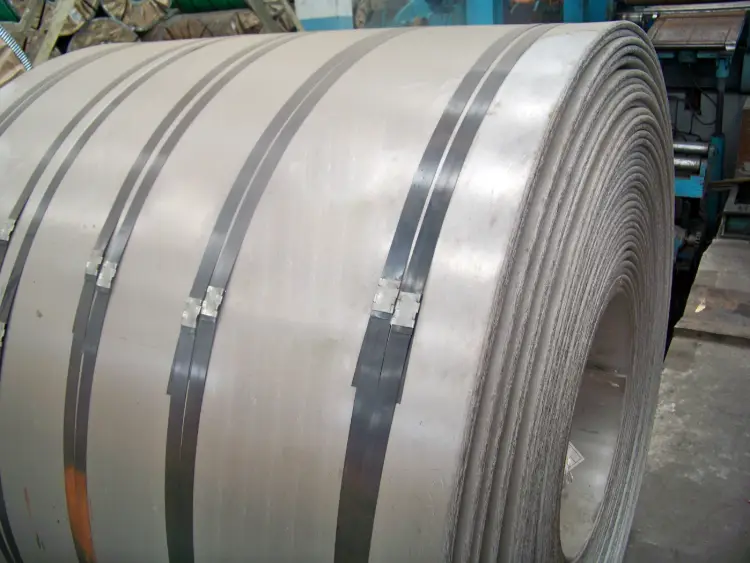
HP295 Steel Coil for Gas Cylinders & Vessels
HP295 Steel Coil for Gas Cylinders & Vessels | Q/BQB 329-2009 Baosteel Standard
Detailed material data for HP295 hot-rolled steel coil designed for welded gas cylinders and high-pressure vessels under Baosteel's Q/BQB 329-2009 standard.
Hot rolling, controlled rolling, pickling and oiling, slitting, blanking, cold forming, welding (MIG/MAG, TIG, resistance), normalizing (optional)
- Phone : +8618037372205
- Email : [email protected]
- WhatsApp: Contact via Whtsapp
- WeChat: +8618037372205
HP295 Steel Coil for Gas Cylinders & Vessels Introduction
HP295 is a high-strength, low-alloy hot-rolled steel coil specifically engineered for the fabrication of welded gas cylinders and pressure vessels. Governed by Baosteel's Q/BQB 329-2009 enterprise standard, it is a refinement of Chinese national standards (GB/T 6653) tailored to meet stringent safety and performance requirements. The material offers an optimal balance of strength and ductility, with a minimum yield strength of 295 MPa and excellent cold formability, enabling reliable shaping of cylinder shells and heads.
- Typical applications include liquefied petroleum gas (LPG) cylinders, acetylene tanks, and industrial high-pressure containers.
- HP295 exhibits good weldability, essential for longitudinal and circumferential seam welding, and retains sufficient toughness at low temperatures to ensure burst-resistant structures.
- Controlled sulfur and phosphorus levels, along with aluminum grain refinement, enhance cleanliness and uniform mechanical properties across the coil width and length.
- The steel is supplied in as-rolled or controlled-rolled condition, with optional normalizing, and can be further processed by blanking, forming, and welding.
Its consistent thickness profile and surface quality make it a preferred choice for mass production of cylinders complying with international safety codes.
HP295 Steel Coil for Gas Cylinders & Vessels Chemical Composition
The chemical composition is strictly controlled to achieve the required strength and toughness while maintaining excellent weldability. Key elements such as carbon and manganese are balanced to provide a fine-grained ferritic-pearlitic microstructure. Micro-alloying with aluminum ensures grain refinement, and residual elements (P, S) are minimized to prevent embrittlement.
- Values are maximum unless a range is given.
- Aluminum total (Alt) may be replaced by other grain-refining elements under agreement.
| Element | Standard Value | Remarks |
|---|---|---|
| Carbon (C) | ≤0.20% | |
| Silicon (Si) | ≤0.35% | |
| Manganese (Mn) | 0.50–1.50% | Depending on thickness and desired strength level |
| Phosphorus (P) | ≤0.025% | Strict control for toughness |
| Sulfur (S) | ≤0.015% | Ensures cleanliness and ductility |
| Total Aluminum (Alt) | ≥0.020% | Grain refinement; acid-soluble Al also acceptable |
| Nitrogen (N) | ≤0.012% | If not bound by aluminum, can cause strain aging |
| Others (Cr, Ni, Cu, Mo) | ≤0.30% each | Residual elements from scrap; total residuals typically ≤0.70% |
HP295 Steel Coil for Gas Cylinders & Vessels Thermal and Electrical Physical Properties
Physical properties are representative for low-carbon structural steels and are provided for design purposes. Actual values may vary slightly with heat treatment and microstructure. These data are derived from standard references for steel grades with similar composition.
- The thermal expansion coefficient is average over the temperature range 20–200°C.
- Electrical resistivity increases with temperature.
| Property | Typical Value | Unit | Condition |
|---|---|---|---|
| Density (ρ) | 7.85 | g/cm³ | 20°C |
| Modulus of elasticity (E) | 210 | GPa | 20°C |
| Shear modulus (G) | 81 | GPa | 20°C |
| Poisson's ratio (ν) | 0.3 | — | 20°C |
| Thermal expansion coefficient (α) | 12.0 × 10⁻⁶ | 1/K | 20–200°C |
| Thermal conductivity (λ) | 52 | W/(m·K) | 20°C |
| Specific heat capacity (c) | 460 | J/(kg·K) | 20°C |
| Electrical resistivity (ρ_e) | 0.18 × 10⁻⁶ | Ω·m | 20°C |
HP295 Steel Coil for Gas Cylinders & Vessels Mechanical Properties
Tensile testing is performed on transverse specimens taken from the coil in the as-delivered condition. Properties are valid for thicknesses up to 16 mm, which covers the typical coil range. The steel exhibits a distinct yield point and good elongation, enabling deep drawing and bending operations. Impact toughness is guaranteed at 0°C to ensure safe performance in moderate temperature service. Bending tests confirm the absence of cracking during fabrication.
- For thickness ≤12 mm, the elongation is measured on a gauge length of 50 mm (A50).
- Impact values are longitudinal Charpy V-notch (KV2).
| Property | Required Value | Unit | Test Condition |
|---|---|---|---|
| Yield Strength (ReH) | ≥295 | MPa | Transverse, ambient temperature |
| Tensile Strength (Rm) | 440–560 | MPa | Transverse, ambient temperature |
| Elongation after fracture (A) | ≥26 | % | Gauge length 50 mm, thickness ≤12 mm |
| Elongation after fracture (A) | ≥24 | % | Gauge length 50 mm, thickness >12–16 mm |
| Bend test (180°) | d=2a | — | Ambient, uncracked, for all thicknesses |
| Impact energy (KV2) | ≥31 | J | Longitudinal, 0°C, average of three tests |
| Impact energy (KV2), single minimum | ≥22 | J | Longitudinal, 0°C, individual value |
HP295 Steel Coil for Gas Cylinders & Vessels Exact Equivalent Standards and Replaceable Grades
| Country/Region | Standard | Grade | Remarks |
|---|---|---|---|
| China | GB/T 6653-2008 | HP295 | Same grade; properties align with Q/BQB 329 |
| Japan | JIS G3116 | SG295 | Comparable chemistry and mechanicals; used for welded cylinders |
| European Union | EN 10120:2017 | P295NB | Yield 295 MPa, tensile 440–560 MPa; impact temperature specified |
| International | ISO 4978:2018 | P295NB | Harmonized with EN 10120; widely recognized |
HP295 Steel Coil for Gas Cylinders & Vessels Application Introduction
HP295 steel coil is optimized for the economical mass production of welded gas cylinders and similar pressure-containing components. It combines reliable strength with excellent formability and weldability, enabling automated manufacturing lines. Typical service temperatures range from -20°C to +60°C, with proper design.
- Heads and shells are formed by deep drawing, spinning, or roll bending.
- Longitudinal seam welding is performed with submerged-arc or gas-shielded processes.
- After fabrication, cylinders may be heat-treated (stress relieving or normalizing) to restore mechanical properties at weld zones.
- The steel meets requirements for dangerous goods packaging (UN Model Regulations) when used with approved welding procedures.
Product Applications: Welded steel gas cylinders (2 kg to 50 kg LPG sizes), High-pressure seamless-type cylinders (by subsequent processing), CNG Type 1 all-metal cylinders, Acetylene cylinders with porous filler, Spherical and cylindrical pressure vessels for stationary storage
Processed into products: Cylinder body shells (rolled cylinders), Dished ends (heads) formed by deep drawing or spinning, Base rings and neck rings, Valve boss fittings, Reinforcement and baffle plates for large vessels, Repair patches for cylinder re-certification (approved procedures)
Application industries: Industrial gas supply (oxygen, nitrogen, argon, acetylene), Domestic and commercial LPG distribution, Compressed Natural Gas (CNG) vehicle fuel systems, Fire extinguisher manufacturing, Refrigerant and specialty gas containers, Pressure vessels for water treatment and hydraulic accumulators
HP295 Steel Coil for Gas Cylinders & Vessels Similar or Alternative Material Recommendations
| Country/Region | Standard | Grade | Remarks |
|---|---|---|---|
| China | GB/T 6653 | HP265 | Lower yield strength (≥265 MPa); used where less strength is acceptable |
| China | GB/T 6653 | HP325 | Higher yield strength (≥325 MPa); suitable for heavier-duty vessels |
| Japan | JIS G3116 | SG255 | Similar base composition with lower carbon equivalent; easier forming |
| European Union | EN 10120 | P245NB | Lower strength variant; may require thicker wall for same pressure |
| USA | ASTM A612/A612M | Grade A | Pressure vessel steel with min. yield 260 MPa; closer to HP265 |
Notes:
Additional requirements per Q/BQB 329-2009 may include:
- Ultrasonic testing (UT) to A435/A577 or equivalent for laminations.
- Non-metallic inclusion rating (e.g., ASTM E45).
- Grain size determination (ASTM E112, typically ASTM No. 7 or finer).
- Surface quality: free from detrimental scale, scratches, and gouges.
- Dimensional tolerances according to customer agreement; camber and flatness control for coil processing.
Fabrication note: The carbon equivalent (CE) is usually kept below 0.40% to ensure crack-free welding without preheating. Post-weld heat treatment may be required depending on cylinder code. The steel is not intended for sour service (H2S) without special qualification.
- Share



