
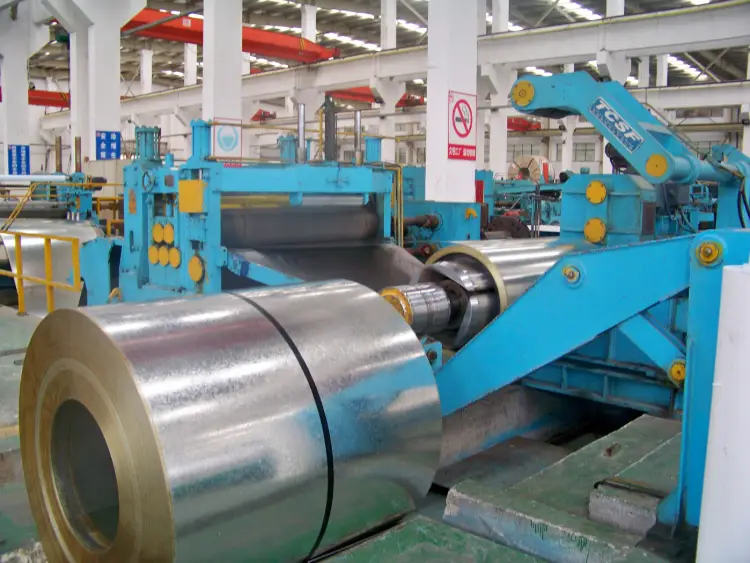
HP265 Steel Coil for Gas Cylinders
HP265 Steel Coil for Gas Cylinders: Q/BQB 329-2009 Analysis & Equivalents
Comprehensive datasheet of HP265 steel coil to Q/BQB 329-2009, including chemical composition, mechanical and thermal properties, international equivalents, and typical applications in gas cylinder production.
Hot rolling, controlled rolling, pickled and oiled, cold forming, deep drawing, welding
- Phone : +8618037372205
- Email : [email protected]
- WhatsApp: Contact via Whtsapp
- WeChat: +8618037372205
HP265 Steel Coil for Gas Cylinders Introduction
HP265 is a hot-rolled steel coil grade specified in Baosteel Enterprise Standard Q/BQB 329-2009, specifically designed for welded gas cylinders and pressure vessels. It offers a good combination of strength, ductility, and weldability. The grade exhibits a minimum yield strength of 265 MPa and minimum tensile strength of 380 MPa, with excellent formability for deep-drawing cylinder bodies. Controlled rolling ensures fine grain structure and consistent properties. Typical thickness ranges from 1.5 mm to 4.0 mm, suitable for high-speed automatic welding lines in LPG and industrial gas cylinder manufacturing.
HP265 Steel Coil for Gas Cylinders Chemical Composition
The chemical composition of HP265 is controlled to ensure good weldability and formability. Fine grain strengthening is achieved through microalloying with aluminum. Standard limits according to Q/BQB 329-2009 are listed below. Residual elements are not explicitly required but are kept low to avoid detrimental effects on cylinder properties.
| Element | Standard Value (max, unless range given) | Remarks |
|---|---|---|
| C | 0.20 | |
| Si | 0.35 | |
| Mn | 0.50 – 1.20 | |
| P | 0.030 | |
| S | 0.030 | |
| Al(total) | ≥ 0.015 | Fine grain practice |
| Nb, V, Ti | Not required (may be added) |
HP265 Steel Coil for Gas Cylinders Thermal & Electrical Physical Properties
The following physical properties are typical for carbon-manganese steels and can be used for engineering calculations. They are not part of the mandatory standard requirements and may vary slightly depending on exact composition and temperature. Values are given at room temperature unless indicated.
| Property | Typical Value | Unit | Condition / Temperature |
|---|---|---|---|
| Density (ρ) | 7.85 | g/cm³ | 20 °C |
| Elastic Modulus (E) | 210 | GPa | 20 °C |
| Shear Modulus (G) | 81 | GPa | 20 °C |
| Poisson's Ratio (ν) | 0.3 | – | 20 °C |
| Thermal Expansion Coefficient (α) | 12.0 × 10⁻⁶ | K⁻¹ | 20 – 100 °C |
| Thermal Conductivity (λ) | 51 | W/(m·K) | 20 °C |
| Specific Heat Capacity | 486 | J/(kg·K) | 20 °C |
| Electrical Resistivity (ρₑ) | 0.20 | μΩ·m | 20 °C |
HP265 Steel Coil for Gas Cylinders Mechanical Properties
Mechanical properties are determined on test pieces taken in the transverse direction. Values below refer to the as-delivered condition (hot-rolled). Thickness range typically 1.5 – 4.0 mm. Bending test is performed at 180° with a mandrel diameter equal to 2 times the thickness (2a). Impact requirements are not specified in the standard but can be agreed for low-temperature service.
| Property | Specified Value | Unit | Test Condition |
|---|---|---|---|
| Yield Strength (ReH) | ≥ 265 | MPa | Room temperature, transverse |
| Tensile Strength (Rm) | ≥ 380 | MPa | Room temperature, transverse |
| Elongation after fracture (A50) | ≥ 24 | % | 50 mm gauge length |
| Bend Test (180°) | d = 2a, no cracks | – | Through 180°, mandrel diameter = 2 × thickness |
HP265 Steel Coil for Gas Cylinders Fully Equivalent Material Standards & Substitutable Grades
| Country/Region | Standard | Grade | Remarks |
|---|---|---|---|
| China | GB/T 6653 | HP265 | National standard equivalent |
| European Union | EN 10120 | P265NB | Chemically and mechanically equivalent |
| International | ISO 4978 | HR265 | Hot-rolled steel for welded gas cylinders |
| Japan | JIS G3116 | SG265 | Very close composition and properties, often interchangeable |
HP265 Steel Coil for Gas Cylinders Application Introduction
HP265 steel coil is optimized for the manufacture of welded gas cylinders and pressure vessels. Its fine-grain structure and controlled chemistry ensure reliable performance in high-pressure containment, even under fatigue loading. The material is suitable for both cold forming and welding, enabling mass production of cylinders conforming to international safety standards.
Product Applications: 2 kg to 50 kg LPG cylinders, Welded industrial gas cylinders for oxygen, nitrogen, argon, Refrigerant cylinders (R134a, R410A), Small pressure vessels for fire extinguishers
Processed into products: Cylinder body (shell) – deep drawn or rolled and welded, Upper and lower heads (end caps), Valve bosses and neck rings, Foot rings and base plates
Application industries: LPG cylinder production, Industrial and medical gas cylinder manufacturing, Refrigerant and aerosol container manufacturing, Automotive compressed natural gas (CNG) cylinder production
HP265 Steel Coil for Gas Cylinders Similar / Alternative Material Recommendations
| Country/Region | Standard | Grade | Remarks |
|---|---|---|---|
| China | GB/T 6653 | HP295 | Higher strength (min YS 295 MPa) for heavier-duty cylinders |
| EU | EN 10120 | P295NB | Similar to HP295, alternative for increased wall thickness reduction |
| China | Q/BQB 329 | HP235 | Lower strength option for smaller cylinders or less demanding applications |
Notes:
HP265 is normally delivered with a pickled and oiled surface (PO) to facilitate forming and welding. Tight gauge control (±0.08 mm) is typical for Baosteel products. For low-temperature service (e.g., below -20 °C), supplementary impact test requirements should be negotiated. The material is not intended for post-weld heat treatment, though stress relieving may be applied for certain cylinder designs.
- Share



