
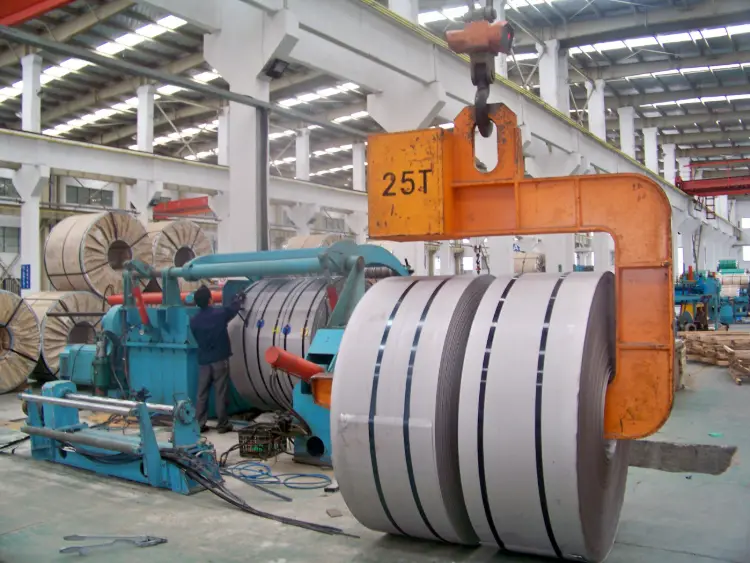
HP235 Steel Coil for Gas Cylinders & Vessels
HP235 Steel Coil for Gas Cylinders & Vessels | Q/BQB 329-2009
Comprehensive material data for HP235 steel coil per Baosteel standard Q/BQB 329-2009, covering chemical composition, mechanical properties, thermal/electrical physical properties, international equivalents, and application guidance.
Hot rolling, cold forming, welding, deep drawing, bending, normalizing (optional)
- Phone : +8618037372205
- Email : [email protected]
- WhatsApp: Contact via Whtsapp
- WeChat: +8618037372205
HP235 Steel Coil for Gas Cylinders & Vessels Introduction
HP235 is a low-carbon structural steel specifically developed for welded gas cylinders and gas vessels, standardized under Q/BQB 329-2009 (Baosteel enterprise specification). It exhibits excellent cold formability, superior weldability, and reliable strength-toughness balance at service and sub-zero temperatures.
The steel is produced as hot-rolled coils or strips with strict control of sulfur and phosphorus to guarantee a clean microstructure and resistance to lamellar tearing. Delivery conditions are typically as-rolled or normalized, and the material can be processed into cylinder bodies, ends, and associated components through conventional press forming, deep drawing, and welding operations.
HP235 Steel Coil for Gas Cylinders & Vessels Chemical Composition
The chemical composition of HP235 according to Q/BQB 329-2009 (aligning with GB 6653-2008) is tightly controlled to ensure excellent weldability, formability, and resistance to aging. Low phosphorus and sulfur are maintained for high integrity in welding. Residual elements are restricted to prevent adverse effects on toughness and heat-affected zone properties.
| Chemical Element | Standard Value | Remarks |
|---|---|---|
| C | ≤ 0.16 | |
| Si | ≤ 0.35 | |
| Mn | ≤ 0.90 | |
| P | ≤ 0.025 | |
| S | ≤ 0.015 | |
| Alt | ≥ 0.015 | Total aluminum |
| Crⁱ | ≤ 0.30 | Residual element |
| Niⁱ | ≤ 0.30 | Residual element |
| Cuⁱ | ≤ 0.30 | Residual element |
| Moⁱ | ≤ 0.08 | Residual element |
| Nbⁱ | ≤ 0.05 | Residual element |
| Vⁱ | ≤ 0.02 | Residual element |
| Tiⁱ | ≤ 0.02 | Residual element |
| Nb+V+Ti | ≤ 0.12 | Sum of micro-alloying residuals |
HP235 Steel Coil for Gas Cylinders & Vessels Thermal and Electrical Physical Properties
The following physical properties are typical for HP235 carbon steel at ambient temperature, and are relevant for design, heat treatment, and welding thermal analysis. Values may vary slightly with processing history and temperature. Data are derived from standard references for low-carbon steel grades with similar composition.
| Property | Typical Value | Unit | Condition / Temperature |
|---|---|---|---|
| Density (ρ) | 7.85 | g/cm³ | At 20 °C |
| Modulus of elasticity (E) | 205 | GPa | At 20 °C |
| Shear modulus (G) | 79 | GPa | From E and ν, 20 °C |
| Poisson's ratio (ν) | 0.30 | — | At 20 °C |
| Thermal expansion coeff. (α) | 12.0 | 10⁻⁶/K | 20 °C – 100 °C |
| Thermal expansion coeff. (α) | 12.8 | 10⁻⁶/K | 20 °C – 200 °C |
| Thermal conductivity (λ) | 50 | W/(m·K) | At 20 °C |
| Specific heat capacity (c) | 486 | J/(kg·K) | At 20 °C |
| Electrical resistivity (ρₑ) | 0.15 | µΩ·m | At 20 °C |
HP235 Steel Coil for Gas Cylinders & Vessels Mechanical Properties
Mechanical properties are determined in accordance with GB/T 228.1 and GB/T 229 standards, as required by Q/BQB 329-2009. The values apply to the as-delivered condition (as-rolled or normalized). Yield strength and elongation requirements vary with thickness to ensure adequate cold forming behavior. Impact toughness is measured on longitudinal standard V-notch specimens at 0°C.
| Property | Standard Requirement | Unit | Test Condition / Thickness |
|---|---|---|---|
| Yield strength (ReH) | ≥ 235 | MPa | All thicknesses |
| Tensile strength (Rm) | 380~500 | MPa | All thicknesses |
| Elongation after fracture (A) | ≥ 26 | % | Thickness ≥3 mm, gauge length 5.65√S₀ |
| Elongation after fracture (A₈₀) | ≥ 24 | % | Thickness <3 mm, gauge length 80 mm |
| Bend test (180°) | d=1.5a | — | Thickness ≤7 mm |
| Bend test (180°) | d=2a | — | Thickness >7~12 mm |
| Impact energy (KV₂) | ≥ 34 | J | 0 °C, longitudinal, standard V-notch specimen |
HP235 Steel Coil for Gas Cylinders & Vessels Fully Equivalent Standards & Substitutable Grades
| Country/Region | Standard | Grade | Remarks |
|---|---|---|---|
| China | GB 6653-2008 | HP235 | Identical chemical and mechanical requirements; base standard for HP235. |
| International (ISO) | ISO 4978:2007 | P235S | Equivalent grade for welded gas cylinders; yield ≥235 MPa, tensile 380-500 MPa. |
| European Union | EN 10120:2017 | P235S | Direct European counterpart; same yield and tensile range, suitable for pressure equipment. |
| Japan | JIS G3125:2021 | SPHT1 | Japanese standard for gas cylinder steel; yield ≥235 MPa, excellent weldability. |
HP235 Steel Coil for Gas Cylinders & Vessels Application Introduction
HP235 is the material of choice for welded gas cylinders that require a combination of ductility, notch toughness, and cost-effectiveness. Its low carbon equivalence enables trouble-free manual, submerged-arc, and gas-shielded welding without preheating under normal conditions. Typical applications include:
Product Applications: Domestic LPG cylinders (from 5 kg to 50 kg), Industrial acetylene cylinders, Oxygen and inert gas cylinders, Compressed natural gas (CNG) containers (Type I), Air receiver tanks below 50 L
Processed into products: Cylinder bodies (shell sections – cylindrical formed from coil), Deep-drawn ends (dished heads, hemispherical/bell ends), Cylinder necks and valve bosses, Weld neck flanges, Base rings and foot rings (formed from strip), Reinforcement pads and brackets
Application industries: Gas cylinder manufacturing, Industrial & medical gases (oxygen, nitrogen, argon), Liquefied petroleum gas (LPG) distribution, Pressure vessel and boiler industry, Portable fuel and energy storage
HP235 Steel Coil for Gas Cylinders & Vessels Near-Equivalent & Comparable Alternative Materials
| Country/Region | Standard | Grade | Remarks |
|---|---|---|---|
| China | GB 6653-2008 | HP245 | Higher minimum yield strength (≥245 MPa); slightly higher tensile; used when increased strength is needed. |
| China | GB 6653-2008 | HP265 | Yield ≥265 MPa; for higher-pressure gas cylinders; still good weldability. |
| European Union | EN 10120:2017 | P245S | Yield ≥245 MPa; similar formability and weldability, can be substituted with design adjustment. |
| European Union | EN 10120:2017 | P265S | Higher strength alternative; careful welding procedure adjustment may be required. |
| Japan | JIS G3125:2021 | SPHT2 | Yield ≥255 MPa; similar application, but slightly higher carbon content possible. |
| China | GB/T 700-2006 | Q235B | General structural steel; not specifically certified for gas cylinders but may be used for non-pressure parts under restricted conditions due to higher sulfur/phosphorus tolerance. |
Notes:
All information conforms to Q/BQB 329-2009 and is cross-checked with GB 6653-2008. Values represent typical requirements; actual mill certificates may show narrower ranges. Hydrogen-induced cracking resistance is enhanced by the controlled sulfur content. For thick parts or special low-temperature service, normalization may be agreed upon. HP235 is not intended for sour service without individual qualification.
- Share



