
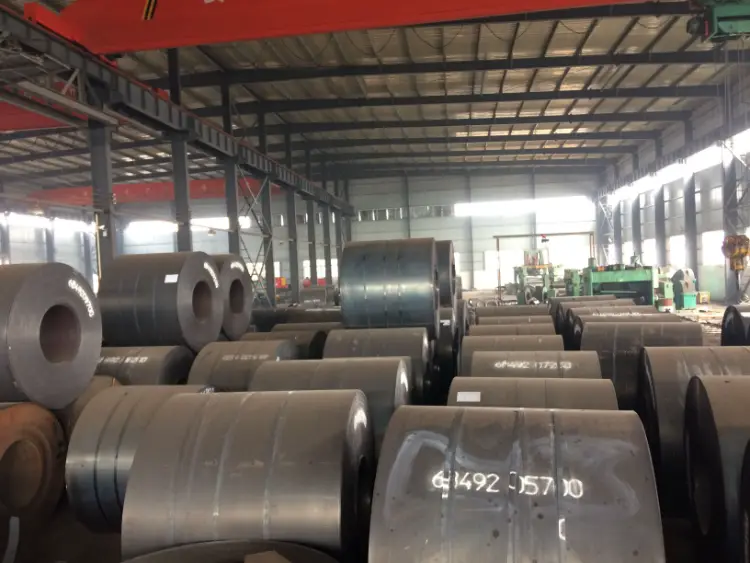
JIS G3116 SG325 Steel Coil for Gas Cylinders
JIS G3116 SG325 Steel Coil for Gas Cylinders: Properties, Equivalents & Applications
Comprehensive material data for JIS G3116 SG325 hot-rolled steel coil for gas cylinders, including chemical composition, mechanical and physical properties, international equivalents, and application guidance.
Hot rolling, normalizing (optional), cold bending, welding, deep drawing, stamping, and hydroforming
- Phone : +8618037372205
- Email : [email protected]
- WhatsApp: Contact via Whtsapp
- WeChat: +8618037372205
JIS G3116 SG325 Steel Coil for Gas Cylinders Introduction
JIS G3116 SG325 is a hot-rolled steel coil specified in the Japanese Industrial Standard for welded gas cylinders. It is a low-carbon, high-strength structural steel with enhanced formability and weldability, specifically designed for manufacturing high-pressure gas containers. SG325 exhibits a minimum yield strength of 325 MPa and tensile strength between 440 and 590 MPa, ensuring robust performance under cyclic pressure loads. The steel is produced via controlled rolling and normalizing processes, delivering fine-grained microstructure and excellent notch toughness at ambient temperatures. Its superior surface quality and thickness accuracy make it suitable for deep drawing, bending, and welding operations required in cylinder production. The material is typically supplied in the as-rolled or normalized condition, and it can withstand hydrostatic pressure tests without leakage, complying with strict safety standards for compressed gas storage and transportation.
JIS G3116 SG325 Steel Coil for Gas Cylinders Chemical Composition
Chemical composition according to JIS G3116 for SG325. Values are maximum unless a range is indicated. The steel may contain microalloying elements such as Nb, V, Ti, or Mo at the manufacturer's discretion to refine grain size and improve mechanical properties, provided they do not adversely affect weldability and formability.
| Element | Standard Value | Remarks |
|---|---|---|
| C | ≤ 0.20 | Carbon content controlled for strength and weldability |
| Si | ≤ 0.35 | Silicon for deoxidation; higher values may be allowed by agreement |
| Mn | 0.50 – 1.00 | Manganese enhances strength and hardenability |
| P | ≤ 0.040 | Phosphorus limited to avoid cold brittleness |
| S | ≤ 0.040 | Sulfur restricted for hot workability and impact toughness |
| Others | Nb, V, Ti, Mo etc. may be added as needed (not specified) | Optional microalloying to meet mechanical requirements |
JIS G3116 SG325 Steel Coil for Gas Cylinders Physical Properties
These physical properties are typical for low-carbon structural steels similar to SG325. They are derived from general material databases and are not part of JIS G3116 requirements. Actual values may vary slightly with processing history and temperature. They are provided for design and simulation purposes.
| Property | Typical Value | Unit | Test Condition / Remarks |
|---|---|---|---|
| Density (ρ) | 7.85 | g/cm³ | At room temperature |
| Elastic Modulus (E) | 210 | GPa | In tension, at room temperature |
| Shear Modulus (G) | 80.8 | GPa | Calculated, at room temperature |
| Poisson's Ratio (ν) | 0.30 | — | Elastic range, room temperature |
| Thermal Expansion Coefficient (α) | 12.0 × 10⁻⁶ | /K | Between 20°C and 100°C |
| Thermal Expansion Coefficient (α) | 13.5 × 10⁻⁶ | /K | Between 20°C and 300°C |
| Thermal Conductivity (λ) | 50 | W/(m·K) | At room temperature |
| Specific Heat Capacity (cp) | 460 | J/(kg·K) | At room temperature |
| Electrical Resistivity (ρ_e) | 1.5 × 10⁻⁷ | Ω·m | At room temperature |
JIS G3116 SG325 Steel Coil for Gas Cylinders Mechanical Properties
Mechanical properties are specified in JIS G3116 for test pieces taken in the transverse direction. Values vary with thickness. Tensile test uses JIS Z 2241, bending test JIS Z 2248. The bending test requires no cracks on the outside of the bent portion. Impact properties are not a standard requirement for SG325 but may be agreed upon.
| Property | Standard Requirement | Unit | Test Condition / Remarks |
|---|---|---|---|
| Yield Strength (ReH) | ≥ 325 | MPa | Applicable for thickness ≤ 20 mm; upper yield point or 0.2% proof stress |
| Tensile Strength (Rm) | 440 – 590 | MPa | Thickness ≤ 20 mm |
| Elongation (A) | ≥ 26 | % | JIS No.5 test piece, thickness >1.6 to 3.0 mm (gauge length 50 mm) |
| Elongation (A) | ≥ 31 | % | Thickness >3.0 to 6.0 mm (JIS No.5) |
| Elongation (A) | ≥ 26 | % | Thickness >6.0 to 20 mm (JIS No.1A or No.14A, gauge length 200 or 50 mm) |
| Bending Test (180° bend) | Inside radius = 1.5 t | — | t = thickness of specimen; no cracks on outer surface |
JIS G3116 SG325 Steel Coil for Gas Cylinders Equivalent Material Standards & Designations
| Country/Region | Standard | Grade | Remarks |
|---|---|---|---|
| Japan | JIS G3116 | SG325 | Original specification |
| China | GB/T 6653 | HP325 | Yield ≥ 325 MPa, tensile 490–635 MPa; for welded gas cylinders, nearly identical usage |
| International | ISO 4978:1999 | — | No exact match; SG325 fits between P310NB and P355NB grades depending on thickness limits |
| Europe | EN 10120 | P310NB | Closest European grade; yield ≥310 MPa, tensile 430–560 MPa; similar composition but lower sulfur/phosphorus limits (P≤0.025, S≤0.015) |
JIS G3116 SG325 Steel Coil for Gas Cylinders Application Introduction
SG325 steel is tailored for high-pressure welded gas cylinders, where a balance of strength, ductility, and weld integrity is paramount. Its fine-grain structure ensures resistance to brittle fracture under rapid pressure changes. The steel is used to produce seamless and two-piece welded cylinders for storing and transporting compressed industrial gases, LPG, CNG, dissolved acetylene, and fire-extinguishing agents. The surface condition and thickness tolerance are critical for consistent forming, spinning, and welding. Post-weld heat treatment (normalizing) is often applied to relieve residual stresses and refine the weld zone microstructure. With its excellent strength-to-weight ratio, SG325 allows thinner wall designs, reducing material cost and cylinder weight while maintaining safety margins.
Product Applications: Welded high-pressure cylinders for oxygen, nitrogen, argon, CO₂, helium, hydrogen, LPG cooking gas cylinders (domestic and commercial), CNG cylinders for vehicles, Portable acetylene cylinders (dissolved acetylene), Fire extinguisher bodies (portable and wheeled), Diving air and nitrox tanks
Processed into products: Cylinder shell halves (deep drawn or spun), Cylinder neck rings and collar reinforcements, Base rings and foot rings, Valve protection caps and shroud assemblies, Boss inserts (machined from forgings), Pressure relief device rupture disc holders
Application industries: Industrial gas manufacturing and distribution, Liquefied petroleum gas (LPG) and compressed natural gas (CNG) automotive sectors, Fire-fighting equipment production, Medical and diving gas cylinder manufacturing, Chemical processing and cryogenic liquid storage
JIS G3116 SG325 Steel Coil for Gas Cylinders Comparable & Substitution Materials
| Country/Region | Standard | Grade | Remarks |
|---|---|---|---|
| Japan | JIS G3125 | SPA-H | High-strength atmospheric corrosion-resistant steel; used for cylinder-like applications but with added Cu-Cr-Ni, not a direct substitute. |
| China | GB/T 6653 | HP295 | Lower yield strength (≥295 MPa) grade for gas cylinders; may substitute when SG325 is over-specified. |
| USA | ASTM A414/A414M | Grade G | Pressure vessel steel with min yield 240 MPa, much lower strength; not directly equivalent, but usable in less demanding cylinder designs after revalidation. |
| Europe | EN 10120 | P265NB | Widely used gas cylinder steel grade in Europe; lower strength (yield ≥265 MPa) but excellent toughness; can be considered with thicker walls. |
| India | IS 6240 | 240/300 | Specification for LPG cylinder steel; yield around 240-300 MPa, inferior mechanical properties; substitution requires careful engineering. |
Notes:
Supplementary information:
1. Weldability: SG325 has a carbon equivalent (CE) typically below 0.40% when Mn ≤ 1.0% and C ≤ 0.20%, making it easily weldable by resistance, arc, and submerged arc processes. Preheating is generally not required for thicknesses up to 10 mm, but post-weld normalizing is recommended to refine the heat-affected zone.
2. Hydrostatic testing: Finished cylinders must withstand hydrostatic pressure tests (e.g., 1.5 times the working pressure) without permanent deformation or leakage, as per national regulations (e.g., JIS B 8231 or ISO 9809-1).
3. Grain refinement: Aluminum-killed steel is commonly used to ensure fine austenitic grain size (ASTM No.5 or finer), which improves toughness and formability. Controlled rolling or normalizing helps achieve the required microstructure.
4. Certification: Material test certificates (JIS G 0415 or EN 10204 type 3.1) are normally supplied with chemical composition, tensile, and bend results. Additional tests like ultrasonic inspection, impact at low temperatures, or surface nondestructive testing can be agreed upon.
5. Limitations: This steel is not intended for service at temperatures below -20°C without specific qualification. For low-temperature applications, fine-grain killed steel with impact guarantees (e.g., JIS G 3126 SLA series) should be considered.
- Share



