
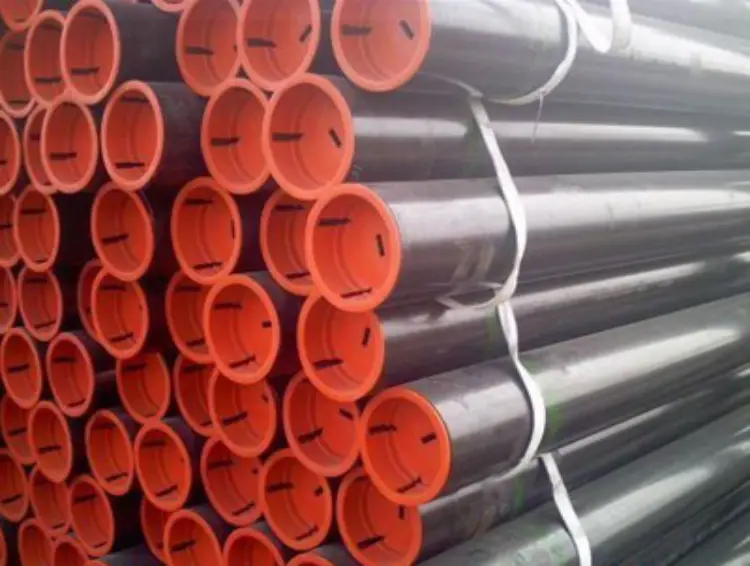
GB/T 9711 PSL1 L360 SSAW Pipe
GB/T 9711 PSL1 L360 SSAW Pipe: High-Strength Line Pipe for Oil & Gas Transmission
Comprehensive material data for GB/T 9711-2011 PSL1 L360 spiral submerged-arc welded (SSAW) steel pipe, including chemical composition, mechanical properties, thermal and electrical physical properties, international equivalents, and application guidance.
Forming and welding of hot-rolled coil, cold expansion (optional), coating, etc.
- Phone : +8618037372205
- Email : [email protected]
- WhatsApp: Contact via Whtsapp
- WeChat: +8618037372205
GB/T 9711 PSL1 L360 SSAW Pipe Introduction
GB/T 9711-2011 L360 PSL1 SSAW pipe is a high-strength, low-alloy steel line pipe manufactured by spiral submerged-arc welding, primarily used for conveying oil, gas, and water in pipeline systems. The grade L360 designates a minimum yield strength of 360 MPa, equivalent to API 5L X52. Produced under the PSL1 (Product Specification Level 1) requirements, this material offers a balanced combination of strength and toughness with good weldability and bendability. SSAW (spiral submerged-arc welded) pipes are formed by spirally coiling hot-rolled strip and welding the seam automatically, enabling large diameters and wide wall-thickness ranges. Typical delivery condition is as-welded from hot-rolled coil, with optional normalizing available. The steel exhibits excellent dimensional accuracy and uniform mechanical properties, making it a reliable choice for long-distance transmission pipelines, structural applications, and pressure vessels.
GB/T 9711 PSL1 L360 SSAW Pipe Chemical Composition
The chemical composition limits for PSL1 L360 are prescribed in GB/T 9711-2011. Only carbon, manganese, phosphorus, and sulfur are mandatory. Other elements (Nb, V, Ti, etc.) may be added at the manufacturer's discretion, but their total content is not specified for PSL1; typical residual limits are noted.
- Heat analysis applies before any product analysis adjustment.
- Carbon equivalent (CEV) is not required for PSL1 unless agreed upon between purchaser and manufacturer.
| Element | Specified Value | Remarks |
|---|---|---|
| Carbon (C) | ≤0.28 | Maximum |
| Manganese (Mn) | ≤1.40 | Maximum |
| Phosphorus (P) | ≤0.030 | Maximum |
| Sulfur (S) | ≤0.030 | Maximum |
| Niobium + Vanadium + Titanium (Nb+V+Ti) | ≤0.15 (typical agreement) | May be specified by agreement; often controlled to ≤0.15 % for grain refinement and precipitation strengthening. |
GB/T 9711 PSL1 L360 SSAW Pipe Thermal and Electrical Physical Properties
The following thermal and electrical properties are typical for low-carbon line pipe steel of grade L360 (similar to X52). These values are not specified in GB/T 9711-2011 but are provided for engineering reference. Actual properties may vary slightly depending on exact chemical composition and manufacturing conditions.
- Properties are measured at room temperature unless otherwise noted.
- Values are representative of the base metal after welding, with no significant change in bulk physical characteristics.
| Property | Typical Value | Unit | Test Conditions |
|---|---|---|---|
| Density (ρ) | 7.85 | g/cm³ | 20 °C |
| Modulus of Elasticity (E) | 205 | GPa | 20 °C, tension |
| Shear Modulus (G) | 80 | GPa | 20 °C, calculated |
| Poisson's Ratio (ν) | 0.30 | – | 20 °C |
| Thermal Expansion Coefficient (α) | 12.2 | 10⁻⁶/K | 20 °C – 100 °C |
| Thermal Conductivity (λ) | 50 | W/(m·K) | 20 °C |
| Specific Heat Capacity (c) | 460 | J/(kg·K) | 20 °C |
| Electrical Resistivity (ρ_e) | 0.143 | µΩ·m | 20 °C |
GB/T 9711 PSL1 L360 SSAW Pipe Mechanical Properties
Mechanical property requirements for L360 PSL1 SSAW pipe are given in GB/T 9711-2011, including tensile testing on the pipe body and weld, and guided bend tests for the weld.
- All tensile specimens are taken transverse to the pipe axis (flat rectangular samples).
- Bend test (face and root bend) uses 180° bending with a mandrel diameter dependent on wall thickness.
- Charpy impact testing is not mandatory for PSL1, but can be agreed upon. Typical ductile behavior is achieved at service temperatures above -20 °C.
| Property | Required Value | Unit | Test Condition / Remarks |
|---|---|---|---|
| Yield Strength (Rt0.5) | 360 – 530 | MPa | Transverse test, pipe body |
| Tensile Strength (Rm) | 460 – 760 | MPa | Transverse test, pipe body |
| Elongation (A) | ≥22 | % | Transverse rectangular specimen, all wall thicknesses (according to Table 6) |
| Weld Tensile Strength | ≥460 | MPa | Minimum value; weld must not fail below this stress |
| Bend Test – Mandrel Diameter (t ≤25 mm) | 2 t | – | 180° face and root bend for AW/SAW pipes; t = wall thickness |
| Bend Test – Mandrel Diameter (t >25 mm) | 3 t | – | 180° face and root bend |
| Charpy Impact (optional) | By agreement (e.g., ≥27 J at 0°C) | J | PSL1 does not require impact testing; typical agreed values for toughness |
GB/T 9711 PSL1 L360 SSAW Pipe Exactly Equivalent Material Standards and Alternative Grade Designations
| Country / Region | Standard | Grade | Remarks |
|---|---|---|---|
| USA / International | API 5L, 46th Ed. (2018) / ISO 3183:2019 | PSL1 Grade X52 | The direct equivalent of GB/T 9711 L360; identical strength and chemical limits for PSL1. |
| International / Worldwide | ISO 3183:2019 | L360 PSL1 | Mirrors GB/T 9711-2011; adopted as Chinese National Standard GB/T 9711. |
| European Union | EN 10208-2:2009 | L360NB (or L360MB) | EN 10208-2 pipe standard covers L360 for flammable fluids; requirements are slightly different (usually PSL2 level toughness). L360NB is the base equivalent for PSL1-like delivery. |
GB/T 9711 PSL1 L360 SSAW Pipe Application Introduction
L360 SSAW pipe is widely used where a balance of strength, cost, and reliability is required. The spiral-welded manufacturing method allows economical production of large-diameter pipes (up to ~3000 mm) with relatively thin walls, ideal for long-distance pipelines. Typical applications and components include:
Product Applications: Spiral submerged-arc welded line pipe (bare, coated, or lined), Pressure vessels (when rolled and welded from plate of same grade), Tubular structures (wind turbine towers, offshore jacket legs, etc.), Casing and conductor pipes for onshore/offshore wells (non-sour service)
Processed into products: Pipe spools and fittings (elbows, tees, reducers) fabricated from the same material, Flanges (weld-neck) and connectors, Pipeline supports, anchors, and thrust blocks, Pump station and compressor station piping components, Manholes and large access tees
Application industries: Oil & Gas (upstream and midstream): gathering lines, transmission mains, distribution pipelines, Petrochemical: process piping, refinery connections, Water & Wastewater: municipal water mains, penstocks, intake/outfall pipes, Construction & Civil Engineering: structural piling, foundation tubes, bridge supports, Power Generation: cooling water lines, hydroelectric penstocks
GB/T 9711 PSL1 L360 SSAW Pipe Similar Alternative Materials with Close Mechanical Performance
| Country / Region | Standard | Grade | Remarks |
|---|---|---|---|
| International | API 5L / ISO 3183 | X42 (L290) / X46 (L320) | Lower strength grades; may be substituted in less demanding applications where design stress allows. Easier forming and welding. |
| International | API 5L / ISO 3183 | X56 (L390) | Higher strength grade; can be used when increased pressure rating is needed, keeping wall thickness similar. Requires attention to weldability and toughness. |
| USA | ASTM A53 / A53M | Grade B | General purpose carbon steel pipe. Yield strength ~240 MPa, much lower; suitable for non-critical structural and low-pressure water lines. |
| China | GB/T 9711-2011 | L290 / L320 / L390 | Neighboring grades within the same standard, offering step-wise strength levels for various pipeline design requirements. |
Notes:
PSL1 vs. PSL2: L360 PSL1 has no mandatory Charpy impact requirement and relaxed NDT; it is typically used in moderate temperatures and non-sour environments. For severe conditions (low temperature, sour service, offshore), PSL2 L360 or higher grades with stricter control are recommended. Weldability: With CEV typically ≤0.40 (by agreement), preheat and interpass temperature control may be required for thick sections. Corrosion protection: SSAW pipes are often supplied with external 3-LPE coating and internal epoxy lining for buried service. All references to standards are for guidance only; always refer to the latest edition of the respective specification and supplementary project requirements.
- Share



