
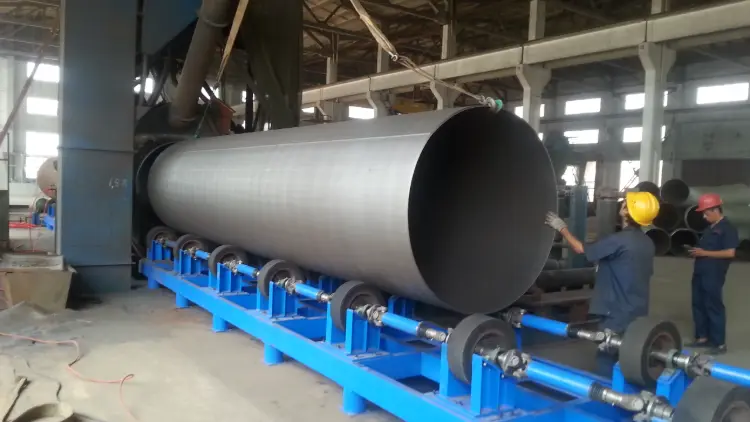
GB/T 9711 L485 Pipeline Steel
GB/T 9711 L485 Pipeline Steel: High-Strength Steel for Oil & Gas Transmission Pipelines
Explore the chemical composition, mechanical properties, thermal performance, equivalent grades, and applications of GB/T 9711 L485 pipeline steel, a high-strength steel for longitudinal and spiral welded pipes in oil and gas transportation.
Thermo-mechanical controlled processing (TMCP), normalizing rolling, submerged-arc welding for pipe fabrication
- Phone : +8618037372205
- Email : [email protected]
- WhatsApp: Contact via Whtsapp
- WeChat: +8618037372205
GB/T 9711 L485 Pipeline Steel Introduction
GB/T 9711 L485 is a pipeline steel grade specified in the Chinese national standard for steel pipes used in petroleum and natural gas industries. It corresponds to API 5L X70 and offers a minimum yield strength of 485 MPa, ensuring reliable performance in high-pressure transmission systems.
- High strength and excellent toughness for demanding environments
- Good weldability and formability tailored for pipe manufacturing
- Typically supplied as hot-rolled plate or strip for longitudinal and spiral welded pipes
- Can be thermo-mechanically rolled to achieve the required mechanical properties
This grade is widely utilized in long-distance onshore and offshore pipelines due to its balanced strength-ductility combination.
GB/T 9711 L485 Pipeline Steel Chemical Composition
Typical chemical requirements for GB/T 9711 L485 PSL2 steel. Values are maximum unless a range is given. The composition is designed to achieve high strength, good weldability, and hydrogen-induced cracking (HIC) resistance. Carbon equivalent (CEV) is usually controlled to ≤0.43% (or CE Pcm ≤0.25%) for thick-wall pipes.
| Chemical Element | Nominal Value (wt%) | Remarks |
|---|---|---|
| C | ≤ 0.12 | Max |
| Si | ≤ 0.45 | Max |
| Mn | ≤ 1.70 | Max, may be adjusted for thickness |
| P | ≤ 0.025 | Max |
| S | ≤ 0.015 | Max |
| V | ≤ 0.10 | Max |
| Nb | ≤ 0.10 | Max |
| Ti | ≤ 0.06 | Max |
| Cu | ≤ 0.35 | Max |
| Ni | ≤ 0.30 | Max |
| Cr | ≤ 0.30 | Max |
| Mo | ≤ 0.10 | Max |
| N | ≤ 0.012 | Max |
| Al (total) | 0.015 – 0.060 | Range |
| V+Nb+Ti | ≤ 0.15 | Sum of microalloying elements |
| B | ≤ 0.0005 | Max, if added |
| CEV (IIW) | ≤ 0.43 | Depending on thickness and specification |
| CE Pcm | ≤ 0.25 | For low-temperature toughness or critical applications |
GB/T 9711 L485 Pipeline Steel Thermal and Electrical Physical Properties
The following physical properties are representative of L485 pipeline steel at room temperature and are not mandatory per GB/T 9711. They are provided for design and modeling purposes. Actual values may vary slightly with microstructure and manufacturing process.
| Property | Typical Value | Unit | Test Condition |
|---|---|---|---|
| Density (ρ) | 7.85 | g/cm³ | At 20°C |
| Modulus of Elasticity (E) | 210 | GPa | At 20°C |
| Shear Modulus (G) | 80 | GPa | Approximate at 20°C |
| Poisson's Ratio (ν) | 0.27 – 0.30 | — | At 20°C |
| Thermal Expansion Coefficient (α) | 11.7 × 10⁻⁶ | 1/K | Average 20–100°C |
| Thermal Conductivity (λ) | ~50 | W/(m·K) | At 20°C |
| Specific Heat Capacity (c) | ~450 | J/(kg·K) | At 20°C |
| Electrical Resistivity (ρ_e) | ~0.18 | μΩ·m | At 20°C |
GB/T 9711 L485 Pipeline Steel Mechanical Properties
Mechanical properties are tested on pipe body material (transverse to rolling direction) in accordance with GB/T 9711. Values represent minimum (or range) requirements. Actual properties may vary with thickness and thermal treatment.
- Yield strength and tensile strength are measured at room temperature.
- Bend test performed as 180° guided bend around a mandrel without cracking.
- Charpy V-notch impact test is required for PSL2, with temperature specified by the purchaser (commonly 0°C or -20°C).
- DWTT (Drop Weight Tear Test) shear area is often specified for pipes with D > 508 mm.
| Property | Required Value | Unit | Test Condition |
|---|---|---|---|
| Yield Strength (ReH) | 485 – 635 | MPa | Transverse, minimum ReH 485 MPa, maximum 635 MPa |
| Tensile Strength (Rm) | 570 – 760 | MPa | Transverse |
| Elongation (A) | A ≥ 1940·(A₀)^0.2 / Rm^0.9 (minimum 18%) | % | Gauge length 50 mm or 5.65√So; depends on specimen cross-sectional area; typically ≥22% for plate or strip 12.7 mm thick |
| Bend Test (Mandrel Diameter) | 2t (t ≤ 10 mm); 3t (t > 10 mm) | — | 180° bend; no cracks visible to the unaided eye |
| Charpy V-Notch Impact (KV₂) | ≥ 27 J (individual) / ≥ 40 J (average) | J | PSL2; at 0°C or as per purchase order (e.g., -20°C) |
| DWTT Shear Area | ≥ 85 % | % | At 0°C or colder for PSL2 pipes with D > 508 mm (typical) |
GB/T 9711 L485 Pipeline Steel Equivalent Material Standards and Replaceable Grades
| Country/Region | Standard | Grade | Remarks |
|---|---|---|---|
| USA | API 5L (45th Ed.) | X70 (PSL2) | Identical strength level; widely used globally |
| International | ISO 3183:2019 | L485 | Direct equivalent; same designation |
| Europe | EN 10208-2:2009 | L485MB | Bluekote pipes for combustible fluids; comparable strength and toughness |
| Canada | CSA Z245.1 | Grade 483 (X70) | Corresponds to X70 class for Canadian pipeline applications |
| Russia | GOST R 52079 | K65 (Х70) | Similar strength category |
GB/T 9711 L485 Pipeline Steel Application Introduction
GB/T 9711 L485 is specifically engineered for pipeline systems transporting oil, natural gas, and other fluids under high pressure. Its combination of strength and toughness makes it suitable for onshore and offshore installations, even in cold climates. Typical applications include:
Product Applications: Long-distance trunk pipelines, Gathering lines, Subsea flowlines, High-pressure station piping, Spiral and longitudinal welded pipes up to large diameters
Processed into products: Pipe body (straight and spiral welded), Induction bends (hot-formed from L485 pipe), Tees and reducers, Flanges and fittings (forged from equivalent grade), Valve bodies (when fabricated from similar chemistry)
Application industries: Oil and Gas Transmission, Petrochemical Processing, Offshore Engineering, Water Infrastructure (high-pressure water mains), Structural Applications (piling, supports)
GB/T 9711 L485 Pipeline Steel Similar/Comparable Steel Grades
| Country/Region | Standard | Grade | Remarks |
|---|---|---|---|
| China | GB/T 9711 | L450 (X65) | Lower strength (450 MPa min YS) but better toughness; can be used if design allows lower grade |
| USA/Global | API 5L | X65 (PSL2) | Similar to L450; often used in moderate pressure pipelines |
| China | GB/T 9711 | L555 (X80) | Higher strength (555 MPa min YS) for high-pressure lines; requires careful welding |
| USA/Global | API 5L | X80 | Equivalent to L555; used in high-pressure gas transmission |
| Europe | EN 10208-2 | L450MB (X65) | Lower strength European option; suitable for less demanding service |
Notes:
Additional notes:
- For sour service (H₂S environments), supplementary HIC/SSC testing may be required, and chemistry (especially S ≤ 0.002%, P ≤ 0.020%) may be further restricted.
- Carbon equivalent (CEV) limits are typically ≤0.43% for thickness ≤ 25 mm; for thicker sections, lower CEV may apply.
- Impact test temperature is commonly specified at 0°C for PSL2, but can be -20°C or colder based on design conditions.
- All data are based on GB/T 9711-2017; actual material certificates should be consulted for exact values.
- Share



