
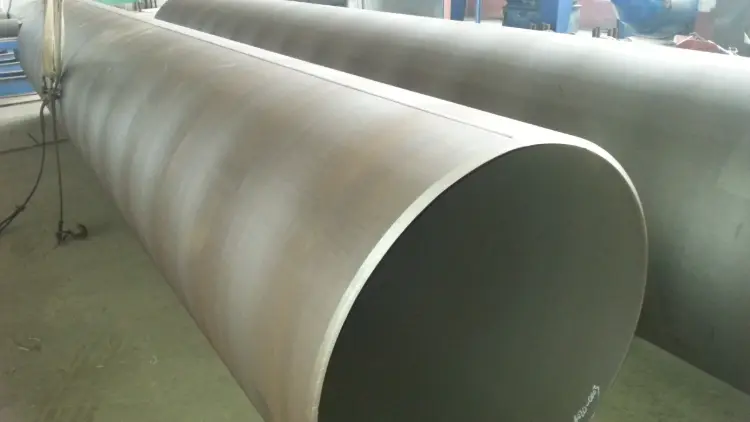
L415 Pipeline Steel (GB/T 9711)
L415 Pipeline Steel (GB/T 9711) - Equivalent to X60 for Oil & Gas Transmission
Detailed material data for L415 pipeline steel according to GB/T 9711 standard, covering chemical composition, mechanical and physical properties, international equivalents, and application guidance.
Welding (ERW, SAW, SAWH), hot rolling, cold forming, heat treatment (normalizing, TMCP)
- Phone : +8618037372205
- Email : [email protected]
- WhatsApp: Contact via Whtsapp
- WeChat: +8618037372205
L415 Pipeline Steel Introduction
L415 is a high-strength low-alloy (HSLA) pipeline steel grade specified in China's GB/T 9711 standard, which aligns with ISO 3183 and API 5L X60. It is primarily designed for oil and gas transmission pipelines, offering a minimum yield strength of 415 MPa (60 ksi) and excellent toughness, weldability, and resistance to brittle fracture. The steel is typically produced through thermomechanical controlled processing (TMCP) or normalized rolling, resulting in a fine-grained microstructure that provides a good balance of strength and ductility. Key features:
- Minimum yield strength 415 MPa
- Good weldability and low carbon equivalent
- High resistance to hydrogen-induced cracking (HIC) when specified
- Suitable for sour service with appropriate heat treatment
The grade is extensively used in long-distance pipeline projects, both onshore and offshore, and can be supplied in various pipe forms including seamless and welded (ERW, SAW). Delivery condition is usually as-rolled, TMCP, or normalized, depending on project requirements.
L415 Pipeline Steel Chemical Composition
The chemical composition of L415 pipeline steel is carefully controlled to ensure weldability, strength, and toughness. Values below are based on the PSL2 (Product Specification Level 2) requirements of GB/T 9711-2017, which imposes tighter limits than PSL1. A maximum carbon equivalent (CEIIW) of 0.43% is typically applied. Microalloying with niobium, vanadium, and titanium refines grain size and improves properties.
| Element | Specified Value | Remarks |
|---|---|---|
| Carbon (C) | ≤ 0.12% | Lower C improves weldability |
| Silicon (Si) | ≤ 0.45% | Killed steel practice |
| Manganese (Mn) | ≤ 1.60% | Contributes to strength |
| Phosphorus (P) | ≤ 0.025% | Strict control for toughness |
| Sulfur (S) | ≤ 0.015% | Reduced for HIC resistance |
| Vanadium + Niobium + Titanium (V+Nb+Ti) | ≤ 0.15% | Microalloying for grain refinement |
| Nickel (Ni) | ≤ 0.30% | Residual element |
| Chromium (Cr) | ≤ 0.30% | Residual element |
| Molybdenum (Mo) | ≤ 0.30% | Residual element |
| Copper (Cu) | ≤ 0.50% | Residual element |
| Aluminium (Altotal) | 0.015 – 0.060% | Fine grain practice |
| Nitrogen (N) | ≤ 0.012% | Including bound nitrogen |
| Carbon Equivalent (CEIIW) | ≤ 0.43% | Typical requirement for weldability |
L415 Pipeline Steel Physical Properties
Physical properties are typical for low-carbon microalloyed steel and are affected by microstructural condition and temperature. These data are suitable for engineering calculations at room temperature unless otherwise noted.
| Property | Typical Value | Unit | Test Condition |
|---|---|---|---|
| Density (ρ) | 7.85 | g/cm³ | 20 °C |
| Elastic modulus (E) | 205 | GPa | Room temperature |
| Shear modulus (G) | 79 | GPa | Estimated from E and Poisson's ratio |
| Poisson's ratio (ν) | 0.3 | – | Room temperature |
| Thermal expansion coefficient (α) | 12.0 × 10⁻⁶ | K⁻¹ | Between 20 °C and 100 °C |
| Thermal conductivity (λ) | 50 | W/(m·K) | 20 °C |
| Specific heat capacity | 480 | J/(kg·K) | 20 °C |
| Electrical resistivity (ρ_e) | 0.15 | μΩ·m | 20 °C |
L415 Pipeline Steel Mechanical Properties
Mechanical properties are determined by tensile testing at room temperature and impact testing. The specified values correspond to PSL2 requirements under GB/T 9711-2017. Actual values may be higher and are verified by mill tests. The bend test confirms ductility and absence of defects.
| Property | Specified Value | Unit | Test Condition |
|---|---|---|---|
| Yield Strength (ReH or Rt0.5) | ≥ 415 | MPa | Room temperature, transverse specimen |
| Tensile Strength (Rm) | 520 – 760 | MPa | Room temperature, transverse specimen |
| Elongation after fracture (A) | ≥ 21 | % | Gauge length 50 mm (2 in), wall thickness ≤ 12.5 mm; for thicker walls, formula applies |
| Bend test | No cracks or defects | – | 180° bend around a mandrel of diameter 3t (t = wall thickness) |
| Impact energy (KV) | ≥ 40 (average) / ≥ 30 (single) | J | Full-size specimen (10×10 mm), at -10°C (or as agreed) |
L415 Pipeline Steel Full Equivalent Material Standards and Designations
| Country / Region | Standard | Designation | Remarks |
|---|---|---|---|
| International | ISO 3183:2019 | L415 (PSL2) | Identical technical delivery conditions |
| USA | API 5L (46th ed.) | X60 (PSL2) | Equivalent strength level, widely used |
| Europe | EN 10208-2 | L415MB | TMCP thermomechanical rolled, comparable mechanical properties |
| Canada | CSA Z245.1 | Grade 415 (Cat II) | Similar requirements for line pipe |
| Russia | GOST 20295 Type K | K52 (approximate) | Yield strength ~415 MPa, but minor chemistry differences |
L415 Pipeline Steel Application Introduction
L415 (X60) pipeline steel is a workhorse for modern energy transportation infrastructure. Its balanced properties make it suitable for a wide range of applications:
- Long-distance onshore pipeline networks
- Offshore risers and flowlines
- City gas distribution (larger diameters)
- Pressure piping in refineries and petrochemical plants
- Structural tubulars requiring toughness at low temperatures
Product Applications: Spiral submerged-arc welded pipe (SAWH), Longitudinal submerged-arc welded pipe (SAWL), High-frequency welded pipe (HFW / ERW), Seamless line pipe
Processed into products: Line pipe segments and field bends, Induction bends and elbows, Reducers and tees, Flanges and weld-neck adapters, Pipeline valves and fittings, Sour service piping when required
Application industries: Oil & Gas (upstream, midstream, downstream), Petrochemical and Chemical Processing, Power Generation (boiler tubing, water lines), Water Transmission
L415 Pipeline Steel Similar or Alternative Materials
| Country / Region | Standard | Designation | Remarks |
|---|---|---|---|
| China / International | GB/T 9711 / API 5L | L360 / X52 | Lower strength grade (360 MPa min YS); may be used where pressure requirements are reduced |
| China / International | GB/T 9711 / API 5L | L450 / X65 | Higher strength grade (450 MPa min YS); offers thinner wall potential but requires stricter welding control |
| China / International | GB/T 9711 / API 5L | L485 / X70 | Significantly stronger; used in high-pressure large-diameter pipelines, demands advanced welding consumables |
| Europe | EN 10028-3 | P355NL1 | Pressure vessel steel with comparable strength but different toughness regime, not for line pipe |
| China | GB/T 1591 | Q420C | General structural steel with similar YS, but lower toughness and not suitable for sour service |
Notes:
Additional requirements such as HIC (Hydrogen-Induced Cracking) testing per NACE TM0284, SSC (Sulfide Stress Cracking) testing per NACE MR0175/ISO 15156, or through-thickness testing (Z-quality) can be specified for sour service environments. For higher toughness at extremely low temperatures, impact test temperature may be lowered to -45°C with agreement. Plate/coil source may require microstructural verification for TMCP condition.
- Share



