
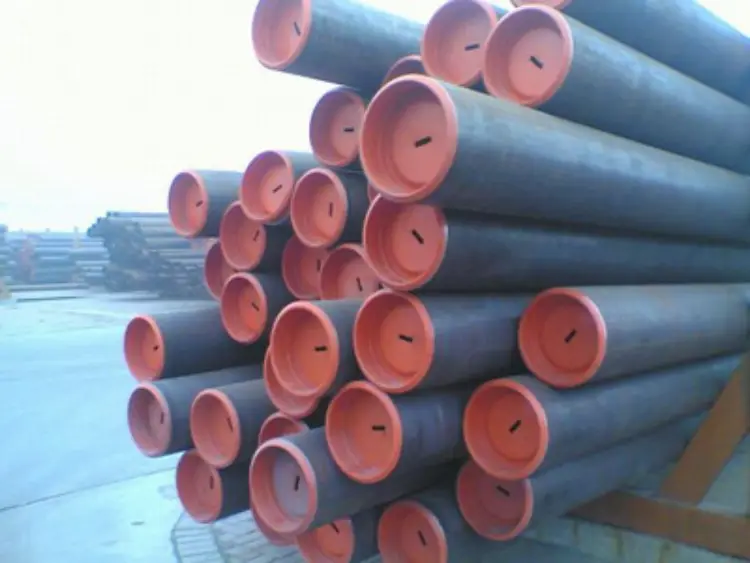
GB/T 9711 L390 Pipeline Steel
GB/T 9711 L390 Pipeline Steel Properties and Global Equivalents
Comprehensive material data for GB/T 9711 L390 pipeline steel including composition, mechanical properties, and international standards cross-reference.
Hot rolling, normalizing, thermomechanical rolling (TMCP), welding
- Phone : +8618037372205
- Email : [email protected]
- WhatsApp: Contact via Whtsapp
- WeChat: +8618037372205
GB/T 9711 L390 Pipeline Steel Introduction
GB/T 9711 L390 is a high-strength low-alloy steel grade designed for oil and gas transmission pipelines. It corresponds to API 5L X56 and ISO 3183 L390, offering a minimum yield strength of 390 MPa. The steel is produced via controlled rolling or thermomechanical processing to achieve fine grain structure and excellent weldability. Typical delivery condition is as-rolled or normalized. L390 provides a good balance of strength, toughness, and resistance to environmental cracking, making it suitable for long-distance onshore and offshore pipelines.
GB/T 9711 L390 Pipeline Steel Chemical Composition
Chemical composition limits according to GB/T 9711-2017 for L390 grade, PSL 2 requirements. Values represent maximum permissible content unless stated otherwise. Microalloying elements such as Nb, V, and Ti are added for grain refinement and precipitation strengthening. The sum of Nb+V+Ti is controlled to ensure weldability and toughness.
| Element | Maximum Value (%) | Remarks |
|---|---|---|
| Carbon (C) | 0.22 | PSL2; 0.28 for PSL1 |
| Silicon (Si) | 0.45 | Typical maximum |
| Manganese (Mn) | 1.40 | |
| Phosphorus (P) | 0.025 | PSL2 |
| Sulfur (S) | 0.015 | PSL2 |
| Niobium (Nb) | 0.05 | Typical microalloy addition |
| Vanadium (V) | 0.06 | Typical microalloy addition |
| Titanium (Ti) | 0.04 | Typical microalloy addition |
| Nb+V+Ti | 0.15 | Sum of microalloys |
GB/T 9711 L390 Pipeline Steel Thermal and Electrical Physical Properties
GB/T 9711 does not specify thermal or electrical properties. The values provided below are typical for carbon‑manganese pipeline steels of similar grade and are given as reference for engineering calculations. Actual properties may vary with exact composition and manufacturing process.
| Property | Typical Value | Unit | Condition / Remarks |
|---|---|---|---|
| Density (ρ) | 7.85 | g/cm³ | Room temperature |
| Modulus of Elasticity (E) | 205 | GPa | Room temperature |
| Shear Modulus (G) | 80 | GPa | Calculated |
| Poisson's Ratio (ν) | 0.3 | — | Room temperature |
| Thermal Expansion Coefficient (α) | 11.7 | 10⁻⁶ / K | 20–100 °C |
| Thermal Conductivity (λ) | 50 | W/(m·K) | Room temperature |
| Specific Heat Capacity (c) | 460 | J/(kg·K) | Room temperature |
| Electrical Resistivity (ρ_e) | 0.15 | µΩ·m | Room temperature |
GB/T 9711 L390 Pipeline Steel Mechanical Properties
Mechanical properties per GB/T 9711-2017 for L390 PSL 2. Tensile testing is performed in transverse direction. Elongation is determined on a gauge length of 50 mm (or calculated per standard formula). Charpy impact test is conducted at 0 °C on full-size specimens; average of three tests must meet minimum. Bend test is carried out without cracks; mandrel diameter depends on wall thickness.
| Property | Required Value | Unit | Test Condition |
|---|---|---|---|
| Yield Strength (ReH) | 390 – 545 | MPa | Transverse |
| Tensile Strength (Rm) | 490 – 760 | MPa | Transverse |
| Yield to Tensile Ratio (ReH/Rm) | ≤ 0.93 | — | PSL2, optional requirement |
| Elongation (A, 50 mm) | ≥ 19 | % | Transverse strip test |
| Charpy V‑notch Impact Energy (KV) | ≥ 27 (average) | J | 0 °C, transverse, full‑size |
| Bend Test | No cracks | — | Mandrel diameter per product specification |
GB/T 9711 L390 Pipeline Steel Fully Equivalent Material Standards & Substitute Grades
| Region | Standard | Grade | Remarks |
|---|---|---|---|
| International | ISO 3183 | L390 | Identical, base specification |
| United States | API 5L | X56 | Equivalent, PSL1/PSL2 |
| Europe | EN 10208-2 | L390ME | TMCP condition, equivalent |
| Europe | EN 10208-2 | L390NE | Normalized condition, equivalent |
| Russia | GOST R 52079 | К56 (K56) | Similar strength grade |
GB/T 9711 L390 Pipeline Steel Application Introduction
L390 pipeline steel offers an optimum combination of strength, toughness, and weldability, making it a preferred choice for large-diameter gas and oil transmission lines. Its controlled chemistry and fine-grained microstructure ensure resistance to ductile fracture propagation and hydrogen-induced cracking.
Product Applications: Long-distance cross-country pipelines, Station and terminal piping systems, Offshore subsea pipelines, High-pressure gathering lines
Processed into products: Line pipe segments (SAW, ERW, seamless), Hot induction bends, Pipe tees and elbows, Concentric and eccentric reducers, Weldneck flanges and blind flanges
Application industries: Oil and gas transmission, Petrochemical and refining, Water injection and discharge systems, Offshore riser and flowline applications
GB/T 9711 L390 Pipeline Steel Similar / Alternate Materials Recommendations
| Region | Standard | Grade | Remarks |
|---|---|---|---|
| China | GB/T 9711 | L360 (X52) | Lower strength, 360 MPa yield; thicker wall may compensate |
| China | GB/T 9711 | L415 (X60) | Higher strength, 415 MPa yield; may reduce wall thickness |
| United States | API 5L | X52 | Economical alternative if lower pressure is acceptable |
| United States | API 5L | X60 | Upgraded strength option for higher operating pressures |
Notes:
Carbon equivalent: Typically CE(IIW) ≤ 0.43% to ensure good field weldability without preheat. Material is often supplied with Charpy test requirements at 0°C or -10°C per user specification. Hydrogen Induced Cracking (HIC) and Sulfide Stress Corrosion Cracking (SSCC) resistant grades can be specified for sour service (e.g., L390M Sour). Coating and cathodic protection are standard for buried pipelines.
- Share



