
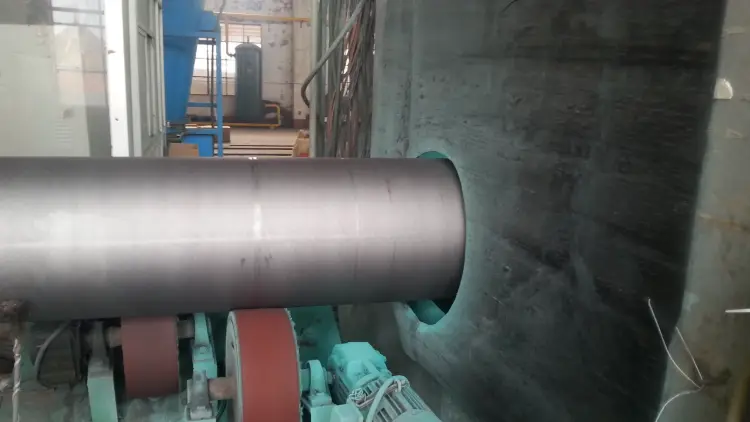
GB/T 9711 L360 Pipeline Steel
GB/T 9711 L360 Pipeline Steel: Complete Reference Guide to Properties, Equivalents & Uses
Explore the chemical composition, mechanical and thermal physical properties, international equivalent grades, and typical applications of L360 (X52) pipeline steel under Chinese standard GB/T 9711. Complete data for engineers.
Hot rolling; controlled rolling; normalizing; thermo-mechanical control processing (TMCP); quenching and tempering (as required by product specification level)
- Phone : +8618037372205
- Email : [email protected]
- WhatsApp: Contact via Whtsapp
- WeChat: +8618037372205
GB/T 9711 L360 Pipeline Steel Introduction
L360 is a widely used pipeline steel grade defined in Chinese standard GB/T 9711-2017 (Petroleum and natural gas industries – Steel pipe for pipeline transportation systems). It corresponds to the international grade API 5L X52 and ISO 3183 L360. The digit '360' indicates a minimum specified yield strength of 360 MPa. The steel is designed for transmission of oil, gas, and other fluids over long distances and is supplied in various pipe types including seamless and welded (longitudinal or spiral). It offers a good balance of strength, toughness, and weldability, and is typically delivered in thermo-mechanical control processed (TMCP), normalized, or quenched and tempered condition depending on thickness and service requirements.
- Key features: high strength, adequate ductility, good low-temperature toughness, and reliable weldability.
- Typical application: mainline pipes, gathering lines, and processing plant piping.
GB/T 9711 L360 Pipeline Steel Chemical Composition – Product Analysis Limits for L360 PSL2 per GB/T 9711
The chemical composition is based on product analysis requirements for L360 PSL 2 seamless and welded pipes in accordance with GB/T 9711-2017 (corresponding to ISO 3183 L360). PSL 2 imposes stricter limits on sulfur and phosphorus and requires minimum impact toughness. Carbon equivalent (CEIIW) is controlled to ensure weldability. Residual elements like Cu, Ni, Cr, and Mo are limited to avoid adverse effects. The total microalloying (V+Nb+Ti) is maximized to 0.15% to achieve fine grain refinement and strength without sacrificing toughness.
- Typical ladle analysis values may be slightly lower to compensate for possible pick-up during welding.
| Element | Mass Fraction – Max (%) | Remarks |
|---|---|---|
| C (Carbon) | 0.22 | Product analysis; for wall thickness > 20 mm, may be reduced to 0.20 max in some thickness ranges |
| Si (Silicon) | 0.45 | Usually minimum not specified for steelmaking, but typical range 0.10 – 0.35 |
| Mn (Manganese) | 1.40 | Ensures sufficient hardenability and strength |
| P (Phosphorus) | 0.025 | PSL 2 requirement; lower than PSL 1 (0.030) for improved toughness |
| S (Sulfur) | 0.015 | PSL 2 requirement; strict control for cleanliness and HIC resistance |
| V (Vanadium) | 0.10 | Microalloying element; contributes to precipitation strengthening |
| Nb (Niobium) | 0.05 | Microalloying; grain refinement and retardation of recrystallization |
| Ti (Titanium) | 0.04 | Microalloying; grain refinement, nitrogen fixation |
| Cu (Copper) | 0.50 | Residual element; no deliberate addition required |
| Ni (Nickel) | 0.50 | Residual element |
| Cr (Chromium) | 0.50 | Residual element |
| Mo (Molybdenum) | 0.50 | Residual element |
| V+Nb+Ti | 0.15 | Sum of microalloying elements, required to be ≤0.15% for PSL 2 pipes |
| CEIIW (Carbon Equivalent) | 0.43 | For thickness > 6.35 mm, PSL 2; calculated by CE = C + Mn/6 + (Cr+Mo+V)/5 + (Cu+Ni)/15 |
GB/T 9711 L360 Pipeline Steel Thermal and Electrical Physical Properties
The physical properties listed below are typical for carbon-manganese pipeline steel similar to L360/X52 at room temperature and atmospheric pressure. These values are not part of the mandatory standard requirements but are widely accepted for engineering design calculations. They are derived from general material databases and apply to steel with a density of approximately 7.85 g/cm³.
- Properties such as thermal conductivity and specific heat may vary slightly with temperature and microstructure.
- Poisson's ratio is assumed constant in the elastic range.
| Property | Typical Value | Unit | Conditions / Notes |
|---|---|---|---|
| Density (ρ) | 7.85 | g/cm³ | At 20°C |
| Elastic Modulus (E) | 205 – 210 | GPa | At room temperature |
| Shear Modulus (G) | ~81 | GPa | Calculated from E = 210 GPa and ν = 0.3 |
| Poisson's Ratio (ν) | 0.3 | – | In elastic range |
| Thermal Expansion Coefficient (α) | 11.7 × 10⁻⁶ | 1/K | Mean coefficient between 20°C and 100°C |
| Thermal Conductivity (λ) | ~51 | W/(m·K) | At 20°C |
| Specific Heat Capacity (c) | ~480 | J/(kg·K) | At 20°C |
| Electrical Resistivity (ρe) | ~0.16 × 10⁻⁶ | Ω·m | At 20°C, for carbon steel |
GB/T 9711 L360 Pipeline Steel Mechanical Properties
The following mechanical properties are according to GB/T 9711-2017 for L360 PSL 2 steel pipes. Tensile testing is performed on transverse (welded pipes) or longitudinal (seamless pipes) specimens. For PSL 2, yield-to-tensile ratio is limited to ensure strain capacity. Charpy impact tests are mandatory at 0°C. Values for elongation may vary depending on specimen type; the table shows minimum elongation for 50 mm gauge length (rectangular) and 5.65√S₀ (round) specimens.
- Actual properties after forming and welding must meet requirements.
- For wall thicknesses above 30 mm, slightly different values may apply.
| Property | Standard Requirement | Unit | Test Conditions / Remarks |
|---|---|---|---|
| Yield Strength (Rt0.5) min | 360 | MPa | Transverse (welded) or longitudinal (seamless) specimen; max 530 MPa. For wall thickness ≤ 30 mm. |
| Tensile Strength (Rm) | 460 to 760 | MPa | Specimen orientation same as yield test |
| Yield to Tensile Ratio (Rt0.5/Rm) max | 0.93 | — | Required for PSL 2 pipes to ensure adequate ductility |
| Elongation (A50) min | 21 | % | Rectangular strip specimen, gauge length 50 mm (2 in), wall thickness ≤ 30 mm, transverse test |
| Elongation (A5.65√S₀) min | 22 | % | Round specimen, proportional gauge length; calculated by formula in standard |
| Guided Bend Test | No cracks or defect exceeding permitted limits | — | Bend diameter according to wall thickness (e.g., 3T for t ≤ 12.7 mm), 180° bend; full-section or side bend |
| Charpy Impact Energy (KV2) min | 27 (average) | J | Full-size 10×10×55 mm specimen, at 0°C, transverse; individual min 20 J; sub-size specimen values proportionally adjusted |
| Hardness (if specified) | ≤ 250 HV10 or ≤ 22 HRC | — | Optional supplementary requirement for sour service or welding qualification |
GB/T 9711 L360 Pipeline Steel Fully Equivalent Material Standards and Substitute Grades
| Country / Region | Standard | Grade | Remarks |
|---|---|---|---|
| China | GB/T 9711 | L360 | Original standard; PSL 1 and PSL 2 available |
| USA | API 5L | X52 (PSL 1 / PSL 2) | Direct equivalent; also supplied as X52N (normalized), X52Q (quenched & tempered), X52M (TMCP) |
| International | ISO 3183 | L360 | Base standard for GB/T 9711; identical technical requirements |
| European Union | EN 10208-2 | L360MB | M: TMCP delivery; also L360NB (normalized) and L360QB (quenched & tempered); all equivalent with L360 PSL 2 |
| Canada | CSA Z245.1 | Grade 359 | Minimum YS 359 MPa (52 ksi), directly equivalent to X52; used in Canadian oil & gas pipelines |
| Australia | AS 2885 / AS 3862 | X52 (equivalent) | Meets API 5L X52 requirements; typically ordered as API 5L Grade X52 |
| Russia | GOST 20295 | K52 (Т52) | Yield strength category 52 (kgf/mm²), approximately 510 MPa min TS and 353 MPa min YS; equivalent in strength class |
GB/T 9711 L360 Pipeline Steel Application Introduction
L360 pipeline steel is the backbone of modern energy transportation infrastructure. Its excellent combination of strength, toughness, and weldability makes it the preferred choice for high-pressure transmission pipelines and gathering systems.
- It can be manufactured into seamless tubes for small diameters and heavy walls, or welded pipes (LSAW, SSAW, ERW) for large-diameter trunk lines.
- In sour service environments, supplementary requirements for HIC (hydrogen-induced cracking) and SSC (sulfide stress cracking) can be applied per NACE MR0175.
- For subsea applications, the grade is often ordered with increased Charpy requirements at lower temperatures and tighter dimensional tolerances.
Product Applications: Line pipes (seamless, ERW, SAW) for mainline and feeder lines, Long-radius induction bends and cold bends for directional changes, Steel flanges, tees, reducers, and weldable fittings, Riser pipes for offshore platforms and subsea tie-backs, Station piping (compressor and pumping stations)
Processed into products: Main trunk pipeline sections (typically 10–48 inch OD), Flowlines and gathering line segments, Casing and tubing in some oil wells (limited application, L80, etc., but general structural use), Steel reinforcement elements in pipeline coatings and weight coatings, Support sleeves and end closures
Application industries: Oil and gas exploration and production (upstream), Pipeline transmission (midstream operators), Refinery and petrochemical plants, City gas distribution networks, Mining and slurry transportation, Water and wastewater infrastructure (high-pressure lines)
GB/T 9711 L360 Pipeline Steel Materials with Similar Performance – Close Comparisons and Guidance
| Country / Standard | Grade Designation | Typical Minimum Yield (MPa) | Remarks |
|---|---|---|---|
| API 5L / ISO 3183 / GB/T 9711 | L320 (X46) | 320 | Lower-strength counterpart; suitable for less demanding pressure applications; often interchangeable with L360 for overspecifications in low-pressure lines |
| API 5L / ISO 3183 / GB/T 9711 | L415 (X60) | 415 | Higher-strength alternative; used when higher operating pressure or thinner wall is required; requires slightly more care in welding |
| API 5L / ISO 3183 | X52N / X52Q | 360 | Specific delivery conditions of the same grade; N: normalized; Q: quenched and tempered; suitable where impact toughness at lower temperatures is critical |
| EN 10208-2 | L360NB | 360 | Normalized variant; similar to L360MB but with a more homogeneous microstructure; often used in gas distribution networks |
| API 5L | X42 (L290) | 290 | Softer grade, easier to form and weld; may be substituted for L360 in low-pressure water or slurry pipelines where toughness is not critical |
Notes:
Additional technical notes:
- For sour service applications, the user shall specify “HIC tested” or “SSC tested” in the purchase order; supplementary requirements from NACE MR0175/ISO 15156 apply, and the CEIIW is typically limited to 0.39.
- When ordering pipes to GB/T 9711, it is essential to indicate whether PSL 1 or PSL 2 is required; the data in this sheet correspond to PSL 2 which is the most common for transmission pipelines.
- Dimensional tolerances, hydrostatic test pressure, and non-destructive testing (UT/RT) are specified in the standard and should be agreed upon at the time of inquiry.
- Share



