
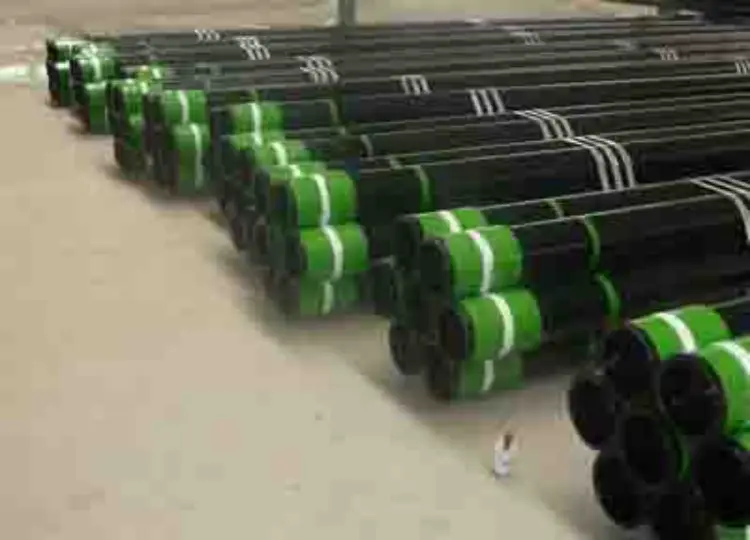
GB/T 9711 L320 Pipeline Steel
GB/T 9711 L320 Pipeline Steel: High Strength for Oil & Gas Transmission
Explore L320 pipeline steel under GB/T 9711 equivalent to ISO 3183 L320 and API 5L X46. Detailed composition, mechanical and physical properties, applications.
Hot rolling, controlled rolling, normalizing, thermomechanical processing, welding (ERW, SAW, spiral), seamless piercing
- Phone : +8618037372205
- Email : [email protected]
- WhatsApp: Contact via Whtsapp
- WeChat: +8618037372205
GB/T 9711 L320 Pipeline Steel Introduction
L320 is a pipeline steel grade specified in GB/T 9711 (equivalent to ISO 3183 and API 5L) for oil and gas transmission systems. It is a low-alloy, high-strength steel with a minimum yield strength of 320 MPa, designed for welded and seamless pipes used in demanding environments. Key characteristics include:
- Excellent weldability and formability.
- Good toughness at low temperatures, suitable for sour service if required.
- Controlled chemistry with microalloying elements (Nb, V, Ti) to refine grain size and enhance strength and toughness.
- Available in PSL1 and PSL2, with stricter requirements for PSL2 grades.
Typical delivery conditions are as-rolled, normalized, or thermomechanically rolled, ensuring consistent mechanical performance across wall thicknesses.
GB/T 9711 L320 Pipeline Steel Chemical Composition
Chemical composition limits as per GB/T 9711 for L320 (PSL2). The steel is microalloyed with Nb, V, and/or Ti to achieve fine grain structure and high strength. For sour service grades, lower S and P are required. All values are maximum unless a range is given. Product analysis tolerances apply per the standard.
| Element | Specification Value (max, %) | Remarks |
|---|---|---|
| Carbon (C) | 0.22 | For PSL2; for PSL1: 0.22 max |
| Manganese (Mn) | 1.40 | For PSL2; for PSL1: 1.40 max |
| Silicon (Si) | 0.45 | Typical limit; standard does not specify separately but often combined with other deoxidation practice |
| Phosphorus (P) | 0.025 | For PSL2; 0.030 max for PSL1 |
| Sulfur (S) | 0.015 | For PSL2; 0.030 max for PSL1; for sour service ≤0.002 recommended |
| Vanadium (V) | 0.05 | Microalloying; combined with Nb and Ti ≤0.15% |
| Niobium (Nb) | 0.05 | Microalloying; combined with V and Ti ≤0.15% |
| Titanium (Ti) | 0.04 | Microalloying; used for grain refinement and toughness |
| Copper (Cu) | 0.50 | Residual element; sometimes specified |
| Nickel (Ni) | 0.50 | Residual element; sometimes specified |
| Chromium (Cr) | 0.50 | Residual element; sometimes specified |
| Molybdenum (Mo) | 0.50 | Residual element; sometimes specified |
| Nitrogen (N) | 0.012 | Often limited to avoid strain aging |
| Aluminum (Al) | 0.015 – 0.060 | Grain refining, total aluminum content |
GB/T 9711 L320 Pipeline Steel Thermal and Electrical Physical Properties
Physical properties are typical for low-carbon pipeline steels similar to L320. Actual values may slightly vary with specific chemistry and processing. These values are provided as general engineering references and are not specified in GB/T 9711. Density ~7.85 g/cm³; Elastic modulus ~205 GPa; Poisson's ratio ~0.3; Thermal expansion ~12.0 µm/m·°C; Thermal conductivity ~45 W/m·K; Specific heat ~480 J/kg·K; Electrical resistivity ~0.16 µΩ·m.
| Property | Typical Value | Unit | Condition |
|---|---|---|---|
| Density (ρ) | 7.85 | g/cm³ | 20°C |
| Elastic Modulus (E) | 205 | GPa | Room temperature |
| Shear Modulus (G) | 80 | GPa | Calculated from E and ν |
| Poisson's Ratio (ν) | 0.30 | — | Ambient |
| Thermal Expansion Coefficient (α) | 12.0 | 10⁻⁶/°C | 20–200°C |
| Thermal Conductivity (λ) | 45 | W/m·K | 20°C |
| Specific Heat Capacity (c) | 480 | J/kg·K | 20°C |
| Electrical Resistivity (ρₑ) | 0.16 | µΩ·m | 20°C |
GB/T 9711 L320 Pipeline Steel Mechanical Properties
Mechanical property requirements for L320 (PSL2) pipes per GB/T 9711. Transverse or longitudinal test piece orientation as per standard. Minimum values unless indicated otherwise. Impact test requirements are for PSL2 at 0°C or lower, for standard and sour service. Bending test is mandrel diameter per wall thickness. Yield strength (ReH) 320–525 MPa; Tensile strength (Rm) 435–655 MPa; Elongation (A) formula-based or minimum 22% (thin wall).
| Property | Specified Value | Unit | Test Condition |
|---|---|---|---|
| Yield Strength (ReH) | 320 – 525 | MPa | Transverse strip test, 0.5% total extension for PSL2 |
| Tensile Strength (Rm) | 435 – 655 | MPa | Transverse strip test |
| Elongation (A) | Af = C · Ax (min 22%) | % | 50 mm gauge length; Af calculated per standard; ISO 2566 conversion may apply |
| Yield to Tensile Ratio (ReH/Rm) | ≤ 0.93 | - | For PSL2 when specified; typical ≤0.90 |
| Charpy Impact (KV) | ≥ 40 (average) | J | -10°C or 0°C, 10×10 mm specimen; individual min ≥30 J; for sour service may be lower temp. |
| Bend Test (Mandrel Diameter) | No cracks or fissures | - | 180° bend; mandrel diameter 6t for t ≤12.7 mm, 8t for t >12.7 mm |
| Hardness | ≤ 250 HV10 | - | Optional requirement; for sour service ≤ 248 HV |
| Shear Area (Drop Weight Tear) | ≥ 85% | % | DWTT at 0°C or design temperature if specified |
GB/T 9711 L320 Pipeline Steel Exact Equivalent Material Standards and Replaceable Grades
| Country/Region | Standard | Grade | Remarks |
|---|---|---|---|
| International / Global | ISO 3183:2019 | L320 | PSL1 and PSL2; identical technical requirements to GB/T 9711 |
| United States | API Spec 5L (46th Ed.) | X46 (PSL1/PSL2) | X46M for metric; same yield and tensile ranges, can replace L320 directly |
| European Union | EN 10208-2 | L320NB | Similar as per EN ISO 3183, but for special applications like gas pipelines |
| Russia | GOST R 52079 | K48 | Approximate equivalent in strength level; verify other requirements |
GB/T 9711 L320 Pipeline Steel Application Introduction
L320 pipeline steel is versatile for medium- to high-pressure transmission of oil, natural gas, and water. It can be fabricated into large-diameter welded pipes and seamless pipes. The material's balance of strength, toughness, and weldability makes it suitable for arctic, offshore, and seismic regions. Typical products include line pipe, structural tubulars, and pressure vessels.
- Oil & gas gathering and transmission lines.
- Offshore risers and flowlines.
- Boiler and heat exchanger tubes.
- Piling and structural pipes.
Product Applications: Longitudinal submerged-arc welded (LSAW) line pipe, Spiral submerged-arc welded (SSAW) pipe, Electric resistance welded (ERW) pipe, Seamless line pipe, Pipe bends and fittings, Pressure vessel shells
Processed into products: Mainline pipe sections, Tie-in spools and risers, Station piping (compressor/pump stations), Hot induction bends, Tees and reducers, Flanges and connectors, Boiler and heat exchanger tubes
Application industries: Oil and Gas (Upstream/Midstream), Petrochemical, Power Generation (boiler tubes), Construction and Infrastructure (piling), Offshore Engineering
GB/T 9711 L320 Pipeline Steel Similar / Approximate Alternative Materials
| Country/Region | Standard | Grade | Remarks |
|---|---|---|---|
| International | API 5L / ISO 3183 | X42 (L290) | Lower yield strength (290 MPa), may be acceptable for less demanding applications |
| International | API 5L / ISO 3183 | X52 (L360) | Higher yield strength (360 MPa), may require re-qualification for welding |
| China | GB/T 9711 | L290 | Next lower grade; lower strength may need thicker wall design |
| China | GB/T 9711 | L360 | Next higher grade; better pressure capability but may impact formability |
| Europe | EN 10208-2 | L290MB | Similar to L290; for gas, requires assessment for L320 replacement |
| Europe | EN 10208-2 | L360MB | Higher strength; suitable when higher design factors are needed |
Notes:
The chemical and mechanical values are based on GB/T 9711-2017 (identical to ISO 3183:2012 and API 5L 46th). For specific wall thicknesses and service conditions (sour, high temperature), supplementary requirements (e.g., HIC, SSCC tests) may apply. For welded pipes, the weld metal and heat-affected zone properties shall meet the specified minimum values. The electrical and thermal properties are typical for carbon-manganese steel and should be verified for critical design calculations.
- Share



