
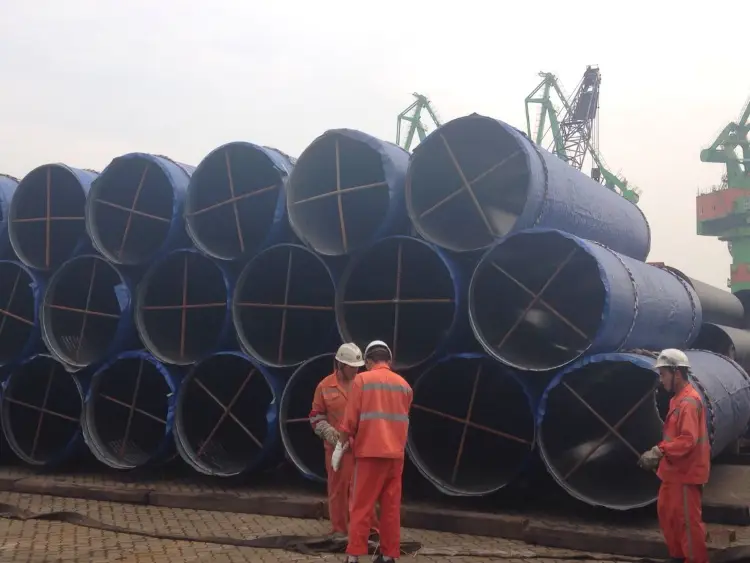
JIS G3461 STB510 Boiler Steel Pipe
JIS G3461 STB510 Boiler Steel Pipe - Carbon Steel for High-Temperature Service
Detailed material data and properties of STB510 carbon steel boiler pipe according to JIS G3461, including chemical composition, mechanical and physical properties, equivalent grades, and application guidance.
Hot-finished or cold-finished; suitable for welding, bending, flanging, and similar forming operations
- Phone : +8618037372205
- Email : [email protected]
- WhatsApp: Contact via Whtsapp
- WeChat: +8618037372205
JIS G3461 STB510 Boiler Steel Pipe Introduction
JIS G3461 STB510 is a carbon steel seamless pipe designed for high-temperature boiler and heat exchanger applications. It offers a good combination of high tensile strength and reliable elevated-temperature performance. The steel is supplied in the normalized condition (or as agreed) and is widely used in power generation and industrial boiler systems. Key characteristics:
- Minimum tensile strength of 510 MPa and yield strength of 295 MPa (wall ≤50 mm)
- Good formability for bending and coiling
- Suitable for hot-dip galvanizing and other surface treatments
- Weldable by conventional methods
JIS G3461 STB510 Boiler Steel Pipe Chemical Composition
Chemical requirements according to JIS G3461 for STB510. Residual elements such as Cr, Ni, Cu may be present from the steelmaking process but are not intentionally added; their contents are typically ≤0.30% each and do not impair the intended service properties.
| Element | Mass Fraction (%) | Remarks |
|---|---|---|
| C | ≤0.25 | |
| Si | ≤0.35 | |
| Mn | ≤0.90 | |
| P | ≤0.035 | |
| S | ≤0.035 |
JIS G3461 STB510 Boiler Steel Pipe Thermal and Electrical Physical Properties
Typical physical properties for carbon steel, applicable to STB510 in the normalized condition. Values are for reference only and may vary slightly with actual composition and heat treatment. All data are at room temperature unless otherwise noted.
| Property | Typical Value | Unit | Test Condition / Temperature |
|---|---|---|---|
| Density (ρ) | 7.85 | g/cm³ | 20 °C |
| Modulus of elasticity (E) | 210 | GPa | 20–100 °C |
| Shear modulus (G) | 81 | GPa | 20 °C (estimated) |
| Poisson's ratio (ν) | 0.30 | - | 20 °C |
| Thermal expansion coefficient (α) | 11.5 × 10⁻⁶ | K⁻¹ | 20–100 °C |
| Thermal expansion coefficient (α) | 12.5 × 10⁻⁶ | K⁻¹ | 20–200 °C |
| Thermal expansion coefficient (α) | 13.0 × 10⁻⁶ | K⁻¹ | 20–300 °C |
| Thermal conductivity (λ) | 51.9 | W/(m·K) | 20 °C |
| Thermal conductivity (λ) | 48.5 | W/(m·K) | 100 °C |
| Specific heat capacity | 486 | J/(kg·K) | 20–100 °C |
| Electrical resistivity (ρₑ) | 0.15 | Ω·mm²/m | 20 °C |
JIS G3461 STB510 Boiler Steel Pipe Mechanical Properties
Tensile and bend test requirements per JIS G3461. The flattening test is also mandatory. Impact toughness is not routinely specified but may be agreed upon for low-temperature service. Elongation values apply to a gauge length of 50 mm. Bending angle is 180° with no sign of cracking.
| Property | Specification | Unit | Test Condition |
|---|---|---|---|
| Tensile strength (Rm) | ≥510 | MPa | Room temperature |
| Yield strength (ReH) | ≥295 | MPa | Wall thickness ≤ 50 mm |
| Yield strength (ReH) | ≥285 | MPa | Wall thickness > 50 mm |
| Elongation (A, longitudinal) | ≥20 | % | Wall thickness < 8 mm |
| Elongation (A, longitudinal) | ≥24 | % | Wall thickness ≥ 8 mm |
| Elongation (A, transverse) | ≥15 | % | Wall thickness < 8 mm |
| Elongation (A, transverse) | ≥18 | % | Wall thickness ≥ 8 mm |
| Bend test | No cracks | - | Bend angle 180°; mandrel diameter = 2 x wall thickness (≤8 mm) or 3 x wall thickness (>8 mm) |
| Flattening test | No cracks | - | Plates pressed until distance H = specified formula; no cracking or flaws |
JIS G3461 STB510 Boiler Steel Pipe Direct Equivalent Grades – Standards and Substitute Grades
| Country/Region | Standard | Grade | Remarks |
|---|---|---|---|
| International | - | - | No exact equivalent exists due to the specific strength level. See nearby similar grades below. |
JIS G3461 STB510 Boiler Steel Pipe Application Introduction
STB510 is intended for high-temperature pressure components in boilers and heat exchangers. It is suitable for environments where the design metal temperature does not exceed approximately 450 °C. Processing and fabrication:
- Readily weldable by TIG, MIG, and resistance welding methods, usually with preheat for thicker sections.
- Excellent bending and cold-forming capability, especially in the normalized condition.
- Can be hot-dip galvanized or aluminized for corrosion protection.
- Typically supplied in straight lengths or U-bend configurations for heat exchangers.
Product Applications: Water-wall tubes, Superheater and reheater sections, Economizer tubes, Shell-and-tube heat exchangers, Downcomer and riser piping
Processed into products: Boiler tube panels, U-bend heat exchanger tubes, Finned tubes (extruded or helical fins), Curved boiler pipe segments (elbows, coils), Tube-to-header stub connections
Application industries: Power generation (conventional steam boilers, waste heat recovery), Petrochemical and refinery (process heaters, cracking furnaces), Industrial boiler manufacturing, Heat exchanger and pressure vessel fabrication, Cogeneration and CHP plants
JIS G3461 STB510 Boiler Steel Pipe Similar / Alternative Materials with Comparable Performance
| Country/Region | Standard | Grade | Remarks |
|---|---|---|---|
| USA | ASTM A210 / ASME SA-210 | Grade C | Tensile ≥485 MPa, yield ≥275 MPa. Slightly lower strength; can be considered with design adjustment. |
| EU | EN 10216-2 | P265GH | Tensile 410–570 MPa, yield ≥235 MPa. Lower strength; not a direct substitution, but common in European boiler systems. |
| China | GB 5310 | 20MnG (20MnG) | Tensile ≥415 MPa, yield ≥240 MPa. Often used for similar temperature ranges; requires strength derating. |
| Germany | DIN 17175 | St45.8 | Tensile 410–530 MPa, yield ≥235 MPa. Obsolete standard but still referenced; strength gap exists. |
| Japan | JIS G3461 | STB410 | Tensile ≥410 MPa, yield ≥245 MPa. Lower strength version within the same standard; may be used where lower stress levels are adequate. |
Notes:
Inspection and testing: Tubes are subjected to hydraulic or non-destructive testing as per standard. Supplementary requirements such as impact testing at low temperatures, tighter chemical composition limits, or ultrasonic examination can be stipulated by the purchaser. Surface condition: Free from harmful defects; slight surface decarburization is permissible but shall not affect minimum wall thickness. Marking: Each tube is marked with the manufacturer's name, standard and grade, dimensions, and heat number.
- Share



