
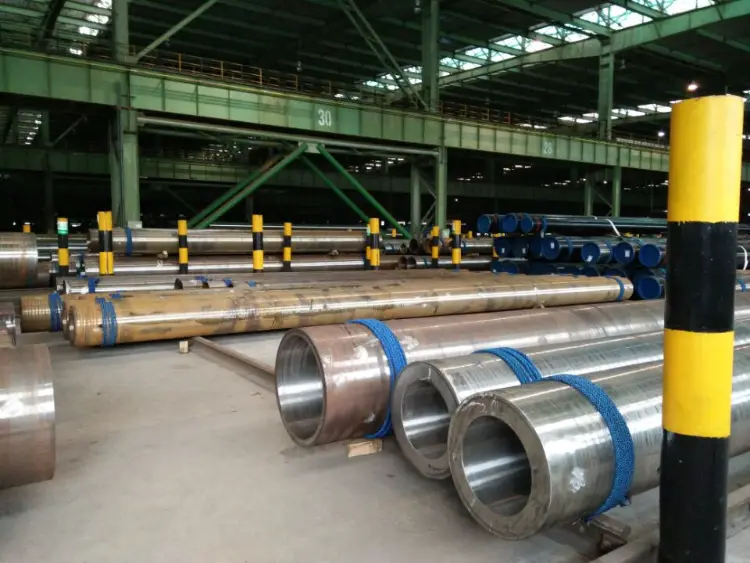
API 5L X46 Pipeline Steel
API 5L X46 Pipeline Steel: Grade Data, Chemical Composition & International Equivalents
Complete technical data for API 5L X46 steel used in oil and gas pipelines. Includes chemical composition, mechanical and physical properties, equivalent grades, and application guidelines.
Hot rolling, cold forming, longitudinal or spiral welding, normalizing, thermomechanical rolling (TMCP), quenching and tempering (on agreement)
- Phone : +8618037372205
- Email : [email protected]
- WhatsApp: Contact via Whtsapp
- WeChat: +8618037372205
API 5L X46 Pipeline Steel Introduction
API 5L X46 is a high-strength low-alloy (HSLA) steel grade primarily used for manufacturing welded and seamless line pipes in the petroleum and natural gas industries. With a minimum yield strength of 46 ksi (317 MPa) and a minimum tensile strength of 63 ksi (434 MPa), X46 offers a balanced combination of strength, toughness, and weldability. It conforms to the API 5L specification, which defines two product specification levels (PSL1 and PSL2); typical supply is in as‑rolled, normalized, or thermomechanically processed condition. This steel is widely adopted worldwide and has direct equivalents in ISO, EN, and GB standards.
API 5L X46 Pipeline Steel Chemical Composition – PSL1 X46
Requirements according to API 5L 46th Edition for PSL1 grade X46. Unless otherwise noted, values are maximum permissible. Elements not listed are not specified in the standard for this grade but may be present at residual levels. For PSL2, tighter limits apply (C ≤0.24, P ≤0.025, S ≤0.015, and Nb+V+Ti ≤0.15%).
| Chemical Element | Standard Value (max, %) | Remarks |
|---|---|---|
| Carbon (C) | ≤0.28 | PSL1, heat analysis. Lower for PSL2 (≤0.24). |
| Manganese (Mn) | ≤1.40 | For Seamless & Welded pipe. |
| Phosphorus (P) | ≤0.030 | |
| Sulfur (S) | ≤0.030 | |
| Silicon (Si) | ≤0.45 | Common deoxidizer; limit usually by agreement. |
| Niobium (Nb) | ≤0.05 | Typically added for grain refinement; combined Nb+V+Ti ≤0.15% for PSL2. |
| Vanadium (V) | ≤0.07 | May be present in microalloyed steels. |
| Titanium (Ti) | ≤0.04 | For inclusion shape control. |
| Copper (Cu) | ≤0.50 | Optional element, may be specified for H2S service. |
| Nickel (Ni) | ≤0.50 | Optional; typical maximum. |
| Chromium (Cr) | ≤0.50 | Optional; typical maximum. |
| Molybdenum (Mo) | ≤0.15 | May be present in low-alloy designs. |
API 5L X46 Pipeline Steel Thermal and Electrical Physical Properties
These values are not specified in API 5L but represent typical engineering data for normalized or controlled‑rolled X46 grade steel. They are suitable for thermal stress analysis, heat transfer calculations, and pipeline design. Slight variations may occur depending on exact chemical composition and manufacturing process.
| Property | Typical Value | Unit | Test Condition / Remarks |
|---|---|---|---|
| Density (ρ) | 7.85 | g/cm³ | At 20°C |
| Elastic modulus (E) | 205 | GPa | At 20°C, dynamic method |
| Shear modulus (G) | 79 | GPa | Calculated from E and ν |
| Poisson's ratio (ν) | 0.30 | - | At room temperature |
| Thermal expansion coefficient (α) | 11.7 | 10⁻⁶/°C | Between 20°C and 100°C |
| Thermal expansion coefficient (α) | 12.5 | 10⁻⁶/°C | Between 20°C and 200°C |
| Thermal expansion coefficient (α) | 13.5 | 10⁻⁶/°C | Between 20°C and 400°C |
| Thermal conductivity (λ) | 50 | W/(m·K) | At 20°C |
| Thermal conductivity (λ) | 45 | W/(m·K) | At 200°C |
| Thermal conductivity (λ) | 38 | W/(m·K) | At 400°C |
| Specific heat capacity (cₚ) | 460 | J/(kg·K) | At 20°C to 100°C, average |
| Electrical resistivity (ρₑ) | 0.22 | μΩ·m | At 20°C |
API 5L X46 Pipeline Steel Mechanical Properties
Mechanical requirements are based on API 5L 46th Ed., Tables 6 & 7, for pipe body transverse (or longitudinal) tests at room temperature. Elongation values depend on specimen dimensions; the listed value corresponds to a standard 2‑in (50.8 mm) gauge length rectangular specimen with wall thickness ≤0.500 in. Bending and impact tests are supplementary unless specified by the purchaser.
| Property | Standard Requirement (min) | Unit | Test Condition / Remarks |
|---|---|---|---|
| Yield Strength (ReH or Rt0.5) | 317 | MPa (46 ksi) | Transverse or longitudinal, 0.5% total extension |
| Tensile Strength (Rm) | 434 | MPa (63 ksi) | Room temperature |
| Elongation after fracture (A) | 23 | % | Gauge length 2 in, wall thickness ≤0.500 in. For other dimensions use API 5L formula. |
| Yield to Tensile ratio (ReH/Rm) | ≤0.93 (max) | - | Applicable for PSL2; for PSL1 no mandatory limit but commonly ≤0.90 |
| Bend test (if ordered) | No cracks or openings >1/8 in | - | Bending angle 90°, mandrel diameter dependent on wall thickness and grade. |
| Charpy V‑notch impact (if ordered) | 27 (avg), 20 (single) at 0°C typical | J | For PSL2 pipe; PSL1 does not have mandatory toughness requirement. |
API 5L X46 Pipeline Steel Direct Equivalent Standards and Grades for X46
| Country/Region | Standard | Grade | Remarks |
|---|---|---|---|
| International | ISO 3183 | L320 | PSL1 and PSL2 available; same 320 MPa yield level. |
| China | GB/T 9711 | L320 | Identical yield requirement; for line pipe. |
| European Union | EN 10208‑2 | L320NB / L320MB | L320NB: normalizing; L320MB: thermomechanical. |
| Canada | CSA Z245.1 | 317 (Grade 317) | Matches the 317 MPa (46 ksi) strength level. |
| Russia/CIS | GOST R 52079 or TU | K50 (К50) | Grade K50 corresponds to ~343 MPa yield, slightly higher; direct match may be specified by agreement. |
API 5L X46 Pipeline Steel Application Introduction
API 5L X46 is predominantly used in oil and gas transmission pipelines, both onshore and offshore, where moderate strength and good toughness are essential. It is also suitable for water and slurry pipelines and certain structural applications. The material can be supplied in seamless or welded form, allowing flexibility in manufacturing processes.
Product Applications: Long‑distance cross‑country pipelines, Gathering lines and distribution networks, Riser pipes and flowlines, Piling and structural pipe, Process piping for non‑corrosive fluids
Processed into products: Line pipe segments (12‑24 m typical), Induction bends and cold‑formed elbows, Tee joints and reducers, Flange adapters and welding necks, Pipe piles for foundation works, Jacket legs and brace members of offshore platforms
Application industries: Oil & Gas Upstream and Midstream, Petrochemical and Refining, Water Transportation, Construction and Civil Engineering, Offshore and Marine
API 5L X46 Pipeline Steel Similar / Closely Comparable Steel Grades
| Country/Region | Standard | Grade | Remarks |
|---|---|---|---|
| Worldwide | API 5L | X42 (L290) | Lower yield strength (290 MPa); often interchangeable for lower‑pressure applications. |
| Worldwide | API 5L | X52 (L360) | Slightly higher strength (360 MPa); can substitute when toughness and weldability are maintained. |
| EU | EN 10208‑2 | L290NB | Equivalent to X42; may be used with design recalibration. |
| EU | EN 10208‑2 | L360NB / L360MB | Matches X52; provides comparable service performance. |
| Japan | JIS G 3456 | STPT 370 | Carbon steel pipe for high temperature; yield ~215 MPa, not a direct mechanical substitute but used in general piping. |
Notes:
Welding: X46 exhibits good weldability with low‑hydrogen processes and preheat recommended for thicker sections. Toughness: For sour service or low‑temperature conditions, supplementary Charpy and drop‑weight tear tests (DWTT) should be specified. Corrosion: Standard carbon‑manganese steel; for H2S or CO2 environments, consider higher‑spec PSL2 or additional testing per NACE MR0175/ISO 15156.
Certification: EN 10204 3.1 or 3.2 certificates are customarily supplied with chemical and tensile test results.
- Share



